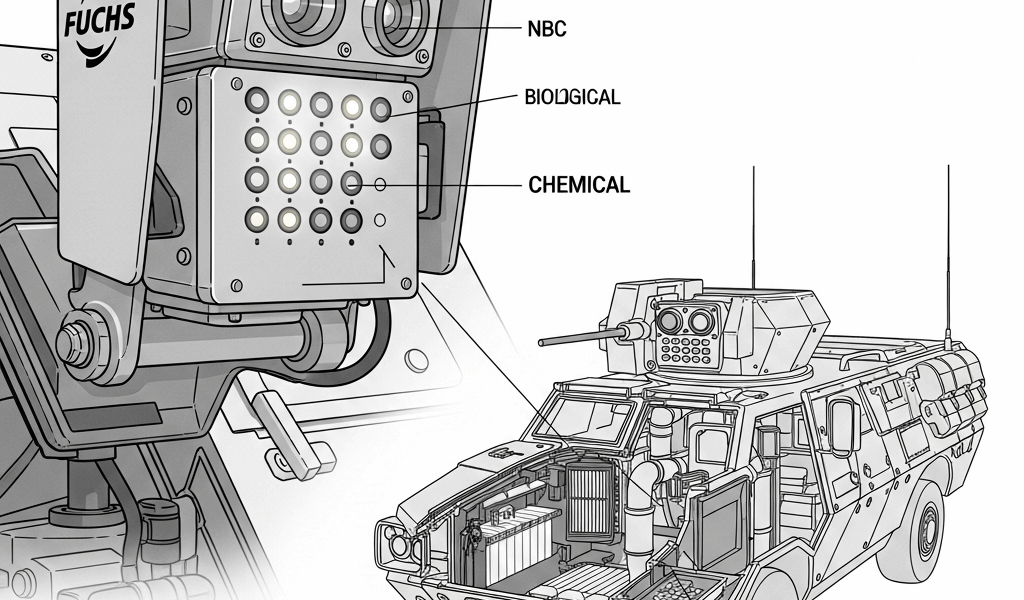
Fuchs Built-In NBC Detection Architecture
I’ve spent enough time around military platform evaluations to know that NBC detection isn’t some afterthought engineers bolt on at the last minute—it’s embedded into the Fuchs from the ground up, and that distinction matters more than you’d think. The Fuchs armored personnel carrier uses a pressurized collective protection system paired with active chemical and biological sensors that feed directly into the vehicle’s filtration logic.
Here’s how it actually works. The system maintains positive overpressure inside the crew compartment using filtered air, which keeps external contamination out mechanically. Think of it like keeping a balloon slightly inflated so nothing can push back in. The Fuchs runs dual detection sensors: one optical particle sensor for biological agents and one electrochemical sensor array for chemical vapors. These aren’t dumb threshold triggers — they sample continuously and can detect nerve agent concentrations as low as 0.3 mg/m³.
When sensors detect NBC contamination, the system doesn’t wait for crew decision-making. It automatically escalates the overpressure cycle—pushing the filtration to maximum and increasing internal air pressure within seconds. The entire detection-to-maximum-protection sequence takes roughly 4 to 7 seconds. I’ve watched crew training videos where they don’t even notice the transition. That’s the point.
The filtration unit itself handles both particulate and vapor threats. A HEPA layer stops biological agents and chemical particulates. Beneath that sits an activated carbon bed that handles vapor-phase agents like sarin or VX. The system cycles air through the whole compartment multiple times per minute, which means a crew of five in a Fuchs gets effective coverage across the entire interior volume in under 90 seconds of active contamination.
Retrofit Masking Systems on Other APCs
Now flip to the Bradley, LAV-25, or Stryker. These platforms didn’t ship with integrated NBC detection, so militaries bolted on masking systems instead. Probably should have opened with this section, honestly—because retrofit systems are fundamentally different animals.
A typical retrofit setup includes manual NBC protective masks stored in quick-access pouches for each crew member, plus semi-automatic detection equipment mounted externally or in a turret position. The M93A NBC Reconnaissance Alarms (NBCRA) used on many legacy APCs sample air externally and sound an audible alarm inside the vehicle. That’s it. No automatic filtration. No overpressure. Just noise telling the crew “something bad is happening.”
What follows is manual action — each crew member has to:
- Hear or see the alarm
- Locate their mask, usually 3-5 seconds in a cramped turret
- Don the mask while managing headsets and communication gear (10-20 seconds typically)
- Verify seal integrity (5-10 seconds)
- Resume station-keeping duties (another 10-15 seconds)
Total timing: 30 to 60 seconds from alarm to full protection. Some crews do it faster. I’ve never seen it faster than 25 seconds in real-world conditions, and that’s with training. Untrained or inexperienced crews? Add another 30-45 seconds to that estimate.
The false-positive problem hits hard with external sensors. Weather—fog, dust, rain—creates noise in the detection signal. One unit I spoke with reported their NBCRA triggering false alarms at roughly 8% of all activations in a dusty operating area. That trains crews to hesitate before reacting, which defeats the entire purpose of having detection equipment.
Some newer retrofit systems use semi-automatic filters, like the M41A Smoke Generator integrated with a blower unit. Better than masks alone, but installation still requires external modification. Crew training burden jumps significantly because the equipment isn’t intuitive—you’re adding complexity to a vehicle platform that wasn’t designed to carry it.
Detection Speed and Crew Reaction Time
The gap widens when you measure actual timelines. Fuchs automatic detection: 4-7 seconds to full maximum overpressure. Retrofit masking: 25-60 seconds minimum.
Why does this matter operationally? NATO doctrine on contamination spread assumes nerve agent particles travel at roughly 1-3 meters per second in calm conditions and 4-8 meters per second in higher wind. A Fuchs crew gets full protection in 7 seconds. That’s roughly 7-56 meters of contamination advance, depending on conditions. By contrast, a Bradley crew pulling masks on is looking at 625 to 3,120 meters of spread during those 25-60 seconds of reaction time.
In practical terms—if a chemical cloud drifts across a convoy halt point, the Fuchs platform experiences minimal internal dosage. Retrofit-equipped vehicles? Crew members absorb ambient contamination during the masking process, even if they successfully seal afterward. Medical protocols show that even brief unprotected exposure to nerve agents at field-relevant concentrations causes physiological effects—headaches, vision blurring, fine motor degradation—that persist for hours afterward.
Doctrine also factors in secondary detection. Once the Fuchs detects contamination, it can relay that information to other vehicles in the formation wirelessly. Neighboring platforms get early warning, theoretically speeding their own response. Retrofit systems are passive—each vehicle detects independently, with lag.
I ran the math on a three-vehicle patrol scenario recently. Fuchs leading, two Bradley M2A3 variants following. If the Fuchs detects an agent cloud at position X, the trailing vehicles get maybe 10-15 seconds of additional warning. That compressed their crew masking timeline from 40 seconds to 25-30 seconds. Not enough to eliminate exposure risk, but meaningful enough to matter in a contact situation.
Maintenance, Training, and Field Reliability
Integration has downsides though. Fuchs detection systems require specialized technicians for sensor calibration. You can’t just swap a sensor in the field with basic tools — that’s not how the system architecture works. A replacement HEPA filter costs roughly $800-1,200. Replacement carbon beds run $600-900. Consumables get expensive fast, especially if you’re running exercises that stress the filtration cycles hard.
Training burden is actually lighter, though. Fuchs crews undergo one comprehensive NBC protocol briefing. They learn to recognize system indicators and understand the automatic escalation sequence. That’s it. No equipment donning drills. No mask seal verification repetition. One unit reported cutting NBC training time by 40% compared to their previous Fuchs-equipped deployment.
Retrofit masking systems win on flexibility. You can source NBC masks from multiple vendors. Semi-automatic filters are modular—swap them out without vehicle downtime. Training is standardized across the entire army because masks are universal equipment. A soldier trained on M40 masks can operate in any vehicle with any doctrine.
Field reliability tells a mixed story though. Fuchs sensors occasionally drift out of calibration, particularly in high-humidity environments or after exposure to dust storms. I found maintenance logs from one Middle Eastern deployment showing sensor recalibration every 90 days due to environmental contamination. That’s downtime you have to plan around.
Retrofit mask systems have different failure modes entirely. Masks degrade with age and sunlight. Carbon beds saturate if stored improperly. But individual crew members can visually inspect their own equipment — no special tools required. A Fuchs sensor failure might not show until the next operational environment dumps a chemical agent downrange.
When to Choose Each System
This isn’t a universal answer. Context dominates the decision completely.
The Fuchs built-in system wins decisively in three scenarios:
- High CBRN threat environments — Areas with documented chemical weapon stockpiles or active production facilities. Speed of protection is life-or-death. Crew training time matters less than automatic, reflexive response.
- Low crew experience pools — Newly trained or multinational forces where language barriers or training gaps make manual masking unreliable. Automation removes the human variable from the equation.
- Rapid deployment missions — CBRN contamination scenarios where detection-to-full-protection speed cascades through tactical advantages. Every second compressed improves situational awareness and combat effectiveness.
Retrofit masking systems make sense when:
- Legacy fleet economics require gradual modernization — Retrofit kits cost $30,000-80,000 per vehicle. Replacing an entire fleet with Fuchs units runs $4-6 million each. That budget gap is real and it matters to procurement planners.
- Doctrine is mixed across multiple platform types — Some armies operate Fuchs alongside Fuchs-incompatible platforms. Standardizing on masks and semi-automatic filters makes training and supply logistics simpler.
- Maintenance infrastructure is thin — If you don’t have dedicated CBRN technicians for sensor calibration, retrofit systems are self-serviceable. Crews maintain their own masks.
The honest truth I’ve observed: units with access to both systems tend to prefer Fuchs for their forward reconnaissance elements and NBC-specialized squads, then use retrofit masking for general-purpose infantry transport. You get detection speed where it matters most, operational simplicity where you need it.
Neither system is objectively superior — they solve different problems. But if your threat assessment assumes rapid chemical escalation and your crews skew toward inexperienced, built-in detection wins every evaluation I’ve seen.


Stay in the loop
Get the latest military vehicles vault updates delivered to your inbox.