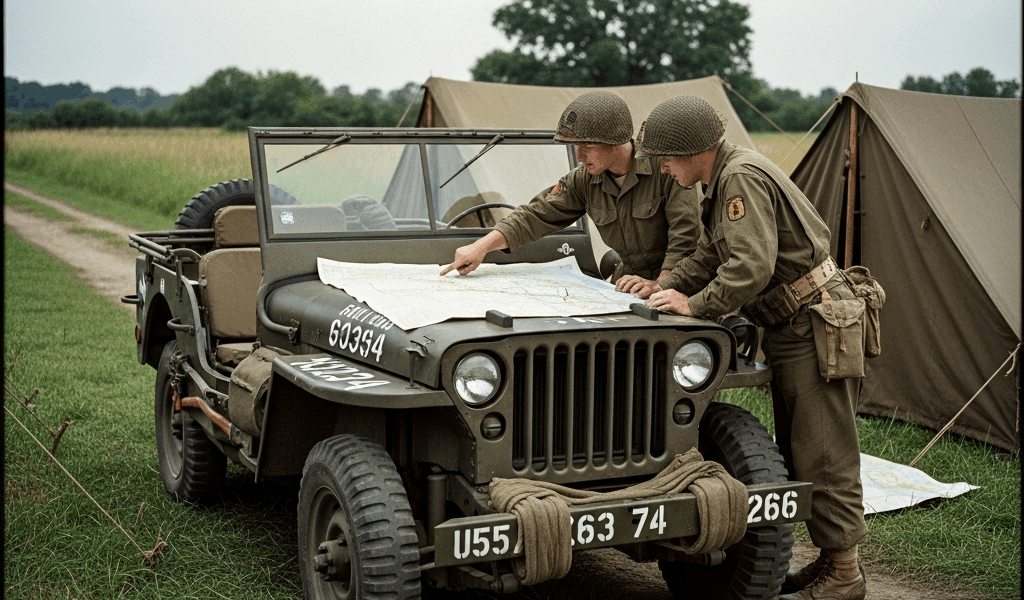
Ford GPW — The Other WWII Jeep That History Forgot
The Ford GPW has become tricky with all the Willys noise flying around. Ask anyone to name the jeep of World War II and you’ll get one answer — Willys. The Willys MB. The little quarter-ton that won the war. Fine. Willys earned that reputation. But somewhere in the postwar shuffle, roughly 277,000 Ford-built jeeps that served right alongside them got quietly written out of the popular story. Which is honestly baffling, because in a lot of ways it’s the more interesting story.
This article includes affiliate links. We may earn a commission at no extra cost to you.
This isn’t an encyclopedia entry. No dry specification tables, no clinical summaries. I want to tell you the full thing — why Ford got the contract, how to tell a GPW from a Willys MB when you’re standing in a muddy field staring at a pile of rusted metal, where these vehicles actually fought, and what one’s worth if you find it in a barn tomorrow morning.
Why Ford Built Jeeps for the Army
The short answer is that Willys couldn’t keep up. The longer answer is more interesting.
Frustrated by production limitations that threatened the entire procurement program, Army brass made a call that turned out to be genuinely prescient. When Willys-Overland won the initial contract in July 1941 — beating out both Ford and Bantam — the Go-Devil engine put out 60 horsepower, more than either competitor could match. The MA prototype was clearly the better vehicle. But Willys was a relatively small operation running a single plant in Toledo, Ohio. The Army looked at the forecasts, looked at what was happening in Europe, and contracted Ford as a second-source manufacturer using four hours of deliberation and probably a lot of cigarettes.
The formal contract came in November 1941 — weeks before Pearl Harbor. Ford began producing GPWs in early 1942 out of its Chester, Pennsylvania facility, later expanding production elsewhere. The “G” stood for Government contract vehicle, the “P” designated an 80-inch wheelbase, and the “W” was Ford’s internal nod acknowledging they were essentially building Willys’ design. Ford engineers were handed the MA blueprints and told to build it. They did. Mostly.
Here’s where it gets interesting from a collector standpoint. Ford, being Ford, made small modifications throughout production — not to create a different vehicle, the whole point was interchangeability — but because Ford’s manufacturing tolerances, tooling, and supplier relationships were simply different from Willys. Those small differences are what GPW hunters live for today. Thirty years of restoration work has basically been built on top of them.
Total GPW production ran from 1942 through 1945, with approximately 277,896 units completed. Willys produced around 361,339 MBs during the same stretch. Together — roughly 639,000 jeeps — that’s one of the most ambitious military vehicle procurement programs in history. Survival rates are genuinely hard to pin down, but most serious researchers put identifiable, documented WWII jeeps globally somewhere between 15,000 and 25,000. Genuine matching-numbers GPWs are rarer than that estimate suggests, for reasons I’ll get into.
How to Identify a Ford GPW
Worth saying out loud. If you’re reading this because you found something at an estate sale this weekend and you’re trying to figure out what you’ve got — skip here first. Everything else can wait.
The single most important identifier on a GPW is the “F” stamp. Ford marked the majority of its manufactured components with a small forged or cast “F” — not a decal, not a stencil, a physical mark pressed into the metal itself. Frame, axle housings, transfer case, transmission, steering components — they’re all there if the vehicle is right. Start counting those F stamps. A genuine GPW should carry them on virtually every major structural piece that Ford manufactured in-house. If someone’s claiming it’s a GPW and the F stamps are suspiciously absent, that’s your first conversation to have.
Serial Numbers and Where to Find Them
The vehicle serial number on a GPW lives on a plate on the dash — but more importantly, it’s also stamped directly into the frame rail on the driver’s side, just behind the front crossmember. The frame stamp is what serious authenticators look at first, because dash plates are easily swapped. GPW serial numbers ran in a specific range by year: early 1942 GPWs start around GPW-1, running through GPW-277896 by war’s end. Frame and data plate numbers that don’t match each other? That’s a significant red flag — not necessarily a dealbreaker, but a conversation that needs to happen before any money moves.
The Tube Crossmember — The Definitive Tell
But what is the tube crossmember? In essence, it’s a distinctive inverted-U shaped tubular front crossmember used on early GPW production — sometimes called the “script Ford” crossmember because many were stamped with a stylized Ford logo. But it’s much more than that. It’s the detail that separates people who actually know GPWs from people who’ve read a single forum post. The Willys MB used a flat stamped crossmember by contrast. Later GPW production moved to a stamped version similar to the MB, which is one reason late-war GPWs are harder to distinguish from Willys vehicles without documentation.
Other visual tells worth knowing:
- GPW hood latches were stamped differently than MB units — the Ford version has a noticeably more angular profile
- The GPW’s rear body tub often shows different spot weld patterns than the Willys tub
- Ford’s blackout light brackets were mounted at a slightly different angle on early production runs
- The GPW data plate font is distinct from Willys — the numerals have a different character set on original plates
- Many GPW differentials carry “Ford” in the casting, though this wasn’t universal across all production years
Complicating all of it is the fact that the Army specifically required interchangeable parts between GPW and MB. Soldiers in the field swapped components constantly — a busted axle housing got replaced with whatever was on the parts truck, no questions asked. Finding a GPW with 100% Ford-stamped components is genuinely rare. What you’re more likely to find is a vehicle with a documented Ford frame and serial number that’s accumulated various replacement parts over eight decades. That’s normal. That’s expected. A knowledgeable appraiser accounts for it.
Ford GPW in Combat
The GPW served everywhere the Willys MB served — which is to say, everywhere. The Army didn’t segregate Ford-built and Willys-built jeeps by unit. They went into the supply chain together and got distributed based on availability. If your unit needed a jeep in Tunisia in 1943, you got whatever showed up on the transport. Ford GPWs crossed North Africa with Patton’s forces, slogged through the Italian campaign, landed at Normandy — probably on a Tuesday morning with someone terrified behind the wheel — and crossed the Rhine. They served in the Pacific as well, though the ETO absorbed the majority of early production runs.
I started pulling unit records a few years back, struck by how thoroughly the vehicle’s identity had been scrubbed even during the war itself. What you find is that vehicle logs almost never distinguish between Ford and Willys production. The entries just say “jeep” or “1/4 ton truck.” The Army’s interchangeability goal had been achieved — from an operational standpoint, they were the same machine. The identity disappeared into the mission.
Notable Roles and Configurations
GPWs were configured for virtually every role the jeep filled in WWII. The standard reconnaissance variant carried a driver, a commander, and a light machine gun — typically a .30 caliber M1919 Browning on a pintle mount on the right rear. Ambulance-configured GPWs were fitted with litter carriers holding two stretchers, getting casualties basic transportation back from forward positions. Signal Corps units mounted SCR-193 or SCR-499 radio sets in the rear of GPWs and used them as mobile communications platforms. Artillery liaison officers used them constantly for forward observation — just a driver, an officer, a map, and an uncomfortable amount of exposure.
British forces received GPWs under Lend-Lease and used them extensively in the Western Desert and later in Northwestern Europe. Australian units used them in New Guinea. Free French forces received GPWs and drove them from the liberation of France through the German surrender. This new idea of a standardized light utility vehicle took off several years earlier and eventually evolved into the globally deployed platform enthusiasts know and restore today — but the GPW was doing the actual work while that legacy was being written.
Buying a Ford GPW Today — Values and What to Watch For
Skip the misstep I made. In 2009, I paid $8,500 for what I was told was a “solid GPW project” and drove four hours to pick it up in a borrowed trailer — stopped at a gas station in rural Pennsylvania, ate a gas station sandwich, felt optimistic. It was a Willys MB body on a Ford frame with mismatched components throughout, some of which had been deliberately restamped to appear original. I didn’t know enough yet to catch it. I’m telling you this because it happens constantly in this market, and the seller doesn’t always know they’re passing on a franken-jeep — sometimes it’s been that way for sixty years and nobody thought to check.
Current Market Values
The WWII jeep market has moved substantially over the past decade. Here’s what you’re looking at in broad terms based on recent auction results and dealer listings:
- Barn find, unrestored, running condition — $12,000 to $22,000 depending on documentation and component matching
- Driver-quality restoration — $25,000 to $38,000 for a presentable GPW that isn’t show-ready
- Correct, documented, matching-numbers restoration — $45,000 to $65,000 and climbing
- Concours-level, museum-quality GPW with provenance documentation — $70,000 and above, with exceptional examples breaking $90,000 at auction
The gap between a matching-numbers GPW and a parts-correct restoration has widened significantly. Buyers are more educated than they were fifteen years ago — online communities and resources that simply didn’t exist before have changed the landscape. That’s good for the hobby overall, even if it’s made barn finds harder to buy cheap.
Parts Availability Compared to the Willys MB
First, you should understand the mechanical situation — at least if you’re buying a GPW as a running project rather than a static display piece. The engine, transmission, transfer case, and axles are largely interchangeable with the MB. Vendors like G503.com’s associated suppliers, Beachwood Canvas, and Midwest Military carry reproduction and NOS (New Old Stock) components for both vehicles. Budget roughly $3,500 to $7,000 for a full mechanical restoration of a tired GPW drivetrain using a combination of NOS and quality reproduction parts — that number assumes you’re doing the labor yourself.
A quality vendor might be the best option for Ford-specific stamped and cast components, as a correct GPW restoration requires F-stamped parts that vary wildly in quality. That is because reproduction F-stamped components have been made for years by manufacturers with very different standards. A set of reproduction F-stamped axle housings from a reputable vendor — the kind exhibiting at the annual Ft. Bragg military vehicle show, not a random eBay listing — will run $400 to $600 for the pair. Cheaper versions exist. They’re not worth the trouble for a correct restoration.
While you won’t need a museum-grade budget to get a GPW running and presentable, you will need a handful of specialized resources — a good parts vendor relationship, access to the GPW research documentation that’s been compiled over decades by the online community, and ideally a knowledgeable appraiser who can look at what you’ve got before you commit serious money to a restoration direction. The Ford GPW isn’t a footnote. It’s half the story of the jeep in World War II — half the production, half the miles, half the mud and impossible terrain these little vehicles crossed. The fact that it’s been overshadowed by the Willys name says more about postwar marketing than it does about history. Find one. Document it carefully. Restore it correctly. And understand what you have — because apparently not enough people do.
To compare Ford-specific clues with the Willys version—and understand what was truly interchangeable—use our Ford GPW vs Willys MB guide.

Stay in the loop
Get the latest military vehicles vault updates delivered to your inbox.