“`html
The Stryker RWS M2 Browning Setup
I’ve spent enough time buried in military equipment specs to know that comparing the Stryker 8×8 versus LAV 25 firepower requires getting specific about what “firepower” actually means when rounds are flying. Most people treat these vehicles as interchangeable — at least until you look at the weapon stations mounted topside.
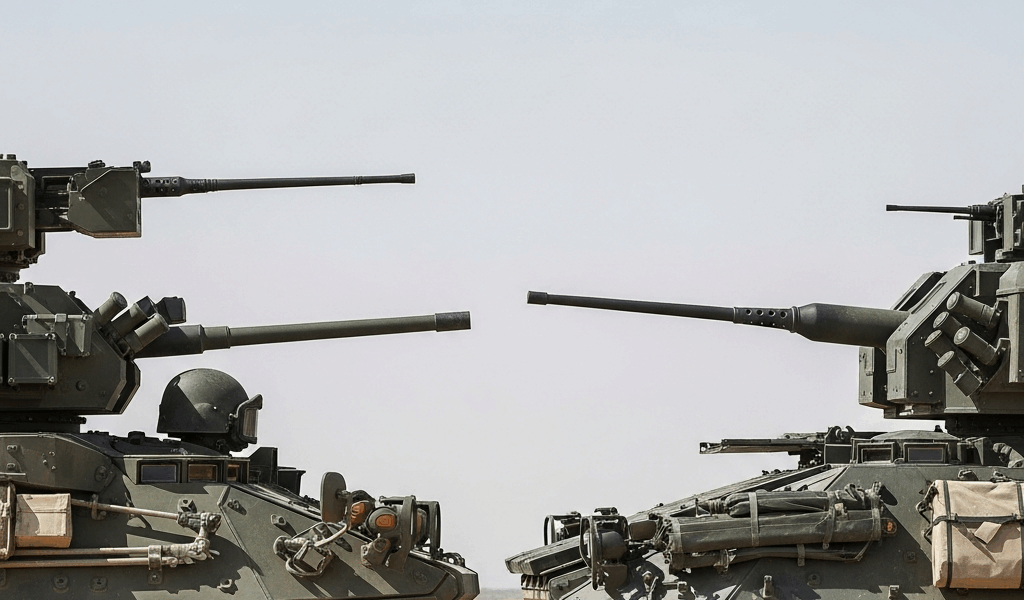
The standard Stryker Infantry Carrier Vehicle mounts a Remote Weapon Station, usually configured with an M2 .50 caliber Browning machine gun as primary armament. That RWS sits topside, giving gunners a commanding view and the ability to engage targets without exposing themselves to return fire. The M2 fires at roughly 450–550 rounds per minute depending on the variant and how well maintenance crews keep it running. Effective range? About 1,830 meters for point targets, though realistic suppressive fire sits more around 800–1,200 meters against personnel in the open.
Coaxial to the M2 sits a 7.62mm NATO machine gun — standard M240 or M249 in most configurations I’ve seen. The coax provides rapid-fire capability for closer threats and softer targets that don’t require heavy firepower. Rate of fire on the 7.62mm runs around 700–900 rpm, giving crews layered firepower options. I learned this the hard way reading after-action reports from Iraq: crews valued that coax far more than doctrine writers suggested they should.
Here’s what gets overlooked by people comparing spreadsheets. The RWS itself is the tactical advantage — remote operation means the gunner stays inside the hull where armor protects them. That’s survivability in a nutshell. The .50 cal penetrates light armor effectively, can suppress enemy positions from distance, and handles vehicles with unarmored engine compartments. But it’s not a cannon. It can’t punch through modern body armor at range the way a dedicated gun system can.
The Stryker lineup includes TOW missile variants (tube-launched, optically-tracked, wire-guided missiles) for crews needing anti-armor punch. Models like the Stryker Anti-Tank — the M1134 specifically — carry two or four BGM-71 TOWs, fundamentally shifting the firepower equation. Range exceeds 4,000 meters. But those are specialized variants you’ll rarely see in baseline unit deployments. The baseline Stryker ICV, what most units actually operate, remains a machine gun platform.
LAV 25 Dual M242 Bushmaster System
The LAV-25 Light Armored Vehicle carries something fundamentally different. A 25mm chain gun, specifically the M242 Bushmaster. This is where the firepower comparison gets real and the numbers stop looking abstract.
The LAV-25 typically mounts dual M242s in a powered turret. Rate of fire is 200–300 rounds per minute per gun, so you’re looking at potential 400–600 rpm combined if both guns cycle simultaneously. That sounds lower than the .50 cal until you understand what those rounds actually do. The 25mm round is an armor-piercing incendiary or high-explosive type — designed to penetrate light armor and fortifications that would merely slow down smaller rounds. Effective range extends to 2,000+ meters for area targets, with aimed fire reliable out to 1,500 meters against meaningful threats.
Ammunition capacity varies — LAV-25s typically carry 300–400 rounds depending on configuration and stowage priorities. Each round weighs substantially more than a .50 cal projectile (roughly 5.5 pounds for certain 25mm types versus 1.6 pounds for .50 cal), so volume matters tactically in sustained operations. Long engagements drain ammunition faster than doctrine expects, honestly.
Coaxial armament on the LAV-25 includes a 7.62mm gun, sometimes upgraded to a .243 Winchester option in certain variants crews get. The coax serves the same role as on the Stryker — rapid suppressive fire at closer ranges where sustained fire matters more than penetration. The difference is the turret itself. The LAV-25 has a fully stabilized, powered turret with ballistic computers in modern configurations. Stryker RWS systems have stabilization too, but the integration and fire control systems differ in ways that matter.
Something I didn’t fully appreciate until digging into maintenance manuals: the 25mm Bushmaster is a dual-feed gun. Gun crews can select different ammunition types on the fly — armor-piercing for hard targets, high-explosive for softer ones. That flexibility is a real tactical asset you can’t overlook. The Stryker’s M2 can cycle different ammunition (armor-piercing, tracer, standard), but the psychological shift of having a dedicated cannon versus a machine gun shouldn’t be underestimated by anyone who hasn’t operated one.
Effective Range and Penetration Comparison
Let’s isolate what each platform can reliably engage without dancing around the specifics.
Against dismounted personnel in the open, both platforms dominate. The Stryker RWS M2 is brutally effective beyond 800 meters — at least if you want reliable suppressive fire. The LAV-25’s 25mm adds precision and psychological impact — you need fewer rounds per target to achieve effect. In urban terrain with hard cover, the 25mm’s greater penetration through concrete and light structures gives the LAV-25 a pronounced edge.
Against light-skinned vehicles and trucks, the M2 .50 cal handles engine blocks, radiators, and fuel tanks efficiently. The LAV-25’s 25mm does the same thing but with greater certainty and overpenetration that carries farther downrange. Against armor — even light body armor like that found on older Humvees or scout vehicles — the 25mm is categorically superior. The .50 cal will eventually penetrate, but the LAV-25 does it at greater ranges with more rounds available.
Against fortified positions, bunkers, or buildings, the LAV-25 gains pronounced advantage. The 25mm round detonates with fragmentation effects and can destroy wall sections outright. The .50 cal suppresses and penetrates walls, but it’s designed for different targets entirely.
Probably should have opened with this section, honestly: neither vehicle was designed to slug it out with main battle tanks or modern infantry fighting vehicles like the Bradley. Both are light armor platforms. The comparison is meaningful only against threats they actually face — armed pickup trucks, fortified compounds, dismounted troops, and unarmored military vehicles in the field.
Which Wins in Modern Combat Scenarios
Convoy escort in Iraq and Afghanistan — the real-world proving ground for both platforms — shows the LAV-25 engaging Taliban fighters in compounds from 1,500 meters where the Stryker required closer approach or multiple rounds to achieve similar effect. That said, Stryker units adapted tactically. The RWS proved easier to operate remotely, keeping gunners safer from IED fragmentation. Both platforms have engaged in sustained combat; doctrine evolved around each one’s strengths.
In urban operations — Mosul, Baghdad, Fallujah — the Stryker’s lighter profile, faster dismount capability, and mounting flexibility gave it different advantages than sheer firepower metrics. LAV-25s provided heavier support from standoff positions where range mattered. Neither “won” overall; they filled complementary roles that commanders learned to exploit separately.
Open-terrain engagements favor the LAV-25 purely on firepower metrics. The 25mm cannon’s range, penetration, and sustained rate of fire exceed .50 cal capabilities by measurable margins. Extended desert operations where targets appear at distance showcase this advantage consistently.
Rapid reaction and dismounted support favor the Stryker. Crews exit faster, operate more effectively in complex terrain, and the lighter armament suits mobile operations where quick repositioning matters more than sustained fire from a static position.
Variants That Change the Equation
The Stryker family includes the M1128 Mobile Gun System, which mounts a 105mm cannon — a completely different animal entirely. That variant genuinely outguns the LAV-25 in any caliber comparison. The Stryker Reconnaissance Vehicle variant uses .50 cal only, reducing firepower further below baseline configurations.
The LAV-AT (Anti-Tank) variant trades the dual 25mm for TOW missiles, flipping the equation entirely. Like the Stryker TOW variant, it becomes an anti-armor platform that outranges both vehicle types we’re discussing here.
Standard configurations matter for this comparison. The LAV-25 wins the pure firepower contest between baseline platforms you’ll actually encounter in deployment. The 25mm Bushmaster cannon system outranges, outpenetrates, and provides more ammunition variety than the Stryker RWS M2 setup by design. But the Stryker’s remote operation, mobility advantages, and modular design create different operational calculus that commanders value.
In direct firepower comparison alone — which was your specific question — the LAV-25 system is superior. That said, modern military effectiveness rarely comes down to one factor. Don’t make my mistake of thinking it does.
“`


Stay in the loop
Get the latest military vehicles vault updates delivered to your inbox.