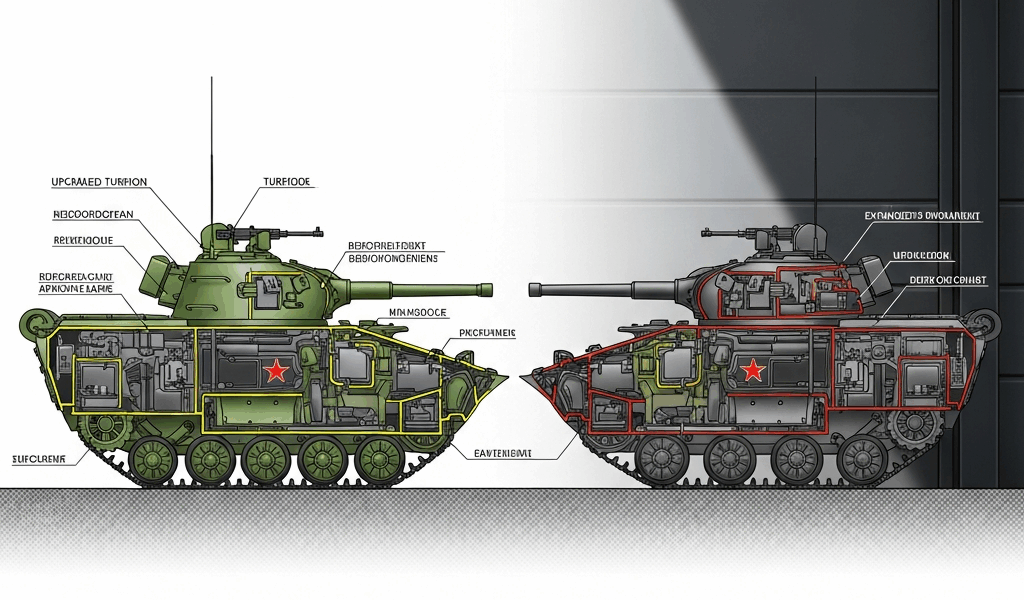
BMP-1 vs BMP-2 — What Actually Changed Between Them
Why the BMP-1 Needed a Successor So Fast
The BMP-1 vs BMP-2 debate has turned into a moving target with all the spec-sheet noise flying around.
The BMP-1 looked revolutionary on paper. The gun was already a problem. That was the core of it — the 73mm Grom low-pressure smoothbore fired a single, slow-moving rocket-assisted round that performed reasonably well against stationary armor at close range. Against fast-moving targets, anything airborne, or anything sitting on a ridgeline above roughly +30 degrees of elevation, the gunner had almost nothing to work with. Israeli aircraft chewed through BMP-1s in the Sinai while the crews struggled to return fire. The gun simply couldn’t point high enough to matter.
Afghanistan made the situation worse. Mountain passes and urban ambushes exposed the elevation problem in brutal, unavoidable terms. Something had to change.
Firepower — The 73mm vs the 30mm Autocannon
But what is the 2A42 autocannon, really? In essence, it’s a dual-feed 30mm automatic cannon with selectable fire rates. But it’s much more than that — it represents a completely different theory of what an infantry fighting vehicle’s main gun should actually accomplish.
The 2A42 fires at either 200–300 rounds per minute on the low setting or 550 rounds per minute on high. Two separate ammunition boxes let the gunner switch between armor-piercing and high-explosive rounds mid-engagement — no mechanical pause, no fumbling. Maximum effective range against infantry and light vehicles runs around 2,000 meters. Against low-flying helicopters, the gun elevates to +74 degrees. That number tells you everything about what Soviet planners were thinking after 1973.
Here’s what people miss when they run the comparisons: a 30mm high-explosive incendiary round at 1,500 meters, delivered in a sustained burst, is often more lethal to infantry in the open than a single 73mm round that has to connect directly. The Grom had raw punch. The 2A42 had probability. In actual firefights — the chaotic, fast-moving kind — rate of fire and the ability to walk rounds onto a moving target matters more than terminal energy per shot. Soviet small-unit commanders understood this before the doctrine caught up.
The missile upgrade gets less attention than it deserves. The BMP-1 carried the AT-3 Sagger — wire-guided, operator-steered, and notoriously unforgiving under fire. The BMP-2 introduced compatibility with the AT-4 Spigot and AT-5 Spandrel, both semi-automatic command line-of-sight systems. The gunner kept the reticle on target. The missile corrected itself. That’s not a minor ergonomic tweak. That’s the difference between a weapon that functions under stress and one that demands an almost inhuman calmness while people are actively shooting at you. Save yourself the trouble I had of glossing over that distinction.
Armor and Survivability — Did Anything Actually Improve
Honestly? Less than the brochures implied.
The BMP-2’s frontal armor was marginally thicker than the BMP-1’s — but both vehicles stayed vulnerable to heavy machine gun fire from the sides and rear at combat distances. A .50-cal M2 or a DShK could punch through the BMP-2’s side armor inside 800 meters without much difficulty. RPG hits were catastrophically lethal in both variants. Some export BMP-1s used aluminum hulls that actually burned on penetration. That’s as bad as it sounds.
What genuinely improved was crew survivability through layout changes rather than raw steel. The BMP-2’s commander received an independent observation station — small upgrade, real consequences. It meant the vehicle commander could scan for threats without depending entirely on the gunner’s sight picture. In a fast-moving engagement, two independent sets of eyes looking at different sectors is worth far more than the weight penalty it added.
There’s one tradeoff worth being honest about, though. The 2A42’s turret is physically larger than the Grom installation. Larger turret means larger silhouette — and in hull-down defensive positions, the BMP-2 presents more of a target than its predecessor. Whether that exchange, better firepower for slightly higher visibility, was worth making is a doctrinal argument rather than a physics one. Soviet planners thought yes. Not everyone agreed, and I’m apparently in the minority that finds the debate genuinely unresolved even now.
Mobility and Crew — How They Felt to Operate
Quick note before the rest of this.
Both vehicles run the UTD-20 diesel engine producing around 300 horsepower. The BMP-2 weighs approximately 14.3 metric tons versus the BMP-1’s 13.5 — and that extra 800 kilograms shows up in amphibious crossings. The BMP-1 crosses water with reasonable confidence. The BMP-2 crosses water with noticeably less of it. Field crews were measurably more cautious about fording operations with the -2, and that caution was warranted.
The spec comparisons never capture what these vehicles actually felt like from the inside. The BMP-1 carried eight infantry troops plus a three-man crew. The BMP-2 dropped troop capacity to seven — partly due to ammunition stowage for the 30mm rounds. Veterans from Soviet and export armies described the interior conditions in terms that wouldn’t survive editorial review. Heat. Exhaust fumes through improperly sealed hatches. Constant mechanical noise at a volume that makes communication nearly impossible after the first hour.
Fatigued by extended time inside a sealed BMP compartment, dismounting infantry arrived at objectives already degraded — slower to react, harder to coordinate, less effective in the first critical minutes of contact. That wasn’t a BMP-2 problem specifically. It was an IFV problem across the board. But the BMP-2 didn’t solve it either, and nobody pretended it had.
The commander’s situational awareness upgrade was real and genuinely appreciated by vehicle crews. The seven infantrymen in the back noticed none of it.
Which One Actually Proved More Useful in Combat
Afghanistan settled the firepower argument in favor of the BMP-2 — and settled it fast. The 2A42’s +74-degree elevation made it the only BMP variant capable of engaging Mujahideen fighters on ridgelines and in elevated positions. Units still running BMP-1s in mountain operations were at a genuine, measurable disadvantage. The Grom simply could not point where the threat was. Units re-equipped with BMP-2s reported immediate improvements in fire support effectiveness against elevated targets. That’s not doctrine. That’s feedback from people who were there.
The Middle East tells a more complicated story. In flat desert terrain with long engagement ranges and significant armor concentrations — the kind of environment the BMP-1 was originally designed for — the 73mm Grom’s anti-armor capability stayed relevant in ways it never could in mountain warfare. Egyptian and Syrian operators found the vehicle genuinely useful in the right context. Context, unfortunately, is not something you get to choose in wartime.
The BMP-1 stayed in service for decades after the BMP-2 entered production. Soviet inventories, Warsaw Pact arsenals, export markets across the Middle East, Africa, and South Asia — the -1 was everywhere. That longevity had nothing to do with the vehicle being good enough. It had everything to do with cost, logistics infrastructure, and the basic military reality that you fight with what exists, not what you’d prefer. Tens of thousands of BMP-1s were already built and fielded. Replacing them all was never a serious option.
So, without further ado, here’s the actual verdict: the BMP-2 was a genuine tactical improvement — not a cosmetic refresh, not a marketing exercise. The autocannon upgrade alone justified the development cost, given what Afghanistan demonstrated. But neither vehicle solved the central tension of the infantry fighting vehicle concept — that protecting infantry while simultaneously providing direct fire support requires compromises that leave everyone somewhat exposed. The BMP-2 managed those compromises better than its predecessor. It did not eliminate them.

Stay in the loop
Get the latest military vehicles vault updates delivered to your inbox.