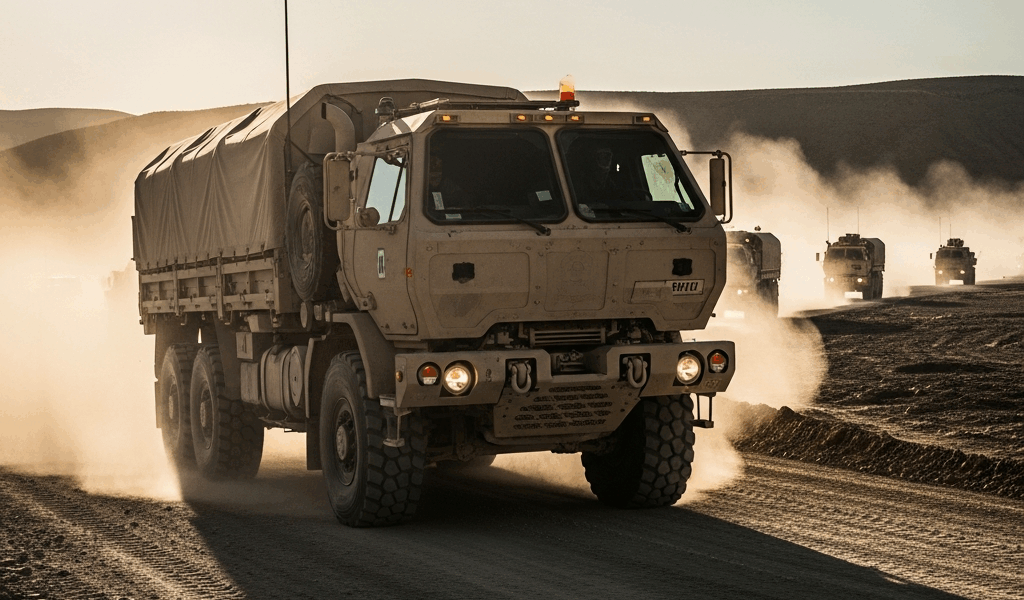
HEMTT — The Army Heavy Truck That Moves Everything
What Is the HEMTT and Why It Matters
Military logistics has shifted noticeably with all the noise flying around about drones, autonomous systems, and next-generation armor. But strip away the flashy stuff and you keep arriving at the same unglamorous truth: somebody has to move the fuel, the ammunition, and the food. And that answer, more often than not, is a big diesel truck most civilians couldn’t name.
But what is the HEMTT? In essence, it’s the Heavy Expanded Mobility Tactical Truck — eight wheels, diesel power, a payload that would embarrass a commercial semi once you take it off pavement, and a service record going back to 1982. But it’s much more than that. It’s the reason American ground forces can sustain operations at the tempo and range they do, in conditions that would strand anything built primarily for highway use.
Oshkosh Defense — out of Oshkosh, Wisconsin, a city that apparently just names things honestly — developed the platform because the Army had a specific and urgent problem. By the late 1970s, the M520 Goer and the aging M54 5-ton cargo trucks were running out of answers. The M54 was a Vietnam-era workhorse, tough in its day, but underpowered and not built for the kind of high-intensity, deep-battlefield logistics the Army envisioned if Soviet armor ever came through the Fulda Gap. The scenario was straightforward and genuinely terrifying: armored columns pushing fast through Central Europe, requiring American forces to move fuel, ammunition, and cargo fast, far, and across broken terrain — not just roads.
Frustrated by platforms that couldn’t keep pace with M1 Abrams tanks and M2 Bradleys across open country, the Army issued requirements that essentially demanded a truck reimagined from first principles. Oshkosh won that contract. In 1981 the first HEMTTs rolled out of the factory — tandem-axle, eight-wheel-drive, powered by a Detroit Diesel 8V92TA engine producing around 445 horsepower — and full production followed in 1982.
What replaced the older trucks wasn’t just more power. The HEMTT brought a central tire inflation system, letting drivers adjust tire pressure on the move depending on terrain — sand, hardpack, mud, take your pick. It brought roughly 10 short tons of payload capacity. And it brought a family-of-vehicles approach — one common chassis across a dozen mission configurations — which simplified maintenance, parts supply, and crew training in ways that quietly compound over decades of service.
The current production variant, the A4, runs an Oshkosh TAK-4 independent suspension system and a Detroit Diesel Series 60 pushing 500 horsepower. New HEMTTs run somewhere between $250,000 and $400,000 depending on variant and configuration — considerably more expensive than the original, considerably more capable. The Army operates over 13,000 of them. That number alone tells you what you need to know about how central this platform really is.
Every HEMTT Variant Explained
Worth flagging before going further, because the variants are where the HEMTT story gets genuinely interesting. The basic chassis is a platform, not a truck in the narrow sense. What sits on top determines the mission, and Oshkosh has been remarkably systematic about exploiting that modularity over four decades.
M977 — Cargo Truck
The M977 is the baseline cargo variant. Ten-ton payload, standard cargo bed with drop sides, and — here’s the detail most people miss — a 4,500-pound-capacity Hiab crane mounted at the front of the bed. The truck loads itself in many situations. Watching a two-person crew self-load ammunition pallets in a forward area with nothing but the onboard crane is one of those quiet logistics moments that saves hours in an actual operation. No forklift. No waiting. Just the truck doing what it came to do.
M978 — Fuel Tanker
The M978 carries 2,500 gallons of fuel — JP-8, diesel, whatever the unit needs. It comes equipped with pumping and metering equipment and can simultaneously receive and dispense. At a forward arming and refueling point — a FARP — you’ll see M978s running with a choreographed efficiency that makes commercial fuel distribution look slow and wasteful. These trucks are the direct reason attack helicopters can stay in the fight longer than their internal fuel capacity would otherwise allow. That’s not a small thing.
M984 — Wrecker
The M984 is the recovery variant, and it is genuinely massive — 25-ton boom crane, 25-ton winch, and the capability to self-recover when things go wrong. It can also recover other HEMTTs, which matters enormously in field conditions. Skip the misstep I made of assuming “recovery vehicle” just means tow truck. The first time I watched an M984 drag a fully loaded M1 Abrams free from a waterlogged training field, I had a completely different understanding of what that term actually means in practice.
M985 — Ammunition Carrier
The M985 is configured specifically for ammunition handling — flatbed designed for standard ammunition pallets, crane matched to the weight requirements of artillery shells and missile containers. The distinctions between the M977 and M985 matter more to ammunition officers than to most readers. Short version: the M985 is optimized around the specific tie-down, safety, and handling requirements that ammunition logistics demands, and those requirements are not casual.
Palletized Load System — PLS
The PLS is where things get modular in the most literal sense possible. A hook-arm mechanism — specifically the Multilift MK IV hook hoist — loads and unloads standard 20-foot flat racks without any external equipment. One driver can swap cargo configurations in minutes. Flat rack loaded with water? Drop it, pick up a rack loaded with 155mm shells, drive to the gun line. The PLS represents the furthest evolution of the HEMTT philosophy: maximum flexibility, minimum personnel, and a simplicity of operation that holds up under the worst possible conditions.
Other Variants
The family also includes the M1074 and M1075 PLS trucks, the HEMTT Load Handling System, and a range of A-Kit and B-Kit configurations for further specialization. Field maintenance trucks, water distributors, semi-trailer versions — the chassis has been adapted for almost every sustainment function the Army runs. There’s also the Heavy Expanded Mobility Ammunition Trailer — the HEMAT — which pairs with cargo variants to effectively double throughput on ammunition supply routes. Unglamorous. Essential.
HEMTT in Combat — From Desert Storm to Afghanistan
Military vehicle enthusiasts know the HEMTT’s combat record mostly in fragments. The full picture is more impressive — and more sobering — than the highlights suggest.
Desert Storm in 1991 was the first real operational test at scale. The famous “Hail Mary” flanking maneuver — VII Corps sweeping west across the Iraqi desert — required moving a genuinely incomprehensible quantity of fuel, ammunition, and supplies over hundreds of miles of open terrain, largely at night, largely off established roads. HEMTTs were central to that operation. The Army was moving approximately 1.3 million gallons of fuel per day at the height of the ground war. Most of that fuel moved in M978 tankers — not pipeline, not airlift. Trucks.
The terrain performance held up. The central tire inflation system proved its value repeatedly — M978 crews dropping pressure for sand travel, reinflating quickly when they hit hardpack. There were breakdowns, as there always are, but the maintenance-to-availability ratio exceeded expectations for a platform operating under those conditions. That’s not a given for military hardware, especially in fine desert sand.
Operation Iraqi Freedom in 2003 added a dimension nobody had fully war-gamed. The push to Baghdad was fast — the logistics tail struggled to keep pace — and supply convoys became combat operations. HEMTT crews, technically motor transport soldiers and not infantry, were engaging small arms, IEDs, and ambushes on routes that intelligence had assessed as cleared. The platform held up reasonably well against small arms fire, though it was never designed for that. The Army subsequently added armored cab kits — the Oshkosh TAK-4 cab armor package — to improve crew survivability on contested convoy routes. Lesson learned, expensively.
Afghanistan presented entirely different problems. High altitude, extreme temperature swings from minus-20 Fahrenheit winters to 110-degree summers, and road conditions that barely deserve the word. The HEMTT’s roughly 19 inches of ground clearance and articulated steering helped in mountain terrain — but the platform’s size created real access problems. Some forward operating bases in Kunar and Nuristan provinces were simply unreachable by HEMTT, requiring rotary-wing resupply for fuel and ammunition that would have moved by truck in a more accessible theater. That’s not a HEMTT failure. It’s geography. But it shaped how logisticians started thinking about distributed operations and platform size.
This new operational understanding took shape over several years and eventually evolved into the doctrine on pre-positioned flat racks and distributed resupply that sustainment planners work from today. The logistics backbone nobody discusses publicly is the network of HEMTTs that ran the same convoy routes week after week for years — no single dramatic engagement, just grinding, dangerous, essential work performed by motor transport soldiers whose names don’t appear in news coverage.
Can You Buy a Surplus HEMTT?
Short answer — yes. Longer answer — it depends on the variant, your budget, your mechanical tolerance for surprises, and honestly, which state you live in.
GovPlanet is the primary marketplace for surplus military vehicles, including HEMTTs. Iron Planet and direct government auctions through the Defense Logistics Agency are the other channels worth watching. I’ve tracked HEMTT listings on GovPlanet periodically over the past few years — pricing is all over the place. Stripped M977 cargo trucks with high mileage and cosmetic damage have sold for as low as $8,000 to $12,000. M984 wreckers and M978 tankers in better condition can reach $35,000 to $60,000. PLS variants tend to sell higher because the hook-arm system has obvious commercial utility in construction and agriculture.
Learn from what tripped me up. I assumed “demilitarized” meant “drivable.” It frequently does not. Many surplus HEMTTs are sold as-is after the military has pulled certain components, and some have been demilled more aggressively than others — sometimes far more aggressively. Always request the inspection report. Get eyes on the vehicle before bidding if there’s any way to arrange it. I didn’t do that the first time I seriously evaluated a surplus military vehicle purchase, and what looked like a runner on paper needed roughly $6,000 in work before it would pass a basic mechanical inspection. Learn from that rather than repeating it.
Registration is the second obstacle — and probably the more frustrating one. The HEMTT was never designed to meet highway safety standards for civilian sale, which means titling it varies wildly by state. Title documents from the military are frequently absent or incomplete. Montana is commonly cited in surplus vehicle communities as having a relatively straightforward process for titling unusual vehicles. Other states will have you hiring a lawyer and spending months in correspondence with the DMV. This is not a hypothetical concern. It is a documented, recurring problem for surplus military vehicle buyers, and it catches people off guard every single time.
Practically speaking — the HEMTT runs on JP-8 or diesel No. 2, so commercial diesel works fine. Parts availability through Oshkosh Defense’s commercial parts network is better than you’d expect for a military platform, though some components are still DoD-supply-chain items that take time and money to source. Owner communities on forums like Expedition Portal and the Military Vehicles Preservation Association have built up substantial knowledge about which parts cross-reference to commercial equivalents. That community knowledge is worth more than it sounds.
Fuel consumption is brutal by any civilian standard — somewhere between 4 and 7 miles per gallon depending on load, terrain, and speed. The truck weighs approximately 40,000 pounds empty. You will need property with appropriate access and storage. You will need a CDL Class A with airbrakes endorsement to legally operate it on public roads in most jurisdictions. While you won’t need a commercial fleet operation to justify the purchase, you will need a genuine use case — a farm with serious heavy hauling requirements, a recovery business, or a committed collector who has thought through the long-term maintenance picture. A well-maintained HEMTT might be the best option for that use case, as heavy off-road work requires capability that has no real commercial equivalent at this price point. That is because nothing else in this weight class and capability range gets liquidated at government auction for $15,000.
The HEMTT is not glamorous. It doesn’t generate the recognition that Abrams tanks or Apache helicopters receive when people debate American military capability. But the next time you read about a successful Army operation anywhere in the world, somewhere behind that story is a column of HEMTTs moving in the dark, on bad roads, driven by soldiers whose job title is motor transport — keeping the whole thing running.

Stay in the loop
Get the latest military vehicles vault updates delivered to your inbox.