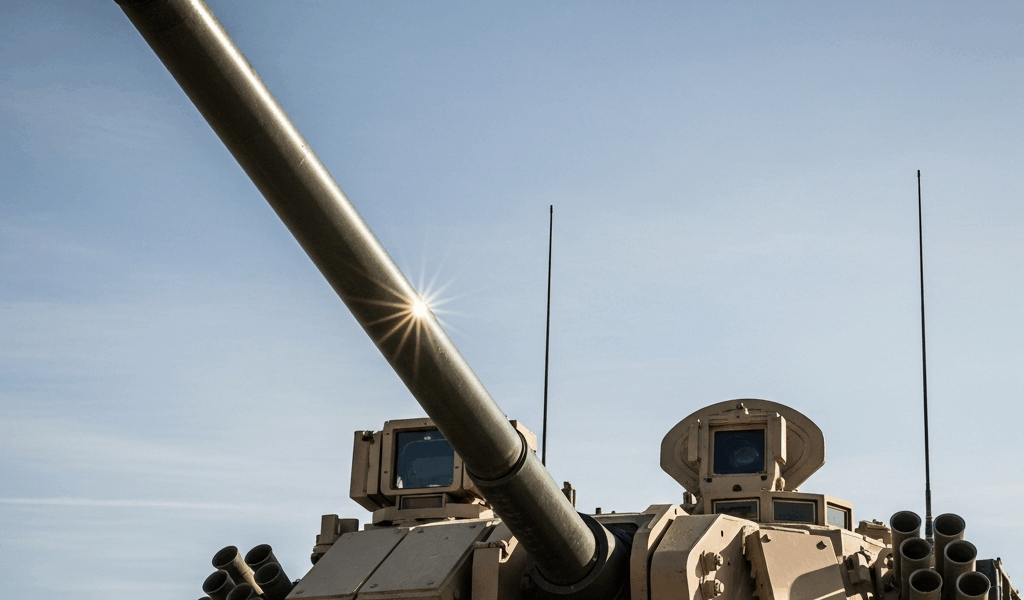
The M242 Bushmaster Cannon and Why It Mattered
When the Army selected it for the Bradley’s turret in the late 1970s, they weren’t just picking a bigger gun—they were making a statement about what an infantry fighting vehicle needed to do.
The M242 fires at 200 rounds per minute in single shot or 500 rounds per minute in burst mode. That rate matters because it gives the gunner options. Flexibility under pressure makes all the difference.
But what is the real advantage? In essence, it’s ammunition selection. The Bradley carries three primary rounds: High Explosive Incendiary (HEI), armor-piercing discarding sabot (APDS), and the later Armor-Piercing Fin-Stabilized Discarding Sabot with Tracer (APFSDS-T). The HEI rounds do what you’d expect—suppress light armor and troops. The APDS rounds, though? Those can defeat the frontal armor of older Soviet-era vehicles like the BMP-1. But it’s much more than that. Early Bradley crews discovered they could engage at 2,000 meters and actually expect penetration on threat vehicles. That changed the calculus of how infantry fighting vehicles fought.
Probably should have opened with this section, honestly—the Bushmaster was revolutionary because it split the difference between a machine gun and a true anti-armor weapon. The Rarden cannon in British Warrior vehicles fired smaller 30mm rounds with less kinetic energy. The Swiss AMOS turret system, by contrast, packed a 35mm gun that was heavier and required more complex ammunition handling. The M242 hit the sweet spot: penetrating enough to matter, light enough that the Bradley stayed mobile — at least if you wanted the thing to actually deploy across a continent without burning through fuel like a main battle tank.
Gunners trained on the weapon learned its ballistics inside their sleep cycles. At 1,500 meters with APDS, you’re aiming roughly 4 meters high on a BMP-2 silhouette. Wind deflection becomes part of muscle memory. I spoke with a gunnery sergeant who served in Desert Storm — he described walking rounds onto target, firing a three-round burst, watching where they hit through the thermal sight, adjusting, and firing again. The Bushmaster’s rate of fire made this teaching moment possible in real combat.
TOW Missile Integration Across Variants
The evolution of TOW missile mounting on Bradley turrets tells a story about institutional learning and the gap between initial designs and what actually happens in the field.
Early Bradley variants — the M2 Infantry Fighting Vehicle and M2A1 — didn’t carry TOW missiles at all. The turret had the Bushmaster and coaxial 7.62mm machine gun. Period. That was 1983. Commanders hated it. They wanted anti-tank capability beyond what the autocannon could deliver. Guided by field experience from European deployments in the 1980s, the Army fielded the M2A0E1 and then the M2A1E1 with dual TOW launchers mounted on the sides of the turret.
Those dual launchers were mechanically simple — pressurized containers, manual or electrical actuation. The gunner had a separate sight picture, typically the M220 system, that allowed lock-on to targets while the Bushmaster was pointed elsewhere. That’s what makes this redundancy endearing to military planners. It saved lives.
The TOW-1 missile had an effective range of roughly 3,000 meters with a 2.27 kilogram shaped-charge warhead. The gunner would acquire a target, fire, and then steer the missile using wire guidance. Sound disorienting? It was. Many crews found the mental overhead of flying a missile while also managing the autocannon too much in sustained combat. Training emphasized discipline — gunner focuses on the TOW until impact, commander keeps eyes on the broader battlefield.
TOW-2 and TOW-2A variants arrived in the 1980s and 1990s with larger warheads and improved penetration. The launcher mechanism stayed largely the same, but the missiles themselves were heavier. Ammunition storage in the cramped Bradley became a puzzle — the vehicle’s interior isn’t exactly spacious. Most variants carried four ready rounds on the turret and kept additional missiles internally. Restocking required the vehicle to halt, which meant sitting still while the crew scrambled to reload.
By the M2A2 era, some brigades removed the TOW launchers entirely, trusting the Bushmaster and relying on dedicated Tank-Killer variants to handle armor threats. Don’t make my mistake — the decision wasn’t cowardice. It reflected doctrine debates that never fully resolved. Is the Bradley a generalist or a specialist? Nobody agreed.
Fire Control Systems and Stabilization
Stabilized turrets change everything about how vehicles fight. A turret that can’t stay level while moving is an expensive platform performing like a cheap one.
The original M2 Bradley used hydraulic stabilization in both axes — gun elevation and turret traverse. Gyroscopic sensors fed data to servo motors. The system wasn’t perfect. Crosswind and vehicle pitch over rough terrain still introduced error. But it allowed firing on the move with a reasonable hit probability. That was the whole point of the Infantry Fighting Vehicle concept.
Early models achieved roughly 60 percent first-round hit probability against stationary targets at 1,500 meters while moving. The number climbed as ammunition types improved and gunners logged more training hours — hours that felt endless in that cramped turret.
The M2A2 introduced the Integrated Sighting Unit (ISU), bundling thermal imaging, daylight optics, and digital fire control into one system. The thermal sight — AN/TAS-4 or later AN/TAS-5 — transformed how crews operated. They could engage targets at night, through smoke, and in weather that would have blinded older systems. The digital fire control computer calculated ballistics, applied corrections for wind and temperature, and highlighted where the round would go. A gunner could rely on the system’s solution in most cases.
The M2A3 variant pushed this further with the Commander’s Independent Thermal Viewer (CITV). The commander now had his own sight picture and could hand-off targets to the gunner with precision. During Operation Iraqi Freedom, this capability — letting the commander hunt threats while the gunner stayed ready — proved invaluable in urban environments where threats could pop up from unexpected angles.
Firing on the move in a Bradley is nothing like firing from a static range. Vehicle suspension articulation, barrel whip, and gyroscopic lag all introduce variability. The fire control system accounts for these through predictive algorithms. When you squeeze the trigger, the computer has already calculated where the gun will be pointing the moment the round leaves the barrel.
Crew Ergonomics and Weapon Handling
Squeezed into a turret measuring roughly 10 feet across and 5 feet tall, the gunner and commander live in an environment of compromise. Neither has room to stretch. Both have learned to accept it.
The gunner sits on the right side of the turret, behind and slightly below the commander. His primary interface is the gun control handle — a joystick-like device that lets him traverse and elevate the turret hydraulically. Trigger buttons on the handle fire single rounds or bursts of the M242. A foot pedal operates the coaxial machine gun. The gunner’s legs tuck under the gun mount. There’s no padding. After eight hours in the turret during a training exercise, your thighs hurt in ways that desk jobs never prepare you for.
The commander sits higher, often with his hatch open, head slightly outside the turret. He has mirror periscopes and, in modern variants, the CITV screen displaying thermal imagery. The commander’s job during fire missions is scanning for follow-up targets and tracking where rounds impact. He communicates with the driver via intercom and with the gunner through voice or hand signals.
Ammunition handling defines the crew’s tempo. The M242 carries roughly 300 rounds of ready ammunition stored in a drum below the gun. Reloading the drum mid-engagement means dropping into the vehicle proper, hauling fresh rounds from storage — typically ammo boxes secured to the floor — and replenishing the turret drum. This takes roughly six minutes with a practiced team working at speed. During sustained fire, ammunition discipline matters enormously.
The TOW launcher, when mounted, was operated by the gunner through a separate optical sight and firing button. The missile sight picture overlaid data on the viewport. Steering the missile distracted from Bushmaster employment — that’s why commanders trained crews to concentrate on one system at a time during intense contact.
Modernization and Future Variants
The slat armor that appeared on Bradley turrets starting in Iraq addressed a specific threat: shaped-charge anti-tank weapons firing at the turret sides. The slats — essentially a grid of steel bars mounted several inches off the hull — disrupt the jet from a warhead, reducing penetration. It’s inelegant. It adds weight and complexity. It works.
The M2A4 variant, introduced in 2019, integrated upgraded sights and digital architecture improvements. The thermal imager resolution increased. The fire control computer now interfaces with the Army’s network infrastructure, allowing the crew to receive fire missions digitally and share target locations with other units in real time. That capability didn’t exist when the Bradley first rolled out, and it matters.
Future turret concepts, still largely in the evaluation phase, explore unmanned or optionally-manned configurations where the gunner operates from a protected position within the vehicle or remotely. These designs retain the basic M242 or move toward larger-caliber guns like the 30mm Mk 44 Bushmaster II. The interface changes, but the fundamental principle remains: maximize firepower while preserving the vehicle’s speed and strategic mobility.
The M2 Bradley’s turret weaponry evolved because field experience demanded it. Crews brought lessons home. Engineers listened. So, without further ado, the result is a system that’s served since 1983 with steady incremental improvements rather than revolutionary overhauls. That’s not exciting. But it’s the way modern military platforms actually work.

Stay in the loop
Get the latest military vehicles vault updates delivered to your inbox.