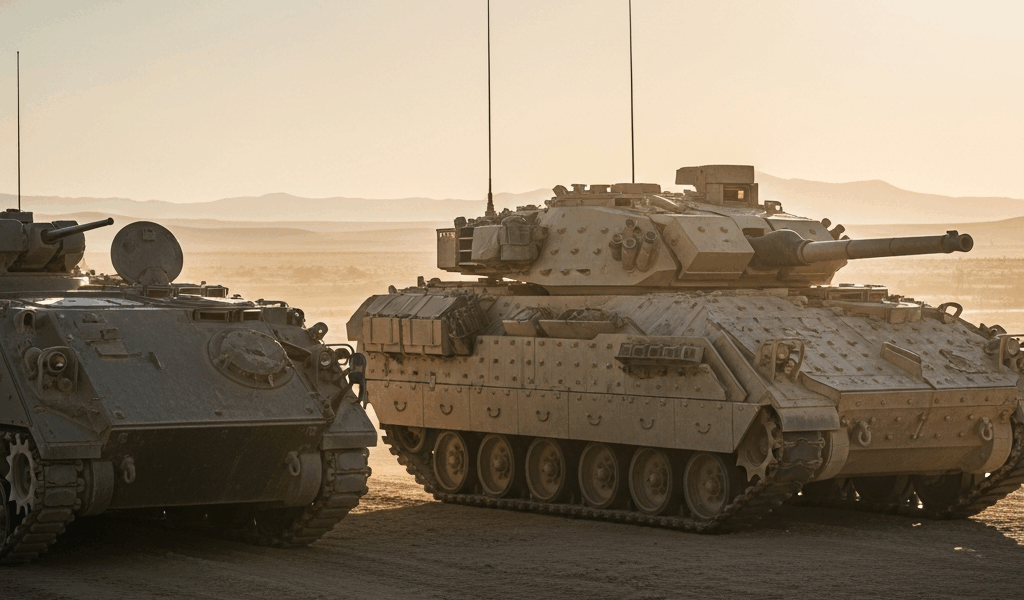
The M2 Bradley replaced the M113 as the U.S. Army’s principal mechanized-infantry squad carrier, but it did not replace every M113-family vehicle. The Bradley is an infantry fighting vehicle built to carry a smaller dismount element while fighting with a 25 mm cannon and TOW missiles. The M113 is a much lighter armored personnel carrier whose adaptable hull continued in command, mortar, medical, maintenance, and other support roles.
That distinction resolves the apparent contradiction: “Bradley replaced the M113” is broadly correct for front-line armored infantry transport, while “the Army kept M113 variants for decades” is also correct. The Armored Multi-Purpose Vehicle—not another Bradley variant—is now replacing many remaining M113-family support vehicles in armored brigade combat teams.
Bradley vs M113 at a Glance
| Question | M113 family | M2 Bradley family |
|---|---|---|
| Basic vehicle type | Armored personnel carrier and adaptable support-vehicle family | Infantry fighting vehicle |
| Original service era | Entered U.S. service around 1960 | Fielded in the early 1980s |
| Primary troop-carrier concept | Transport a larger infantry element under limited armor | Carry a smaller dismount element and provide direct fire and anti-armor support |
| Baseline armament | Common U.S. APC configuration used an externally mounted .50-caliber machine gun; variants differ widely | 25 mm M242 cannon, coaxial 7.62 mm machine gun, and TOW missile launcher on M2/M3 combat variants |
| Protection philosophy | Light aluminum-hull carrier optimized for mobility, transportability, and adaptability | Heavier protected fighting vehicle with armor packages and survivability upgrades varying by configuration |
| Weight and logistics | Far lighter and easier to transport and support | Much heavier, with greater fuel, transport, bridge, recovery, and maintenance demands |
| Current replacement story | AMPV replaces M113 support roles in U.S. armored brigades | Bradley remains a separate fighting-vehicle family while the Army develops its eventual successor |
Exact weight, crew, passenger count, protection, engine, range, and mobility figures depend on variant, modification, armor kit, theater equipment, and date. A 1960s M113, M113A3, M2A0, M2A3, M2A4, M3 cavalry vehicle, M7 fire-support vehicle, and foreign upgrade are not interchangeable specifications.
What the M113 Was Designed to Do
The M113 was created as a light, tracked armored personnel carrier. Its welded aluminum hull reduced weight, and the family’s simple box-like layout provided useful internal volume. The basic carrier could move infantry while shielding them from fragments and some small-arms threats, but it was not designed to trade fire with tanks or modern infantry fighting vehicles.
The standard U.S. carrier’s .50-caliber machine gun offered suppressive fire, often from an exposed position in early configurations. Combat use and later upgrades added shields, turrets, armor, and other equipment, but those changes do not turn every M113 into the same protected weapon system.
The platform’s enduring value was adaptability. The M113 family supported mortar carriers, command posts, recovery and maintenance functions, medical evacuation, air defense, engineering, fire support, and many foreign configurations. Our M113 variant guide separates those roles instead of assigning the baseline APC’s specifications to the entire family.
BAE Systems’ current M113 family overview likewise presents it as a broad vehicle family rather than one frozen Vietnam-era configuration.
What Changed With the Bradley
The M2 Bradley represented a different doctrine. It carries infantry, but it also observes, suppresses, and engages targets with an integrated turret. The 25 mm M242 cannon gives it capability against personnel, positions, and some light armored targets; the TOW launcher provides anti-armor reach; and the coaxial machine gun supports other engagements.
The vehicle pays for those capabilities in weight, size, mechanical complexity, acquisition cost, fuel, transport, recovery, and maintenance. It also carries fewer dismounts than the basic M113 troop-carrier concept. The trade is deliberate: the Bradley is part transport and part fighting system, not merely a heavier battlefield taxi.
Bradley variants and upgrades have changed substantially. The M2 infantry vehicle and M3 cavalry fighting vehicle use related chassis but different mission arrangements; read our M2 vs M3 Bradley guide. BAE Systems’ official Bradley family page documents the continuing vehicle and upgrade program.
Did the Bradley Really Replace the M113?
Yes, in the armored infantry fighting role. Bradley-equipped mechanized infantry gained an organic cannon, anti-tank missiles, sensors, and a more protected fighting platform that the baseline M113 did not provide.
No, not as a one-for-one replacement across every mission. M113-family vehicles remained useful behind or alongside the fighting vehicles as command, mortar, medical, and other support platforms. Building a Bradley for each of those roles would impose unnecessary cost and complexity, while keeping aging M113s indefinitely created protection, mobility, power, and sustainment problems.
The Army’s current answer is the Armored Multi-Purpose Vehicle program. The Army’s first AMPV fielding announcement describes it as the replacement for the M113 family in armored brigade combat teams, with mission variants for general purpose, medical evacuation, medical treatment, mortar carrier, and mission command.
This produces two separate modernization lines:
- Bradley and its eventual fighting-vehicle successor address the infantry/cavalry combat-platform requirement.
- AMPV replaces aging M113-family support vehicles within armored formations.
Firepower Comparison
The baseline comparison is not close because the vehicles were assigned different jobs. A machine-gun-armed M113 can transport troops and provide limited suppressive fire. An M2 Bradley can use its stabilized cannon, coaxial machine gun, and TOW missiles as an integrated fighting system.
That does not mean every vehicle labeled “M113” has only one machine gun. The family includes numerous weapon carriers and foreign turreted conversions. Compare named variants, ammunition, sights, stabilization, elevation, crew arrangement, and doctrine. A specialized M113 derivative should not be used to redefine the baseline APC.
Our Bradley turret and weapons guide covers the M242, coaxial machine gun, and TOW arrangement without turning public specifications into claims about classified performance.
Protection and Survivability
The M113’s light aluminum hull and the Bradley’s heavier protected hull reflect different weight and mission decisions. Later versions of both vehicles received changes and kits, so a single armor-thickness number cannot represent an entire family.
Public sources do not support confident internet claims such as exact “equivalent millimeters” for current Bradley armor, universal hit-survival rates, or a promise that either vehicle will stop a named weapon at every angle. Protection depends on:
- variant and production standard;
- base armor and installed kits;
- hit location, angle, range, and threat;
- stowage and ammunition arrangement;
- fire suppression and damage control;
- crew restraint, training, tactics, and recovery;
- terrain and mission exposure.
The defensible conclusion is narrower: the Bradley was designed as a more protected fighting vehicle, while the M113 was designed as a much lighter carrier. Our Bradley armor-upgrade guide explains the evolution without publishing speculative classified values.
Mobility and Logistics
Both are tracked vehicles, but “mobility” includes more than road speed. The Bradley’s suspension, power, protection, and combat systems support armored maneuver at a much greater vehicle weight. The M113’s lower weight can simplify strategic lift, bridge use, recovery, fuel demand, and operation in infrastructure that cannot support a heavier fighting vehicle.
Amphibious claims need configuration and era. Early M113s were designed with swimming capability, but armor, stowage, condition, local rules, and later modifications can change whether a particular vehicle is authorized and prepared to swim. Do not generalize that capability to every fielded M113, and do not infer that a Bradley lacks all water-crossing options merely because it is heavier.
The engines also differ by model and modernization. The M113A3 uses a diesel powerpack—not a gas turbine. Any comparison that assigns one engine, range, or fuel figure to every M113 or Bradley variant is unreliable.
Which Vehicle Is Better?
For mechanized infantry expected to fight alongside tanks against armored threats, the Bradley provides the relevant cannon, missile, sensors, and protection. For the original light-carrier requirement, the M113 is easier to transport and adapt, but its lower protection and firepower are fundamental constraints rather than minor upgrade gaps.
For command, medical, mortar, and support missions in a modern U.S. armored brigade, the real comparison is increasingly AMPV versus the M113 it replaces—not Bradley versus M113. For foreign operators, the answer depends on the exact M113 upgrade, threat, budget, support network, doctrine, and available replacement vehicles.
Bottom Line
The Bradley did not simply become a bigger M113. It changed the mechanized infantry vehicle from an armored carrier into a fighting platform with cannon and anti-tank missiles. That cost troop space, weight, logistics, and complexity but added capabilities the baseline M113 could not supply.
The M113 remained because its adaptable family handled many jobs that did not require a Bradley. Today, AMPV is replacing those aging M113 support vehicles, while Bradley modernization and successor development address the separate infantry fighting-vehicle mission.

Stay in the loop
Get the latest military vehicles vault updates delivered to your inbox.