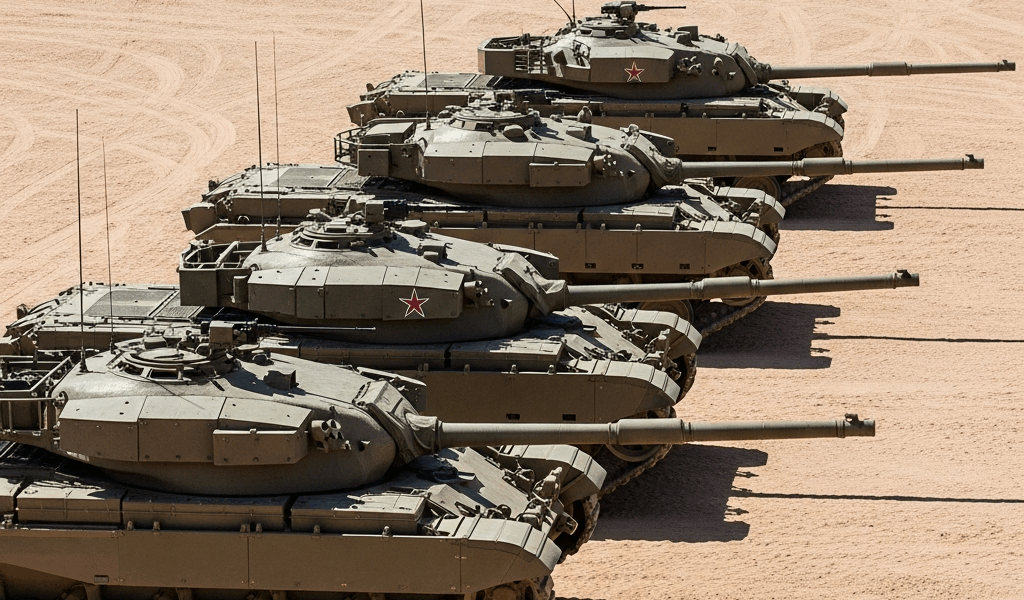
Why the Centurion Kept Getting Better
The Centurion’s history has become harder to navigate with all the mythology flying around. People want to pin its success on one battle, one upgrade, one brilliant engineer making a decision in some London office. That’s not how it happened. The real story is messier and honestly more interesting.
The tank arrived too late for World War II. British designers had spent years — frustrated by repeated failures against German armor — refining a medium tank that could actually survive a real fight. By the time production ramped up in 1945, the war in Europe was over. That timing could have killed the project entirely. Instead, it saved it.
Korea changed everything. When North Korean T-34s rolled south in June 1950, the British had a problem on their hands. Their existing tanks couldn’t reliably punch through Soviet armor at real combat distances. The Centurion, already in service but unremarkable, got a 20-pounder gun bolted in and thrown into the fight. It worked. Better than worked. It dominated.
That success built a pattern the British followed for decades. Rather than start over with a brand-new design every five years, they kept the same hull and swapped in better guns, engines, and fire control systems. The Centurion’s chassis was roomy enough, tough enough, to handle that kind of constant reinvention. That adaptability — not just the original design — is what made it legendary.
Centurion Mk 3 — The Version That Proved It in Combat
The Mk 3 arrived like a confidence injection. Early British tanks in Korea were getting chewed up by T-34-85s firing from positions the older guns couldn’t reach effectively. The 17-pounder was decent. It wasn’t dominance. The 20-pounder changed that calculus entirely.
The upgrade wasn’t just a bigger gun bolted onto the same turret. The 20-pounder pushed 2,430 feet per second muzzle velocity — better penetration geometry at range, better performance against angled Soviet armor. The numbers matter here. They explain why crews suddenly trusted the tank’s ability to win a gunfight when it counted.
The Hook engagement in April 1951 is the proof point. British forces holding a ridgeline got hit by a coordinated T-34 attack. The Centurions held the line. They killed T-34s at ranges where Soviet tankers had no effective reply. That fight — and dozens like it — rebuilt the British armor reputation after years of being badly outgunned.
The Mk 3 carried a crew of five. Frontal armor sat at 90mm thick. A diesel engine kept fuel consumption manageable, which mattered enormously when you’re operating 200 miles from your supply depot. The variant served in Korea, Malaya, and Egypt through the early 1950s. It proved something that would define the Centurion’s entire service life: the basic design was sound enough to accept bigger guns without structural failure or catastrophic balance problems. That was not obvious before Korea. Afterward, it was undeniable.
Shot Kal — Israel Turned It Into Something Else Entirely
This is the piece to know up front. The Israeli Shot Kal Dalet is the most heavily modified Centurion variant ever fielded, and its combat record across five wars speaks louder than any museum exhibit ever could.
Israel acquired Centurions from Britain in the late 1950s. By 1967, they had enough to form full armored battalions. But commanders like Avraham “Bren” Adan looked at the standard Centurion and saw a baseline rather than a finished product. The Sinai was going to be the proving ground — and the standard package wasn’t going to cut it out there.
The Shot Kal started with a retrofit of the Continental AVDS-1790-5A diesel engine. This wasn’t a minor tweak. The 750-horsepower V-12 completely transformed the tank’s performance envelope. Top speed climbed from 21 miles per hour to 34. In desert fighting where engagement ranges stretch vast and maneuver means everything, that difference let crews reach ambush positions faster and break contact before enemy fire got organized. Huge deal.
Then came the gun. The 105mm L7 replaced the 84mm L9 — more explosive force per round, higher accuracy at distance. The Sinai in 1967 was armor-on-armor combat at ranges where precision matters more than volume. Israeli tankers exploited that advantage relentlessly. They killed Egyptian T-54s and T-55s consistently from 1,500 meters while absorbing return fire they could actually survive.
The 1973 Yom Kippur War pushed the Shot Kal harder. Fighting along the Suez Canal against dug-in Egyptian and Syrian forces meant navigating terrain engineered to maximize every defensive advantage possible. The upgraded engine kept Israeli crews moving through sand and rough ground. The gun suppressed prepared positions from standoff range. Explosive reactive armor — appliqué blocks that detonate on impact — got bolted onto turrets in ad-hoc fashion by field mechanics working overnight. It wasn’t elegant. It worked.
I’m apparently someone who gets unreasonably fascinated by upgrade histories, and the Shot Kal works for me while generic “best tank” rankings never do. The Shot Kal Dalet represented something the original designers never imagined: a Centurion that could match contemporary Soviet medium tanks through upgrades alone. Israel kept these tanks in service into the 1980s. Some sources place isolated vehicles in reserve units even into the 1990s. That longevity came entirely from one persistent question — what can this chassis handle that it was never originally designed for?
Centurion AVRE — Built to Breach, Not to Fight Tanks
But what is the AVRE? In essence, it’s a Centurion chassis stripped of its anti-tank purpose and rebuilt around engineering warfare. But it’s much more than that.
The Armored Vehicle Royal Engineers variant mounted a 165mm demolition gun in an enormous turret. Short barrel. Stubby. Designed entirely to fire shaped-charge shells through fortifications, bunkers, and anti-tank walls at close range. This variant never fought other tanks. It fought geography and concrete.
Gun depression angles ran around -10 degrees — limiting, but fine when your target is a fixed bunker you’re engaging from 500 meters. Would have been useless in a tank-versus-tank duel. Skip the misstep I made of reading early specs and assuming it was a general-purpose variant. It absolutely was not.
The crew mindset differed completely from standard Centurion crews. Five members, but different job descriptions entirely. The gunner spent as much time reading terrain and identifying obstacles as acquiring targets. The commander operated as part field engineer, part tank commander. Fascines — bundles of logs lashed to the hull — crossed trenches on demand. These crews worked alongside infantry sappers rather than operating as standard tank platoon elements. Completely different war they were fighting.
British forces deployed AVRE variants through the 1960s and into the early 1980s. The 165mm gun stayed viable against concrete long after the 84mm and 105mm anti-tank guns became obsolete for peer-to-peer combat. It showed the Centurion chassis could be stretched and repurposed for roles nobody predicted when the tank first rolled off production lines at Leeds in 1945.
Which Centurion Variant Actually Had the Biggest Impact
The Shot Kal Dalet won. Not the Mk 3, not the AVRE — the Israeli variant changed modern armor doctrine in ways that still echo through every main battle tank designed after 1975. So, without further ado, let’s dive in.
The Shot Kal proved that mid-life upgrades could keep a 1940s-era platform competitive against front-line contemporary designs well into the 1970s and beyond. That insight hit every armored force like a freight train. The Israelis didn’t replace their Centurions — they evolved them. When the Merkava program took shape in the late 1970s, that philosophy got baked directly into the new platform. Maximum modularity. Deep upgrade potential. A design lifetime measured in decades rather than years.
While you won’t need to rebuild an engine bay to appreciate what this meant doctrinally, you will need a handful of context to understand why it mattered so much. The Vickers Mk 1, Britain’s own successor to the Centurion, inherited the same design ethos — bigger gun, better engine, but the real DNA was upgrade potential. Modern main battle tanks still carry that Centurion legacy in their bones.
This new idea of modularity over replacement took off several years later and eventually evolved into the upgrade-first procurement philosophy armies know and practice today.
What made it possible? Not genius. Simplicity. A roomy hull. An engine bay built without precision-fit components that would shatter under field stress. Armor that could be welded or bolted rather than cast in one irreplaceable piece. The Centurion wasn’t the flashiest tank ever built. It was the smartest — and that turned out to matter far more.

Stay in the loop
Get the latest military vehicles vault updates delivered to your inbox.