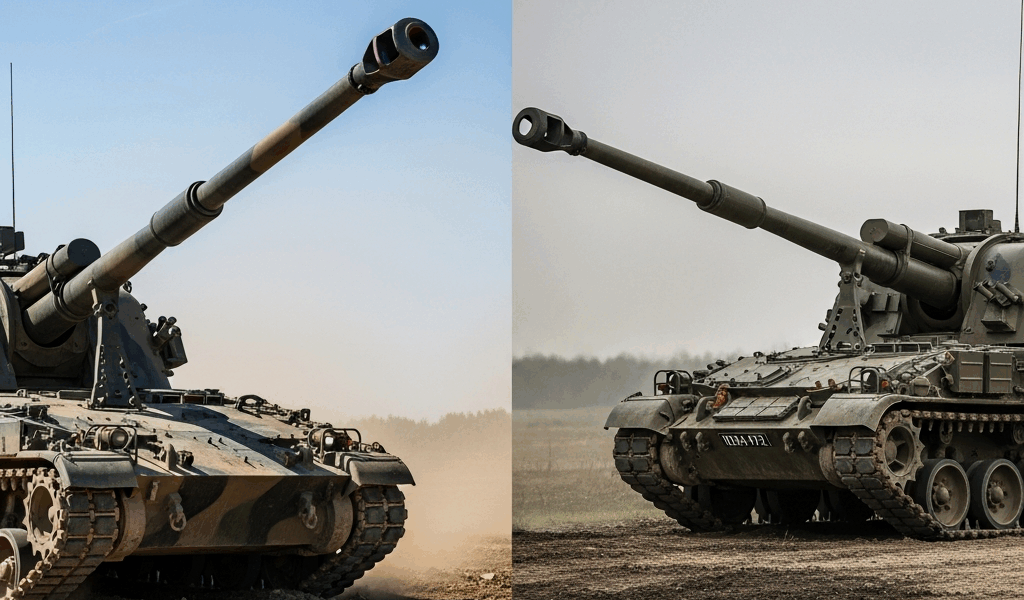
M109 Howitzer vs 2S1 Gvozdika Artillery Comparison — Which Self-Propelled Gun Wins?
The M109 howitzer versus 2S1 Gvozdika comparison has gotten complicated with all the specification sheets flying around. Spent the better part of three years neck-deep in military hardware analysis for defense work, and what actually struck me first wasn’t the range tables or muzzle velocities. It was how fundamentally differently NATO and Soviet engineers solved the same problem: mount a cannon on tracks and keep it breathing.
These platforms represent entirely different worldviews. One prioritized crews staying in the fight for weeks straight across continental distances. The other? Built around firing, vanishing, and letting counter-battery rounds hit empty dirt. Understanding why those design choices existed tells you everything about how NATO and Soviet doctrine actually thought artillery should work.
Design Philosophy and Era — Why They Diverged So Much
The M109 entered service in 1963. American thinking at that moment centered on forward-deployed artillery in Germany, potentially firing support for weeks without rotating crews home. The gun needed to traverse multiple terrain types, survive in armored formations, and sustain fire operations under conditions that would burn out equipment faster than supply lines could replace it.
The 2S1 Gvozdika arrived later — 1971. By then, Soviet doctrine had crystallized into something entirely different. Soviet planners built around rapid, mobile warfare with constant unit displacement. Fire a few rounds, move positions, get out before the Americans massed counter-battery responses that turned stationary guns into scrap metal.
One system designed for staying power. One designed for evading power. That single divergence shaped everything downstream.
Probably should have opened with this section, honestly. The design era matters more than raw specifications ever could. The M109 was built for sustained NATO operations — think extended campaigns. The 2S1 was built for Soviet rapid operations — think strike and scatter. Neither is objectively better until you specify: better at what, exactly?
Firepower and Rate of Fire Breakdown — The Ammunition Story
The M109 fires 155mm rounds. The 2S1 fires 122mm rounds. Seems straightforward — until you examine what those differences actually mean in the field.
A 155mm shell carries roughly 43.5kg of explosive payload. The 2S1’s 122mm round carries approximately 21.8kg. In single-shot terms, the American gun delivers nearly twice the kinetic violence per round. But here’s the thing — artillery doesn’t work in single shots during actual combat.
Sustained rate of fire tells a different story entirely. An M109 maintains approximately 4 rounds per minute continuously — the rate crews can actually sustain across 12-hour operations without burning out breech mechanisms or collapsing ammunition handlers. Push it to 6-8 RPM and you’ll get those rounds downrange fast, but crews feel that intensity grinding on them through extended firefights.
The 2S1’s doctrine emphasized speed differently. It manages 5-6 RPM sustained, but here’s where weight becomes tactical advantage — that 122mm round weighs less than 155mm ammunition. Two ammunition handlers can resupply a 2S1 faster than M109 crews handling heavier American shells. During rapid-fire scenarios — say, 10 minutes of continuous fire before displacement — the 2S1 actually holds operational advantage through sheer ease of ammunition handling.
Ammunition versatility adds another layer. Modern M109s fire GPS-guided Excalibur rounds at $100,000+ per unit, illumination rounds, smoke, and cluster munitions where legally permitted. The 2S1 uses Soviet-compatible 122mm ammunition — cheaper to produce at roughly $500-800 per conventional high-explosive round — but with fewer specialized variants available.
Real-world example from Ukraine’s 2022-2024 operations: M109s engage targets from standoff range using GPS-guided rounds, minimizing time in the firing position. A 2S1 firing from the same location for 20 minutes straight? That position gets compromised. Russian doctrine emphasizes fire-and-displace within minutes for exactly this reason — counter-battery radar catches stationary guns.
Armor Protection and Mobility Trade-offs — The Survivability Equation
The M109 weighs approximately 30 tons fully loaded. The 2S1 weighs 16.8 tons. That 13-ton difference compounds across every operational metric in ways that matter more than the numbers suggest.
M109 hull armor stops small-arms fire and fragmentation across most attack angles. Side armor reaches roughly 30mm equivalent in vulnerable spots, while the front glacis reaches 50mm+. The overall protection envelope does what matters — it keeps crews alive during indirect fire, which is the actual threat to self-propelled guns. When a counter-battery 155mm round lands nearby, it doesn’t care about your side plates. It cares whether fragmentation punches through.
The 2S1’s hull armor is lighter overall — roughly 15mm at thinnest sections, reaching 40mm at the front. Small-arms fire and shell fragments at close range don’t penetrate, but sustained counter-battery fire presents genuine danger. The 2S1 was never engineered to survive being trapped in position. It was engineered to simply not be there when counter-battery rounds arrive.
Mobility connects directly to survivability in modern artillery operations. An M109 reaches roughly 56 km/h on roads, sustains 40 km/h cross-country. That sustained cross-country speed lets it reposition across greater distances without getting pinned down. The 2S1 matches road speeds at 60 km/h but struggles cross-country in soft terrain — weight distribution on older track systems means it sinks in mud where an M109 would muscle through.
I learned this reading Ukrainian operational reports from 2022: crews in heavier equipment survived counter-battery engagements crews in lighter vehicles couldn’t escape. That extra 13 tons meant the difference between displacing 3km to safety and being caught stationary when enemy fire arrived.
Crew Ergonomics and Operational Endurance — Who Lasts the Full Mission?
Artillery operations mean crews working 10-16 hour shifts — sometimes longer. The M109 provides internal volume because the larger gun breech requires it. Ammunition handlers actually have space to move between rounds. The gun captain can stand mostly upright near the breech mechanism.
The 2S1 is cramped. Four crew members squeezed into a smaller fighting compartment, and the turret forces everyone into tight positions. After 8 hours of continuous fire, that compounding fatigue affects targeting precision and ammunition handling speed. Round times degrade. Mistakes increase.
That cramped design contains operational logic though. Soviet doctrine assumed crew rotation — fire 30-40 minutes from one position, displace, swap crews at the next position, keep rotating through multiple positions across a wide area. The same artillery battery creates the appearance of more guns firing from different locations. American doctrine assumed continuity — same crews with same guns deployed for weeks, repositioning strategically but maintaining crew stability.
Modern crew endurance data from Ukraine shows M109 crews maintaining targeting accuracy after 12-hour shifts. 2S1 crews show measurable performance degradation after 10 hours without rotation. Neither approach fails — they reflect different operational assumptions about how long a single firing position remains viable before counter-battery forces overwhelm it.
Modern Variants and Continued Use — What Actually Matters in 2024
The M109 evolved continuously. The M109A1 (1979) added a longer barrel for extended range. The M109A2 (1986) brought ballistic computers. The M109A6 Paladin arrived in 1994 and fundamentally rewired the turret — digital fire control systems, GPS integration, inertial navigation platforms that let guns shoot and move without losing position reference data.
The current M109A7 production model (introduced 2013, still manufactured today) incorporates hybrid powerplants, redesigned turrets with improved crew ergonomics, and digital integration connecting directly to brigade fire direction networks. The U.S. maintains over 2,000 M109 variants across active inventory.
The 2S1 received modernization to the 2S1M standard during the 1980s — enhanced fire control systems, slightly improved optics, reinforced turret structure. That’s where modernization largely stopped. The baseline 1970s design remains foundational. Russia and former Soviet states still operate these guns — Ukraine fielded over 900 2S1 variants during the 2022 invasion — but no comprehensive overhaul happened.
Why the divergence? Cost and inventory logistics. The M109 remains a critical NATO priority in American defense budgets, so continuous upgrades happen. The 2S1 cost almost nothing to manufacture, and thousands already existed across former Soviet militaries. Overhauling them all made less economic sense than developing new platforms like the Msta-S — a 152mm gun introduced 1989, heavier and more capable.
But the 2S1 persists because it works. Crews across multiple militaries know how to operate it. Ammunition supply chains established during the Soviet era remain functional. It fills operational niches lighter than the Msta-S, more agile in rough terrain, cheaper to sustain.
The real 2024 difference comes down to network integration. An M109A6 plugs automatically into NATO fire direction networks — digital terrain databases, satellite positioning, ballistic computers cross-checking with adjacent units. A 2S1M performs identical calculations, but network integration requires adaptation work. It shoots equally accurately once you feed it the firing data, but getting that data into position takes longer.
That network advantage compounds across extended operations. In a hypothetical NATO versus Russia conflict, American artillery would coordinate faster, adjust fire between units quicker, and concentrate firepower more efficiently. The M109 itself isn’t inherently more lethal — it’s the network that multiplies lethality.
For Ukraine’s defense, those older 2S1s do the job because they exist in massive numbers. A 2S1 firing from a dispersed position Ukraine controls is alive. That’s the real comparison — not which gun performs better in abstract terms, but which gun solves the actual problem you’re facing right now.

Stay in the loop
Get the latest military vehicles vault updates delivered to your inbox.