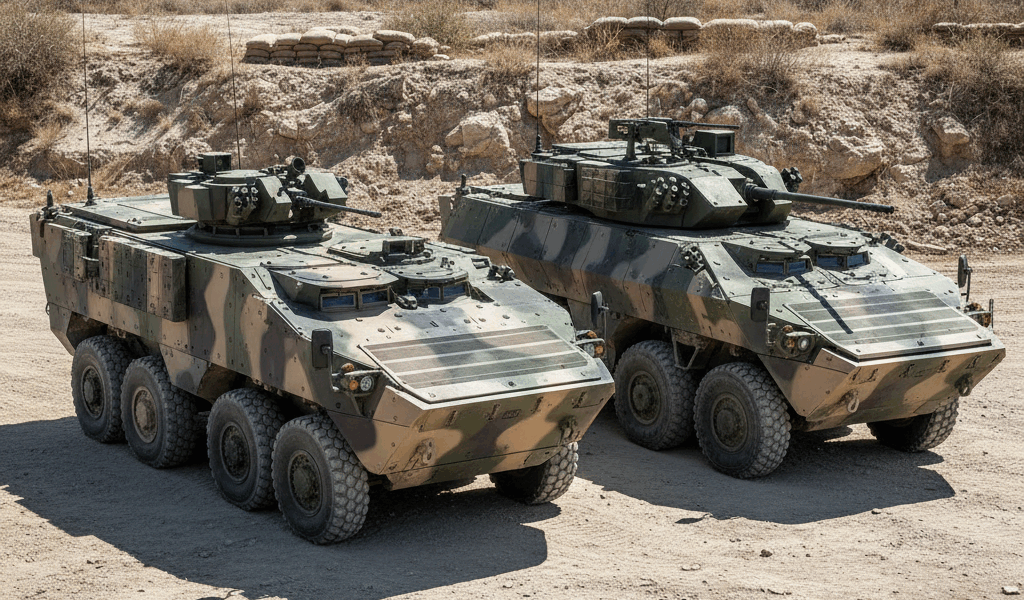
The decisive difference: the Marine Corps LAV-25A2 is a cannon-armed light armored reconnaissance vehicle with limited swim capability, while the Army’s baseline Stryker Infantry Carrier Vehicle is a larger protected transport built around an infantry squad. They share an eight-wheel layout and related design ancestry, but they are not interchangeable vehicles competing for the same job.
A fair LAV-25 vs Stryker comparison must name the Stryker variant. The Stryker family includes infantry carriers, reconnaissance, command, mortar, medical, anti-tank, engineer, fire-support, air-defense, and 30 mm cannon configurations. Comparing the LAV-25’s 25 mm turret with a baseline M1126 ICV is useful; treating every Stryker as if it has the same weapon, weight, armor, or crew is not.
LAV-25 vs Stryker: quick comparison
| Feature | LAV-25A2 | Baseline Stryker ICV |
|---|---|---|
| Primary role | Light armored reconnaissance and mobile direct fire | Protected infantry transport and supporting fires |
| Service | U.S. Marine Corps | U.S. Army |
| Typical crew/dismount organization | Three crew, three scouts, and one enabler in current Marine doctrine | Two-person vehicle crew plus a nine-Soldier rifle squad in Army doctrine |
| Baseline main weapon | M242 25 mm automatic cannon | M2 .50-caliber machine gun or Mk 19 40 mm grenade machine gun on a remote weapon station |
| Water capability | Limited swim capability in suitable protected water; cannot cross the surf line | Not an amphibious swimming vehicle |
| Road speed | 62.2 mph listed for LAV-25A2 | Greater than 60 mph listed for the ICV |
| Published cruising range | About 400 miles | 330 miles or more at 40 mph |
| Combat weight | 31,752 lb for LAV-25A2 in current Marine doctrine | Varies materially by flat-bottom, DVH, DVHA1, armor, and mission package |
Which is better? The LAV-25 is better suited to a reconnaissance formation that needs an organic 25 mm cannon and limited inland-water crossing capability. A Stryker ICV is better suited to moving and supporting a full infantry squad with the protection, network, and payload priorities of a Stryker brigade. A 30 mm Stryker or another mission variant changes the weapon comparison.
They are related, but they are not the same vehicle
Both vehicles descend from the Swiss MOWAG Piranha family through Canadian-developed designs. The Marine Corps adopted the LAV family in the early 1980s. The Army’s Stryker, based on the later LAV III lineage, entered service roughly two decades later.
That common ancestry explains the familiar 8×8 silhouette. It does not mean the Stryker is simply a heavier LAV-25. The hull volume, protection packages, power systems, digital architecture, passenger requirements, weapon stations, and mission variants evolved around different service concepts.
Mission: reconnaissance vehicle versus infantry carrier
What the LAV-25 does
Marine light armored reconnaissance units conduct reconnaissance, security, and economy-of-force missions with a family of LAVs. The LAV-25A2 supplies the formation with mobile observation, scouts, and direct fire against personnel, material targets, and lightly armored vehicles.
The vehicle is not a small tank and should not be judged as one. Its value comes from speed, range, sensors, communications, scouts, and the ability to report and fight for information while avoiding unsuitable engagements.
What the Stryker ICV does
Army doctrine describes the Stryker ICV as the vehicle component of a system built around a rifle squad and vehicle crew. Its primary purpose is to move infantry toward the probable line of contact, provide supporting fires for the dismounted force, and remain available for resupply, casualty evacuation, or extraction.
That passenger requirement is a fundamental design distinction. The Stryker ICV carries a full nine-Soldier squad in addition to its two-person crew. Current 30 mm Stryker configurations can use a three-person crew while retaining capacity for nine infantry Soldiers, so crew figures must always be tied to the variant being discussed.
Firepower: the LAV-25 wins only against the baseline ICV
The LAV-25A2 has a two-person turret with an M242 25 mm automatic cannon, a coaxial M240 7.62 mm machine gun, and a pintle-mounted M240B. Marine doctrine describes the cannon as direct-fire capability against personnel, lightly armored vehicles, and material targets.
The baseline Stryker ICV uses a remote weapon station that can mount an M2 .50-caliber machine gun or Mk 19 40 mm grenade machine gun. In that narrow comparison, the LAV-25 has the heavier direct-fire cannon.
But “Stryker” is a family, not one armament package. The Army has fielded 30 mm cannon Strykers, anti-tank guided-missile vehicles, mortar carriers, and short-range air-defense variants. The retired Mobile Gun System carried a 105 mm gun. Therefore:
- LAV-25 vs baseline M1126 ICV: LAV-25 has the cannon advantage.
- LAV-25 vs 30 mm Stryker: the Stryker has the larger cannon caliber and a different infantry-support role.
- LAV-25 vs anti-tank or air-defense Stryker: the mission and weapon comparison changes completely.
Protection and weight: compare configurations, not slogans
The LAV-25A2 figure in current Marine Corps doctrine is 27,820 lb empty curb weight and 31,752 lb combat loaded. Marine doctrine also states that the baseline fleet includes the ballistic-protection upgrade package.
Stryker weight depends on the hull generation and installed kit. Older flat-bottom ICV references commonly cluster near 19.5 tons, while double-V-hull vehicles increased weight and protection. DVHA1 adds a 450-horsepower engine, stronger suspension, more electrical output, and other changes to support the modernized platform.
It is accurate to say the Stryker ICV generally provides more protected volume for a larger dismounted squad. It is not accurate to assign one permanent weight or armor rating to the entire Stryker family. Appliqué armor, double-V hulls, mission equipment, weapon stations, and other kits change the configuration.
Mobility: similar road speed, different water capability
Published road-speed figures are close: Marine doctrine lists 62.2 mph for the LAV-25A2, while Army doctrine lists a sustained maximum above 60 mph for the Stryker ICV. The LAV-25A2’s published range is about 400 miles; the Army lists 330 miles or more at 40 mph for the ICV. Actual performance depends on load, terrain, maintenance condition, and operating profile.
What “amphibious” means for the LAV-25
The LAV-25 can swim at about 6.5 mph in appropriate protected water, but this capability is frequently overstated. Current Marine doctrine calls it a limited swim capability and states that the vehicle cannot cross the surf line. It can cross suitable streams, lakes, and slow-running rivers when current, banks, soil, and underwater obstacles permit.
The LAV-25 therefore supports an expeditionary Marine force, but it is not an Amphibious Combat Vehicle designed for an open-ocean ship-to-shore assault. It reaches shore through shipping or landing craft and can then use limited swimming for suitable inland-water obstacles.
The Stryker ICV is not designed to swim. It can negotiate permitted fording conditions under applicable procedures, but that is not the same as amphibious operation.
Air transport: possible does not mean tactically effortless
Both families have air-transport considerations, but online comparisons often omit operational constraints. A Marine Corps manual states that a single noncombat-loaded LAV can be moved externally by a CH-53E, while warning that weather and altitude can prevent the lift and that aircraft availability, deck space, cycle time, and added weight sharply restrict its use. The manual characterizes this as primarily administrative rather than a routine tactical method.
Stryker was developed with C-130 intratheater transport as a requirement, but a Government Accountability Office review found significant operational limits on routine C-130 movement. Modern heavier configurations and installed equipment make the exact aircraft, range, runway, load preparation, and combat-ready configuration important.
For either vehicle, “air transportable” should not be translated into “arrives anywhere fully loaded without preparation.” Strategic and tactical movement plans account for aircraft type, distance, fuel, armor, ammunition, accompanying support, and reconfiguration time.
Crew and passenger capacity
Current Marine Corps LAV-25A2 doctrine lists three crew members—driver, gunner, and commander—plus three scouts and one enabler such as a corpsman, mechanic, or engineer. Some older or simplified references say four scouts; the total rear occupancy may look similar, but current doctrinal organization is more precise.
The baseline Stryker ICV uses a two-person vehicle crew and carries a nine-Soldier infantry squad. That larger dismounted element explains much of the vehicle’s volume and mission. Specialized Stryker variants have different crew sizes because they carry mortars, command teams, medical staff, sensors, missiles, engineering equipment, or other systems.
Which vehicle wins?
There is no useful universal winner because the vehicles solve different tactical problems:
- Reconnaissance, organic 25 mm fire, and limited protected-water swimming: LAV-25A2.
- Protected movement of a full infantry squad: Stryker ICV.
- Heavier cannon comparison: name the 30 mm Stryker configuration instead of using the baseline ICV.
- Open-ocean ship-to-shore assault: neither the LAV-25 nor Stryker ICV is the correct direct analogue; compare the Marine Corps Amphibious Combat Vehicle.
- Anti-tank, mortar, air defense, medical, or command missions: compare the relevant family variants.
The best answer to “LAV-25 vs Stryker” is therefore role-specific: the LAV-25 is a smaller reconnaissance and direct-fire platform, while the Stryker ICV is an infantry carrier within a much broader modular vehicle family.
Frequently asked questions
Is the Stryker based on the LAV-25?
They share Piranha-family ancestry, but the Army Stryker is based on the later LAV III lineage. It is not simply an upgraded LAV-25.
Can a LAV-25 swim from a ship to the beach?
No. Marine doctrine says the LAV has limited swim capability and cannot cross the surf line. Its water capability is suited to appropriate inland and protected-water crossings, not an open-ocean assault swim.
Does every Stryker carry a .50-caliber machine gun?
No. The baseline ICV can mount an M2 .50-caliber machine gun or Mk 19 grenade machine gun, while other Stryker variants carry 30 mm cannons, missiles, mortars, air-defense weapons, or specialized mission equipment.
Which vehicle carries more infantry?
The baseline Stryker ICV carries a nine-Soldier rifle squad in addition to its vehicle crew. The current LAV-25A2 doctrinal organization lists three scouts plus one enabler behind its three-person crew.
Related LAV and Stryker comparisons
- LAV-25 capabilities and variants explains the Marine vehicle family in more detail.
- Stryker vehicle guide maps the Army family’s principal mission variants.
- Stryker, LAV, and MRAP compared places both 8×8 vehicles alongside mine-resistant platforms.
- Humvee vs Stryker, LAV-25 vs Fuchs, and Stryker vs Bradley cover adjacent vehicle-selection questions.
Official and primary sources
- U.S. Marine Corps MCTP 3-10D, Employment of Light Armored Reconnaissance
- U.S. Marine Corps MCWP 3-14, LAR mobility and limitations
- U.S. Army doctrine supplement: Stryker Infantry Carrier Vehicle
- U.S. Army Project Manager Stryker Brigade Combat Team
- U.S. Army: 30 mm Medium Caliber Weapon System
- GAO-04-925: Stryker C-130 transportability
Specifications verified July 31, 2026. Vehicle weights, weapons, crew sizes, and protection vary by variant and installed kit; the comparison identifies the baseline configuration wherever possible.

Stay in the loop
Get the latest military vehicles vault updates delivered to your inbox.