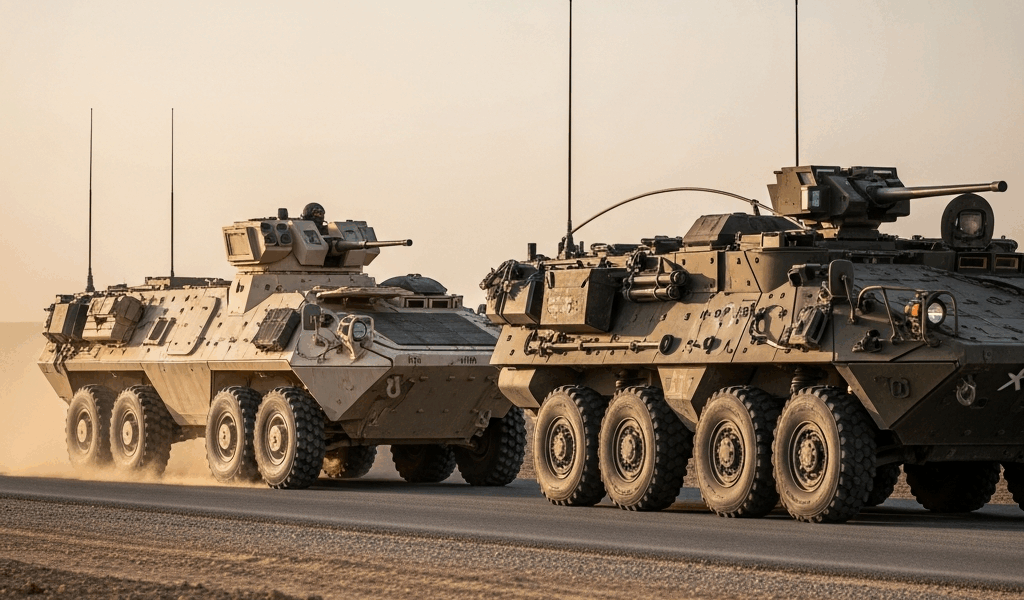
Light armored vehicles are protected, mobile military vehicles designed to trade some of a tank’s armor and firepower for speed, range, deployability, or passenger capacity. The term covers several roles rather than one fixed design. A reconnaissance vehicle such as the LAV-25, an infantry carrier such as the Stryker ICV, and a blast-protected MRAP may all be described as light or medium armored vehicles in general discussion, but they are built for different missions.
This article includes affiliate links. We may earn a commission at no extra cost to you.
The fastest way to compare them is by purpose: the LAV-25 scouts and provides 25 mm direct fire, the baseline Stryker ICV transports and supports an Army rifle squad, and an MRAP prioritizes protection from mines and improvised explosive devices. None is a lightweight substitute for a main battle tank.
Light armored vehicles at a glance
| Vehicle type | Primary job | Typical strength | Main trade-off |
|---|---|---|---|
| LAV-25A2 | Marine light armored reconnaissance and mobile direct fire | Speed, range, 25 mm cannon, limited protected-water swim capability | Less protected volume and fewer dismounts than an infantry carrier |
| Baseline Stryker ICV | Protected transport and support for a nine-Soldier rifle squad | Squad capacity, road mobility, modular vehicle family | Not amphibious; weight and equipment vary considerably by generation |
| MRAP family | Mine, IED, ambush, patrol, convoy, or route-clearance protection | Blast mitigation and protected crew compartment | Height, weight, transport burden, and limits in soft or restricted terrain |
| Tracked light vehicle | Off-road reconnaissance, transport, or fire support | Cross-country mobility and lower ground pressure in some designs | More track maintenance and lower road efficiency than many wheeled vehicles |
Important: “LAV” can mean a specific vehicle family, while “light armored vehicle” is also a broad descriptive category. Likewise, MRAP is a protection-oriented family of vehicles, not a single model. Specifications must be tied to an exact variant and installed armor package.
What counts as a light armored vehicle?
There is no universal weight cutoff that separates every light, medium, and heavy armored vehicle. Services and countries classify vehicles according to doctrine, mission, transport requirements, and force structure. The same vehicle may be described as light armor in one context and medium weight in another.
Most vehicles in this broad category combine several of the following features:
- Protection against small-arms fire, fragments, mines, or improvised explosive devices, depending on the design.
- Wheeled or tracked mobility that is faster or easier to deploy than a main battle tank.
- A mission such as reconnaissance, infantry transport, command and control, casualty evacuation, fire support, anti-tank work, or route clearance.
- A weapon ranging from a protected machine gun to an automatic cannon, mortar, or guided missile system.
- A balance among armor, payload, speed, range, air or sea transport, and cross-country performance.
Those trade-offs explain why a specification-sheet “winner” is usually misleading. More armor raises weight. A larger cannon consumes space and payload. A full infantry squad needs protected volume. Mine protection can increase floor height and center of gravity. The correct vehicle depends on what the unit must do and the threats it expects.
LAV-25: reconnaissance with organic cannon fire
The Marine Corps LAV-25A2 is an eight-wheeled member of the Light Armored Vehicle family. Current Marine doctrine lists a three-person crew—driver, gunner, and commander—plus three scouts and one enabler. Its two-person turret carries the M242 25 mm automatic cannon, a coaxial M240 machine gun, and a pintle-mounted M240B.
The vehicle’s purpose is not to exchange fire with main battle tanks. It supports reconnaissance and security by combining sensors, communications, scouts, speed, and direct fire against personnel, material targets, and lightly armored vehicles.
Marine Corps technical data lists the LAV-25A2 at 31,752 pounds combat loaded, with a maximum land speed of 62.2 mph and a published range of about 400 miles. It also has limited swimming capability in suitable protected water. That capability is often overstated: Marine doctrine says the LAV cannot cross the surf line, so it is not an open-ocean ship-to-shore assault vehicle.
The LAV family includes command, logistics, recovery, mortar, and anti-tank variants. A formation gains more capability from that family mix than from treating every LAV as a cannon vehicle.
Stryker: a vehicle family centered on the infantry squad
The Army’s eight-wheeled Stryker family belongs to a later branch of the Piranha design lineage. The baseline Infantry Carrier Vehicle is organized around a two-person vehicle crew and a nine-Soldier rifle squad. Army doctrine describes the vehicle as transporting infantry toward the probable line of contact, supporting the dismounted force, and remaining available for resupply, casualty evacuation, or extraction.
The baseline ICV uses a remote weapon station that can mount an M2 .50-caliber machine gun or Mk 19 grenade machine gun. Other Stryker variants carry different crews and systems, including reconnaissance, command, mortar, medical, engineer, anti-tank, fire-support, air-defense, and 30 mm cannon configurations.
Army doctrine lists a sustained maximum speed above 60 mph and a cruising range of at least 330 miles at 40 mph for the ICV. Protection and weight cannot be reduced to one number across the whole family: flat-bottom hull, double-V hull, DVHA1, appliqué armor, weapon station, and mission equipment materially change the vehicle.
Unlike the LAV-25, the Stryker ICV is not designed to swim. Its advantage is protected capacity for a full squad and the common vehicle architecture of a Stryker brigade. See the focused LAV-25 versus Stryker comparison for a variant-specific breakdown.
MRAP: protection category rather than one vehicle
MRAP means Mine Resistant Ambush Protected. The Department of Defense accelerated the joint MRAP program in 2007 in response to mine and improvised-explosive-device threats in Iraq and Afghanistan. The program fielded multiple manufacturers and variants rather than one standardized vehicle.
Army guidance describes MRAPs as particularly effective at mitigating blast effects while also providing protection from small arms. Common design themes include a protected crew compartment, greater separation from a blast beneath the vehicle, blast-attenuating seating, and hull geometry intended to redirect energy. The exact construction and protection package varies by model.
MRAP categories and specialized variants cover patrol, utility, troop transport, ambulance, explosive-ordnance-disposal, recovery, and route-clearance missions. The M-ATV was developed to provide better all-terrain mobility than many of the larger vehicles.
The trade-offs are substantial. Army publications identify limitations involving soft soil, visibility, maneuverability, height, and transport. A vehicle optimized to keep occupants alive during a mine blast is not automatically the best reconnaissance platform or infantry carrier. Our MRAP protection guide explains the blast-protection approach and major vehicle families.
LAV vs Stryker vs MRAP: the practical differences
Role
The LAV-25 belongs to a reconnaissance formation. The Stryker ICV moves a full infantry squad. MRAP variants emphasize protected movement through mine and IED threats. Comparing them without the mission is like comparing a scout, a troop carrier, and a protective convoy vehicle solely by top speed.
Firepower
The LAV-25A2 has a 25 mm automatic cannon. A baseline Stryker ICV has a machine gun or grenade machine gun on a remote weapon station, although 30 mm and other specialized Stryker variants change that comparison. MRAP armament varies, but the defining feature is blast protection rather than a particular weapon.
Passenger capacity
The LAV-25A2’s current doctrinal organization includes three crew, three scouts, and an enabler. The baseline Stryker ICV carries a nine-Soldier squad in addition to its two-person crew. MRAP capacity varies across Category I, II, III, and M-ATV designs.
Mobility
LAV and Stryker vehicles exploit high road speed and the logistical benefits of wheels. The LAV-25 adds limited inland or protected-water swimming. MRAP mobility differs widely by model; large vehicles can face problems in soft soil and confined terrain, while the M-ATV was designed for improved off-road performance.
Protection
No public comparison should pretend that one simple armor number describes every configuration. The LAV-25, Stryker, and MRAP families have received protection changes over time. MRAP designs place the strongest emphasis on mine and underbody-blast survival; Stryker and LAV protection must be evaluated by hull generation and installed kit.
Wheeled versus tracked light armored vehicles
Wheels often provide greater road speed, range, quieter travel, and lower maintenance demand than tracks. They also let a unit self-deploy efficiently over road networks. That makes 4×4, 6×6, and 8×8 layouts common among reconnaissance vehicles and armored personnel carriers.
Tracks distribute vehicle weight over a larger contact area and can offer advantages in mud, snow, soft ground, steep terrain, obstacles, and pivoting in confined spaces. Those benefits come with greater mechanical complexity, track wear, vibration, and road-march costs. Neither layout is always superior; terrain and mission decide.
How to compare any armored vehicle accurately
- Name the exact variant. “Stryker” or “MRAP” alone is too broad for a reliable specification.
- Identify the mission. Reconnaissance, infantry transport, route clearance, and direct fire have different priorities.
- Separate crew from passengers. Published capacity figures often mix vehicle crew, scouts, infantry, patients, or mission specialists.
- Check the installed protection package. Hull generation and add-on armor change weight and mobility.
- Distinguish road speed from cross-country performance. Maximum speed says little about soft soil, obstacles, range, or maintenance burden.
- Use current official documentation. Manufacturer marketing and unsourced comparison tables frequently combine incompatible variants.
Frequently asked questions
Is an MRAP a light armored vehicle?
In broad conversation it may be grouped with light or medium armored vehicles, but MRAP is more accurately a protection and mission category. Many MRAPs are considerably heavier than the word “light” suggests.
Is a Stryker the same as a LAV?
No. They share Piranha-family ancestry, but the Marine LAV-25 and Army Stryker were developed for different organizations and missions. The Stryker is not simply an upgraded LAV-25.
Can light armored vehicles defeat tanks?
Some variants carry anti-tank guided missiles, but light armored vehicles generally should not be treated as tank substitutes. Their survivability and tactical employment depend on reconnaissance, movement, supporting units, terrain, and avoiding unsuitable direct engagements.
Are all LAVs amphibious?
No universal answer applies to every vehicle called a LAV. The Marine Corps LAV-25A2 has limited swim capability in suitable protected water, but it cannot cross the surf line. Other designs have different capabilities.
Related vehicle guides
- Stryker vehicle variants and development
- LAV-25 capabilities and armament
- Humvee versus Stryker
- LAV-25 versus Fuchs APC mobility
Official sources
- U.S. Marine Corps MCTP 3-10D: Employment of Light Armored Reconnaissance
- U.S. Army doctrine supplement: Stryker Infantry Carrier Vehicle
- U.S. Army Project Manager Stryker Brigade Combat Team
- U.S. Army MRAP vehicle guidance
- U.S. Government Accountability Office: rapid acquisition of MRAP vehicles
Reviewed August 3, 2026. Specifications and capabilities vary by variant, hull generation, armor package, mission equipment, and operating conditions.

Stay in the loop
Get the latest military vehicles vault updates delivered to your inbox.