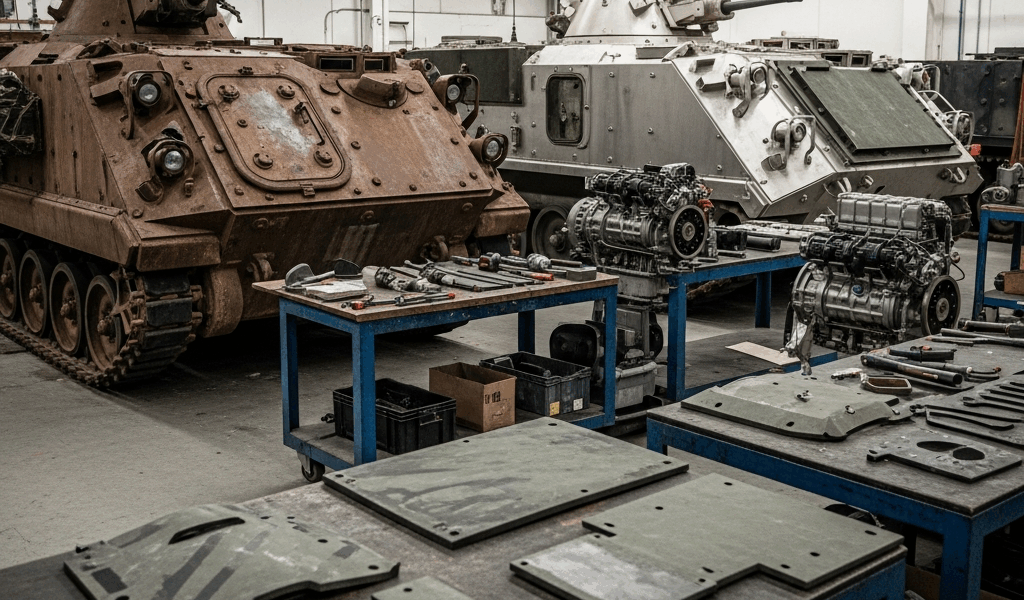
Why M113 Upgrades Matter More Than New Builds
The M113 armored personnel carrier has been around since 1960. That’s over six decades of global spread—more than 80,000 units built across dozens of countries. When I first started digging into military vehicle modernization programs, I assumed older platforms would just get shelved. The reality turned out messier and way more economical than that.
Here’s the thing: militaries don’t ditch the M113 because replacing an entire APC fleet costs billions. A single modern APC runs $2–4 million depending on specs. Upgrading an existing M113? That’s $500,000–$1.5 million per vehicle. For nations running 500+ M113s, that’s the difference between a workable modernization program and financial disaster. Supply chains factor in too. Armies understand M113 logistics cold—parts availability, maintenance routines, crew training. Switching platforms means rewriting doctrine, retraining every mechanic, and gutting your whole procurement system. That institutional weight isn’t laziness. It’s risk management.
Engine and Mobility Upgrades Compared
The original M113A1 runs on a Detroit Diesel 6V53 turbocharged engine—212 horsepower. Frankly, adequate for 1970. For operational tempos today and heavier armor packages? Underpowered.
Turkey’s FNSS upgrade path tells you everything. FNSS, the Turkish manufacturer, developed the Pars and ACV families, essentially rebuilt M113 variants. They swapped the 6V53 for a Cummins QSB6.7 diesel, jumped power to 285 horsepower, and improved fuel efficiency by roughly 15–20%. Top speed climbed from 67 km/h to 90 km/h. Range jumped from 480 km to 600 km per tank. These aren’t marginal improvements—operationally significant.
Australia took a different angle with their M113AS4 upgrade. They kept the Cummins engine option but poured focus into transmission improvements and suspension tuning. Better acceleration, more predictable handling at speed—though top speed stayed in the 80–90 km/h band. The Australians valued reliability and maintenance simplicity over raw horsepower, which made sense for their threat environment and desert logistics.
Germany’s Fuchs-based upgrade (technically different platform, but worth mentioning for context) showed electro-hydraulic powertrains could squeeze more efficiency. Mercedes diesels with modern fuel injection added another 5–8% efficiency gain—though the bill climbed accordingly. Most NATO nations have landed on Cummins or MTU engines as the sweet spot between cost, performance, and supply chain accessibility.
Armor and Protection Modernization
Original M113 hulls used 5–7.5mm aluminum alloy construction. Works against small arms. Useless against shaped charges and modern kinetic threats. This is where it gets complicated because every kilogram of armor added kills mobility.
Modular add-on armor kits solved this practically. RAFAEL (Israel) developed bolt-on composite packages that add protection against RPGs and fragmentation—no hull redesign required. These kits sit on the exterior and come off if the M113 needs to return to transport duties. Cost ran roughly $200,000–$400,000 per vehicle, a fraction of complete redesign. Weight penalty was around 2,500–3,500 kg depending on coverage, which ate range but stayed manageable with upgraded engines.
Switzerland took a more integrated route. Their M113 upgrade incorporated ballistic steel inserts into the hull itself, blending protection with the aluminum core. Better weight distribution, turret traverse speed didn’t suffer—important for urban engagement. The catch: you can’t retrofit this to older hulls easily.
Australia combined external cage armor with selective internal panels. They protected the engine compartment and fuel cells—a straightforward decision that dramatically increased crew survivability in IED-heavy environments like Afghanistan. Probably should have opened with this section, honestly. Your vehicle protection hierarchy should drive upgrade selection, not the other way around.
The composite panel route, from companies like Plasan and IBD Deisenroth, offered weight savings over steel or internal inserts. A typical composite package weighed 30–40% less than equivalent steel but cost 2–3× more. Most NATO nations went with steel add-ons unless operating in extreme mobility-constrained environments like mountain warfare.
Turret and Weapon System Upgrades
The base M113 came with a simple machine gun mount. Modern variants need integrated fire control, stabilized weapons, networked targeting. Remote weapon stations (RWS) became standard.
The 25mm chain gun emerged as NATO’s baseline. The Netherlands and Germany adopted the Bushmaster 25mm RWS—significant anti-materiel capability without a full stabilized turret’s cost or complexity. The 25mm round has good velocity, decent armor penetration against light vehicles, and lighter logistical overhead than 30mm or larger ammunition. Recoil management stayed cleaner, meaning less structural stress on aging aluminum hulls.
Turkey and some Southern European nations preferred 30mm options. The Mauser MK30 and similar weapons offered greater lethality against UAVs, light armor, and fixed positions. The tradeoff: higher cost, increased recoil forces (requiring stronger mounting), heavier ammunition logistics. For nations running M113s in counter-insurgency roles, 25mm usually worked. For higher-intensity conflict scenarios, 30mm made more sense.
Fire control systems ranged widely. Israeli upgrades often integrated thermal imaging and ballistic computers. Swedish variants incorporated full stabilization with dual-axis tracking. The common thread: digitization. Older analog turrets got paired with digital fire control modules, optical improvements, NATO STANAG compliance for data-linking. This didn’t require complete turret replacement—modular upgrades bolted onto existing turrets, kept costs down.
One underrated upgrade was improved coaxial machine gun mounts. Synchronized 7.62mm coaxials with proper ranging and stabilization simplified crew workload and improved first-round hit probability. Not glamorous. Absolutely essential for combat effectiveness.
Which M113 Upgrade Program Sets the Standard
If I had to rank fielded upgrade programs by capability gains and realistic adoption footprint, four programs stand out.
First: Germany’s M113G3 upgrade. They paired a Cummins QSB6.7 engine (285 hp) with modern fire control and selective armor additions. The modular approach meant units could swap between transport, fire support, or NBC defense without major redesign. Over 4,000 German M113s went through this program starting in the late 1990s. Doctrine integration was clean—crews transitioned between old and new models. NATO standardization on radio systems and ammunition made logistics straightforward. This proved you could modernize legacy fleets at scale without breaking procurement processes.
Second: Turkish ACV-15/FNSS Pars. Technically a redesign rather than in-place upgrade, the Pars program showed what aggressive M113 modernization looks like. 285 hp engine, 90 km/h top speed, full digital fire control, modular armor. Over 2,000 produced for Turkish and allied forces. The real win: export viability—nations without brand-new APC programs could acquire Pars variants reasonably. This created a secondary market that sustained the original M113 ecosystem.
Third: Australian M113AS4. A minimalist upgrade focused on engine reliability and suspension improvements rather than armor creep. The Australians understood their operating environment and didn’t over-engineer for threats that wouldn’t happen. 280 vehicles upgraded with a straightforward path: better engines, improved transmissions, networked battle management systems. Doctrine remained light and mobile. This suited nations without unlimited modernization budgets.
Fourth: Swiss armor-integrated approach. Switzerland deliberately chose internal armor integration rather than bolt-on kits. Heavier, slower M113, but with superior protection-to-weight ratios ballistically. Useful for nations operating NATO’s central front where heavy armor mattered. Less practical for expeditionary forces.
Germany’s program wins on adoption scale and interoperability. Turkey’s wins on commercial viability. Australia’s wins on cost efficiency. Your choice depends entirely on doctrine: force projection, armor protection, or financial sustainability?
The M113 isn’t getting retired anytime soon. Upgrade programs will keep these vehicles relevant through the 2040s, at least. That’s not a failure of acquisition planning—it’s sound economics.

Stay in the loop
Get the latest military vehicles vault updates delivered to your inbox.