“`html
Bradley Fighting Vehicle vs M113 Armor Comparison — What Actually Matters in Combat
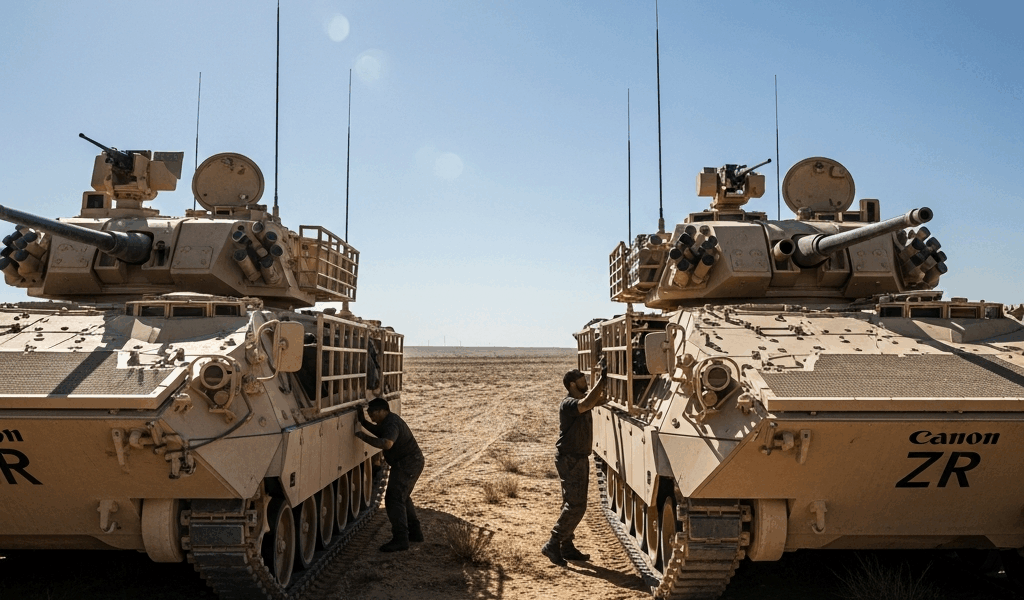
I’ve spent enough time reading armor specifications and combat after-action reports to know that comparing the Bradley fighting vehicle with the M113 isn’t just technical trivia — it’s the difference between which soldiers walk away from an IED blast and which ones don’t. These two platforms, separated by nearly two decades of development, represent fundamentally different answers to the same question: how do you move infantry into a fight while keeping them alive?
Design Origins and Deployment Context
The M113 hit the battlefield in 1960. Aluminum hull, fully tracked, capable of floating — it revolutionized Army mobility almost overnight. Fast, light, and genuinely amphibious. Then came the Bradley in 1981, a direct response to everything the M113 couldn’t do. Specifically, survive peer-level anti-armor fire while delivering meaningful firepower of its own.
That origin story matters because it explains why units still operate both platforms today. The M113 was designed for speed and logistics. The Bradley got built to win firefights — at least if you’re facing an enemy with armor-piercing rounds and RPGs. When you’re conducting peacekeeping in Bosnia, the M113’s lower silhouette and amphibious crossing capability made sense. Different story when you’re operating against enemy equipped with shaped-charge warheads.
Modern warfare didn’t eliminate either vehicle. It just clarified their roles. The M113 evolved into a platform for engineers, air defense crews, and support elements. The Bradley became the armored infantry backbone — and stayed there.
Armor Protection and Survivability
Here’s where the design philosophies diverge completely. The M113 uses aluminum armor — roughly 38mm at the hull front, which translates to moderate protection against small arms and fragmentation but minimal defense against shaped-charge warheads. Close-range rifle fire will punch through M113 side armor without serious resistance.
The Bradley A4 variant pairs steel and composite armor in a significantly lower profile hull. The exact thickness is classified, but independent assessments suggest front-arc protection equivalent to 60-70mm of steel against kinetic rounds. More importantly, the Bradley’s geometry and reactive armor add-ons — available on A3 and later variants — degrade shaped-charge penetration significantly. That matters.
Combat records from Iraq and Afghanistan revealed something uncomfortable: both vehicles took hits they weren’t supposed to survive. Insurgents armed with old Soviet anti-tank rockets scored kills on both platforms. But the hit survival rate — crew walks away or recovers the vehicle — heavily favored Bradley. The lower profile means fewer hit opportunities. The heavier armor means more hits absorbed. The compartmentalization means a hit forward doesn’t necessarily kill the entire squad in back.
Probably should have opened with this section, honestly, because armor is why the Army still fields Bradleys despite their higher cost and logistical burden. The protection differential is real.
The M113’s amphibious capability — it can cross rivers under its own power at 3.6 mph — gives it genuine operational flexibility that Bradley lacks. But that buoyancy comes from aluminum’s low density, which is exactly why it doesn’t stop bullets well. You choose mobility or protection. M113 chose mobility, and that choice came with tradeoffs.
Crew and passenger capacity reflects this tradeoff directly. The Bradley carries nine personnel: two crew, one dismount squad leader, six infantrymen. The M113 carries 11 passengers plus crew. That extra capacity matters in low-intensity operations where you’re moving support personnel, engineers, or liaison teams. In active combat? That 11th soldier in an M113 is more vulnerable simply because they’re sharing less armor volume with more people.
Firepower and Combat Capability
The Bradley mounts a 25mm M242 Bushmaster autocannon with 300 rounds of ammunition. That’s significant firepower. In Iraq, Bradley crews regularly engaged targets — light vehicles, fortified buildings, dismounted fighters — at ranges where the M113’s options couldn’t compete. It wasn’t even close.
The M113 comes in multiple variants. The base APC has no organic firepower beyond what passengers carry. You can get an M113 with a 12.7mm turret, essentially a heavy machine gun, which is adequate for suppressive fire. It won’t penetrate light armor or harden positions. Some international variants mount 40mm grenade launchers or even 20mm guns, but the standard U.S. M113 is a personnel mover, not a weapons platform.
That’s not a limitation in stability operations. I watched footage of M113-equipped units conducting cordon-and-search missions in Afghanistan during 2005. The vehicle’s minimal firepower was actually an advantage — less risk of over-response, easier to coordinate with dismounting infantry. The Bradley in the same role sometimes felt over-gunned. Context matters.
But peer conflict changes everything. Against an enemy with armored vehicles, the Bradley’s 25mm autocannon engages effectively out to 2,000 meters. The TOW missile launcher on most Bradley variants adds anti-tank capability the M113 simply can’t match. In 1991 and 2003, when Iraqi armor was in the fight, Bradley units achieved heavy kill ratios partly because they could shoot back effectively while the enemy was still out of RPG range.
Mobility and Logistics
The M113 does 40 mph on road. Gas turbine engine. Weighs 11 tons. It gets roughly 0.8 miles per gallon with a 200-mile range on internal fuel. That weight matters more than people realize: a C-130 Hercules can carry only one Bradley but can carry one M113 with cargo space remaining. For expeditionary operations, M113s deploy easier — no argument there.
The Bradley weighs 30.7 tons fully loaded, runs at 41 mph, and manages roughly 0.65 miles per gallon with better overall reliability in modern variants. That extra weight costs fuel and range — 190 miles on internal fuel — but the engine and transmission are more robust. An M113 that runs 10,000 hours starts showing transmission wear. Bradleys routinely exceed 15,000 hours.
Cross-country, the Bradley dominates the comparison. Its suspension handles rough terrain better. The weight distribution means it doesn’t get bogged down in mud that stops M113s. Longer track base, lower center of gravity, superior obstacle-crossing ability — those aren’t minor advantages in contested terrain.
Maintenance complexity is roughly equivalent, but parts availability differs significantly. M113 components have proliferated across 50+ countries, so you can often source parts locally in allied nations. Bradley parts are more restricted and centralized through U.S. supply chains. That matters if you’re surging operations and need immediate repairs on a 72-hour timeline.
Modern Upgrade Paths and Service Life
The Army is investing aggressively in Bradley variants — specifically the A4 model with improved fire control, the latest armor packages, and enhanced suspension. There’s a planned service life extension taking the A4 through 2035 or beyond. The Bradley Infantry Fighting Vehicle Upgrade program adds better ergonomics, electrical power, and maintainability improvements. This isn’t a platform being allowed to age gracefully.
The M113 gets incremental upgrades. Better engines, improved suspension, newer fire control if a variant is fitted with a turret. But the platform itself isn’t receiving major investment beyond replacing existing inventory. The Army recognizes that M113s occupy a niche role — it’s not being phased out, but new Bradleys aren’t being replaced by new M113s. The trajectory is clear.
Internationally, this matters enormously. Countries evaluating APCs often look at U.S. Army doctrine and procurement as a signal of which platform the U.S. genuinely prefers in combat. The Bradley’s long-term investment signals confidence. Nations buying Bradleys are buying a vehicle the U.S. Army will support and develop for another 15-20 years. That’s the bet they’re making.
Which Vehicle Wins for Your Mission
Planning peer conflict operations — armored maneuver warfare against a peer or near-peer adversary? Bradley is the only rational choice. The 25mm gun, armor protection, and firepower integration give squad leaders the ability to suppress enemy positions while dismounts assault. The M113 can’t do that job in 2024 conditions. Don’t make my mistake of thinking otherwise.
Operating in stability operations, humanitarian assistance, or lower-threat peacekeeping? The M113 makes sense. Lower cost — roughly $1.5-2 million vs $3-4 million for a Bradley — smaller logistics footprint, and that amphibious capability gives you operational flexibility in austere environments. It’s the right tool for that particular job.
The gray zone — where both platforms see simultaneous use — is mixed operations where threat levels vary. Forward Operating Bases need air defense and engineering support. M113 excels there. Dismounted infantry needs organic firepower and armor. Bradley excels there. Most modern Army rotations mix both because neither platform optimizes for all conditions.
The honest answer is that the Army fields both vehicles because they solve different problems. Trying to make an M113 carry armor protection it was never designed for is like trying to make a Bradley ford rivers under fire. Each vehicle succeeds at what it was built to do, and that’s enough.
“`

Stay in the loop
Get the latest military vehicles vault updates delivered to your inbox.