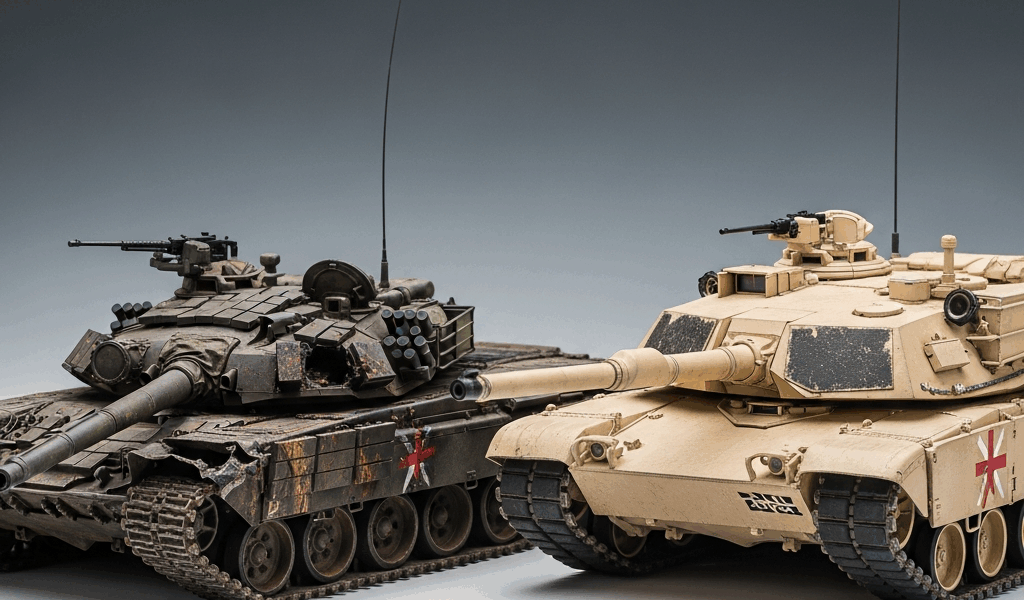
T-72 vs M1 Abrams — Why the Gulf War Was Not Even Close
The T-72 vs M1 Abrams matchup has grown more complex with the myth and revisionism flying around. What I found wasn’t just a story about better hardware. It was a story about a mismatch so complete, so total, that Western armies are still reorganizing their armor doctrine around it. The numbers alone are staggering — Coalition armor losses across the entire war were 36 M1s, none destroyed by Iraqi tanks. Iraq lost somewhere between 3,000 and 4,000 armored vehicles. That’s not a battle. That’s an erasure.
This article includes affiliate links. We may earn a commission at no extra cost to you.
Should call out at the start context instead of kill ratios, honestly. Side-step the error I made. Because without understanding what the T-72 actually was in Iraqi hands — and what the M1 Abrams actually was by 1991 — those numbers look like a fluke instead of a foregone conclusion. So let’s start with the specs, then get into the dirt at 73 Easting and Medina Ridge, where everything stopped being theoretical.
On Paper — Specs That Mattered and Specs That Did Not
The main gun comparison sounds close on paper. The M1A1 carried the 120mm M256 smoothbore — a licensed Rheinmetall design, built in Lima, Ohio. Iraq’s T-72s ran the 125mm 2A46 smoothbore. Bigger caliber. Sounds like a wash, maybe even an Iraqi edge. It wasn’t.
The M256 firing an M829A1 APFSDS round — crews called it the “Silver Bullet,” which tells you something about how they felt about it — could punch through over 600mm of rolled homogeneous armor equivalent at combat ranges. The 3BM17 and 3BM22 rounds available to Iraqi crews fell well short of that standard. Worse, the export T-72 variants shipped to Iraq came with further downgraded ammunition compared to what Soviet crews were actually issued. That gap is meaningful at 2,000 meters. At 3,000 meters, it’s decisive.
Fire control is where the spec sheet stops being interesting and starts being the whole story. The M1A1’s thermal imaging system — the AN/TAS-4 commander’s sight paired with the gunner’s primary sight — let American crews acquire, identify, and engage targets in complete darkness at ranges past 2,500 meters. The T-72’s night vision was a combination of active infrared and image intensification. Solid technology for 1975. Functionally irrelevant in a sandstorm in 1991 against an enemy who could see you clearly while you were essentially blind.
Battle of 73 Easting — Where the T-72 Was Exposed
The piece that matters most here. Because 73 Easting is where abstraction ended and physics began.
February 26, 1991. The 2nd Armored Cavalry Regiment was pushing northeast through the Iraqi desert in a sandstorm bad enough to drop visibility below 1,000 meters for the naked eye. Eagle Troop made first contact under Captain H.R. McMaster. They ran into approximately 28 T-72s and 16 BMPs dug into defensive positions with infantry support. The thermal sights on the M1A1s cut through the sandstorm like it didn’t exist. Eagle Troop destroyed all 28 T-72s and all 16 BMPs — zero M1A1s lost.
The engagement range problem cannot be overstated. American tank commanders described firing at T-72s that had no idea they were under attack until the round hit. The Iraqis weren’t cowards — a lot of them held position and kept fighting. They just couldn’t see their enemy.
Battle of Medina Ridge — The Largest Tank Battle Since WWII
February 27, 1991. The 1st Armored Division engaged the Medina Luminous Division along a seven-kilometer ridge line. The battle lasted roughly 40 minutes. The 1st Armored Division destroyed approximately 186 T-72s, 155 APCs, and 48 artillery pieces. American losses — zero M1A1s destroyed by enemy fire. It’s not a result that happens from technology alone.
Why the Gap Was So Large
Technology explains maybe 60 percent of the outcome. The other 40 percent is harder to quantify. Training, doctrine, ammunition quality, and crew competence all played decisive roles. For readers wanting to explore the full story in detail, M1 Abrams at War by Michael Green provides an excellent account with numerous color photographs covering the M1’s development and combat history.
T-72 Descendants Today — Has the Gap Closed?
Russia hasn’t stood still. The T-72B3 is a meaningfully different vehicle from what Iraq fielded in 1991. Ukraine has shown us something important about what happens when T-72B3s meet modern anti-tank systems and Western-supplied equipment. Russian armor losses since February 2022 have been catastrophic by any historical standard.
The T-72 is not a bad tank. It was never a bad tank. In 1991, Iraq had bad T-72s, badly trained crews, bad doctrine, and ran into one of the best-prepared armored forces ever fielded. The M1 Abrams didn’t win because it was American. It won because every layer of the system — training, doctrine, ammunition, optics, crew quality — was pointed in the same direction simultaneously.
For model builders interested in recreating the Gulf War matchup, both vehicles are available as highly detailed 1/35 scale kits from Tamiya — the M1A2 Abrams and the T-72M1 are both excellent builds.

Stay in the loop
Get the latest military vehicles vault updates delivered to your inbox.