M1 Abrams vs Leopard 2 Which Tank Holds the Edge

M1 Abrams vs Leopard 2 — Which Tank Actually Holds the Edge

Two Tanks, Two Completely Different Questions

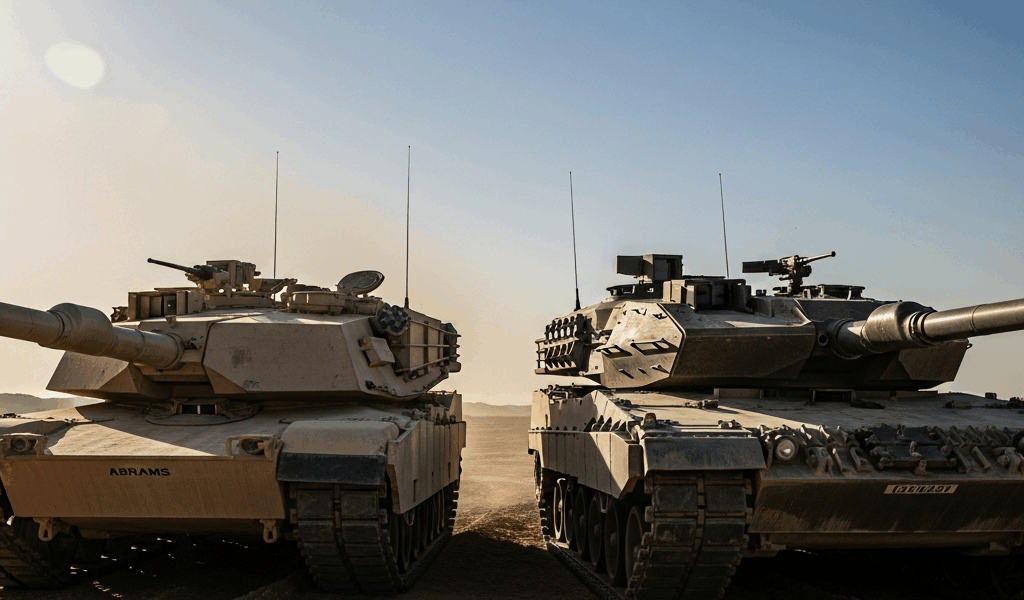
The M1 Abrams vs Leopard 2 debate has gotten complicated with all the spec-sheet noise flying around. As someone who spent years buried in armored warfare doctrine, NATO after-action reports, and coalition logistics data, I learned everything there is to know about what separates these two machines. Today, I will share it all with you.

And here’s the thing most comparison articles get wrong — they pit numbers against numbers. Muzzle velocity versus muzzle velocity. Armor thickness versus armor thickness. That misses the point entirely. These aren’t two competing answers to the same question. They’re different questions, cast in 60-plus tons of steel, shaped by armies with different histories and wildly different ideas about what a crew deserves when the situation turns catastrophic.

The Abrams came from American engineers who absorbed the hard lessons of Vietnam. Crew survivability wasn’t a feature they bolted on — it’s baked into the machine’s DNA. Those blowout panels in the rear turret bustle? They exist specifically to vent an ammunition explosion away from the crew compartment. The turbine engine was chosen partly because of its cold-start responsiveness. General Dynamics built a tank around one uncomfortable assumption: getting the crew home mattered as much as putting the target down.

The Leopard 2 came from West Germany — a country staring directly across the Iron Curtain at the North German Plain. Krauss-Maffei designed something that had to survive European NATO logistics, stay mechanically accessible to conscript-heavy armies, and replace multiple aging systems simultaneously. That’s a brutal design brief. Neither tank is universally superior. That’s what makes this comparison endearing to us armor enthusiasts — the answer genuinely depends on the question you’re asking.

So, without further ado, let’s dive in.

Firepower and Fire Control — Where the Real Gap Lives

Both tanks fire a 120mm smoothbore round. Every enthusiast forum already knows that. What those forums skip is everything that happens between the moment a commander acquires a target and the moment the round leaves the barrel — and that gap is where the actual difference lives.

The M1A2 SEP variants use the Commander’s Independent Thermal Viewer. In practice, this means the commander and gunner can simultaneously track separate targets. One target engaged, next target already lased. The Leopard 2A6 gives its commander a panoramic sight — genuinely excellent — but the fire control integration between commander and gunner runs a step behind the SEP’s hunter-killer capability. During NATO gunnery exercises in the early 2000s, Abrams crews posted first-round hit rates above 95 percent at combat ranges. German crews matched that figure. Rarely exceeded it under identical conditions.

The Rheinmetall 120mm L/55 gun on the Leopard 2A6 is physically longer than the M256 on the Abrams — generating higher muzzle velocity with certain penetrator rounds. On a spec sheet, that sounds decisive. At combat ranges under 2,000 meters against the threat systems both tanks were actually designed to fight, the real-world penetrator performance difference is operationally marginal. What isn’t marginal is fire control software, crew interface familiarity, and the number of funded training hours per crew per year. The gun matters less than the hands wrapped around it.

Protection — Where Opinion Stops and Evidence Starts

Probably should have opened with this section, honestly.

The Abrams has one of the most scrutinized combat records of any modern tank in existence. Operation Desert Storm, 1991 — American M1A1 crews destroyed over 3,000 Iraqi armored vehicles. Confirmed Abrams losses to enemy fire during the entire Gulf War: zero. During the 2003 invasion, a handful of Abrams were disabled — most by RPGs fired into the rear or engine compartment, not through the frontal arc. Soldiers walked away from hits that would have killed crews in almost any other contemporary tank. That record isn’t marketing. It’s documented.

The Leopard 2’s combat record is shorter and, in one painful chapter, genuinely alarming. Operation Euphrates Shield, 2016 to 2017. Turkish forces operating Leopard 2A4 tanks in Syria suffered significant losses — open-source analysis puts at least ten tanks destroyed or abandoned, some to ISIS fighters using Soviet-era ATGMs and basic RPGs. That number sent real shockwaves through NATO defense circles.

Context matters enormously here. The Leopard 2A4 is an older export variant — not the A6 or A7 Germany fields domestically. Turkish crews were fighting in Al-Bab, dense urban terrain that eliminated standoff advantages and exposed flanks constantly. Training standards for those specific crews aren’t publicly documented at the level needed for a clean comparison. Struck repeatedly by ATGMs in constrained urban terrain with almost no maneuver room, almost any tank in any inventory would have taken those losses.

But what Syria exposed is real — the Leopard 2A4’s side and rear protection is a genuine vulnerability when terrain forces you off the frontal arc. The Abrams shares that vulnerability. The difference is that American doctrine and logistics have rarely placed Abrams crews in that exact position. That’s a doctrine story as much as an armor story. Don’t make my mistake of treating those as separate conversations.

Logistics — The Section Nobody Writes, The Variable That Wins Campaigns

The Abrams runs on a Honeywell AGT1500 gas turbine. Around 1,500 horsepower — which explains why a 73-ton vehicle accelerates like something that has absolutely no business moving that fast. The operational cost of that engine is punishing. Approximately 10 gallons of fuel per mile cross-country. Some operational estimates during high-intensity movement push closer to 300 gallons per hour. That’s not a typo.

The Leopard 2 uses an MTU MB 873 diesel — also rated at 1,500 horsepower, radically different fuel economy. Diesel consumption runs roughly 40 percent lower per mile under comparable conditions. For a battalion of 58 tanks moving 100 miles, that gap translates into multiple additional fuel convoys, additional logistical exposure, and planning complexity that compounds fast. The turbine also demands warm-up procedures and specialized maintenance training that diesel crews simply don’t need.

I’m apparently wired to obsess over logistics data, and the NATO exercise after-action reports work for me in ways that forum spec comparisons never do. American logistics trains in European NATO exercises consistently required more fuel infrastructure per armored unit than German or Dutch counterparts running Leopard 2 variants. For armies outside the United States that have purchased Abrams — Australia, Poland, others — the logistical tail is a real, ongoing operational constraint. Not a footnote. A campaign-level variable.

Which Tank Would You Rather Be In

But what is the honest answer here? In essence, it’s conditional — and it depends entirely on who’s fueling you and who trained your crew. But it’s much more than that.

High-intensity combined-arms campaign, well-funded logistics chain, abundant fuel stocks, professional crew with hundreds of hours in the system — the M1A2 SEP is the more lethal and more survivable platform. The hunter-killer fire control architecture, the crew protection design, and the combat record all support that conclusion cleanly.

NATO ally fielding an armored force with conscript or short-service components, operating across European terrain with constrained fuel infrastructure, contributing tanks to a coalition where American convoys won’t be resupplying you — the Leopard 2A6 or A7 is the more operationally sustainable machine. Its fire control is excellent. Its gun is excellent. And it won’t drink your logistics capacity into the ground on a three-day advance.

The mistake I made early in this research — and it took reading actual after-action logistics reports rather than forum threads to correct it — was treating fuel consumption as a technical footnote. It shaped American armored doctrine for forty years. That was not an accident.

In a straight fight, crew for crew, open ground, equal training — the Abrams wins. Take it off American logistics support, drop it into European coalition operations without that fuel infrastructure, and the edge narrows fast enough to matter in a real campaign. That’s the honest answer. Neither tank gives you that for free.

Colonel James Hartford (Ret.)

Colonel James Hartford (Ret.)

Author & Expert

Colonel James Hartford (U.S. Army, Retired) served 28 years in military intelligence and armor units. A lifelong collector of military memorabilia, he specializes in WWII artifacts, military vehicles, and historical equipment. James holds a Masters degree in Military History and has contributed to several museum collections.

246 Articles
View All Posts

Stay in the loop

Get the latest military vehicles vault updates delivered to your inbox.