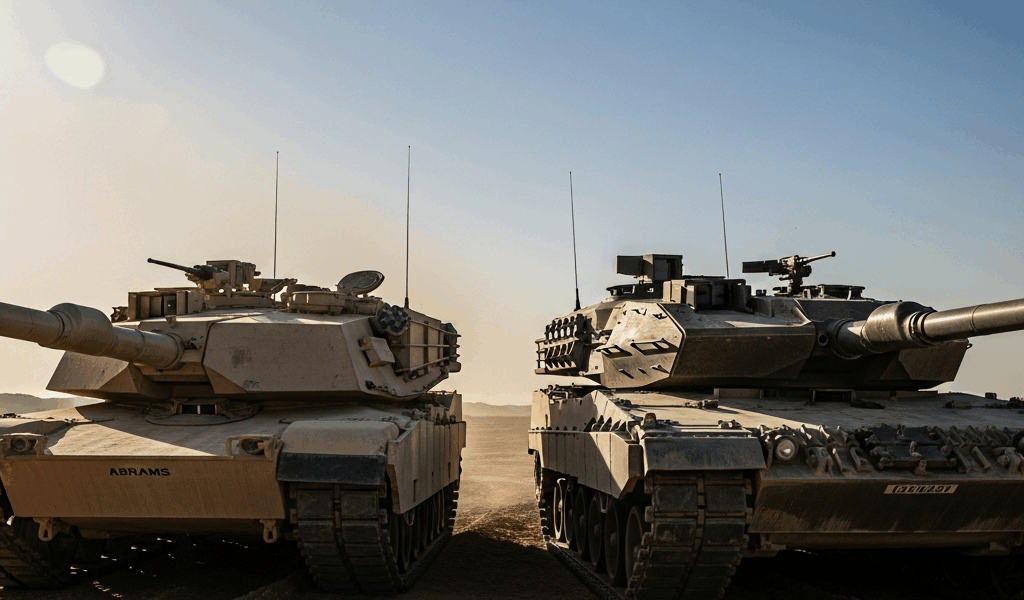
Short answer: there is no responsible one-word winner between the M1 Abrams and Leopard 2. In current configurations, both combine a four-person crew, manual loading, 1,500-horsepower powerplants, advanced thermal sights, and 120 mm smoothbore guns. The Abrams emphasizes U.S. digital architecture, protection upgrades, and a gas-turbine powerpack; the Leopard 2A7 family uses a diesel powerpack, a longer L55/L55A1 gun, and an extensive multinational support base. The better choice depends on the exact variants, ammunition, crew training, support network, terrain, and mission.
This article includes affiliate links. We may earn a commission at no extra cost to you.
This comparison uses the M1A2 SEPv3 and Leopard 2A7/A7V as modern reference points. “Abrams” and “Leopard 2” each describe families spanning decades. Comparing an M1A1 to a Leopard 2A7V—or a Leopard 2A4 to an M1A2 SEPv3—produces a different answer.
M1 Abrams vs Leopard 2: key differences
| Category | M1A2 SEPv3 Abrams | Leopard 2A7/A7V family |
|---|---|---|
| Crew/loading | Four; human loader | Four; human loader |
| Main gun | 120 mm M256, licensed from Rheinmetall L44 | 120 mm L55 or L55A1, depending on configuration |
| Powerplant | 1,500 hp gas turbine | 1,500 hp diesel |
| Published modern weight | Configuration-dependent; Army material lists up to roughly 73.6 U.S. tons | Bundeswehr A7V: 63.9 metric tonnes; KNDS lists configurations under 69 tonnes |
| Current protection examples | SEPv3 armor/protection upgrades; Trophy APS in the GDLS configuration | Enhanced modular protection; Trophy offered/fielded on selected modern configurations |
| Core logistics distinction | Turbine fuel demand and U.S.-centered sustainment | Diesel powerpack and broad European operator base |
Specifications are not perfectly comparable across national configurations. Optional armor, active-protection systems, communications, remote weapon stations, ammunition, and even published weight can differ within the same named variant.
First correction: neither tank uses an autoloader
Both the Abrams and conventional Leopard 2 have four-person crews: commander, gunner, loader, and driver. A human loader selects and loads the main-gun ammunition. This matters because several online comparisons incorrectly give one tank an automatic loader and then build a rate-of-fire verdict around that error.
Official U.S. Army coverage shows Abrams crew members loading 120 mm ammunition, while the Bundeswehr describes the Leopard 2A7 loader as a crew member who can also support the commander with tactical communications. Practical rate of fire therefore depends on training, ammunition arrangement, vehicle movement, fatigue, target sequence, and fire-control workflow—not an autoloader contest.
Firepower: related guns, not identical systems
The Abrams M256 and Leopard 2 gun family share Rheinmetall lineage, but it is misleading to say every modern version has “the same gun.” Rheinmetall’s 120 mm system overview identifies the Abrams M256 as a licensed version of the 44-caliber L44. Modern Leopard 2 configurations use the longer L55 or higher-pressure L55A1.
The L55’s longer barrel can produce higher muzzle velocity than the L44 with a given compatible ammunition type. That is a real technical advantage, but it is not a universal combat verdict. Ammunition, target type, range, impact angle, fire-control solution, barrel condition, and the exact armor package all affect the result.
Ammunition is also not interchangeable merely because both weapons use NATO-standard 120 × 570 mm rounds. The United States fields its own qualified ammunition family, including M829 kinetic-energy rounds and the M1147 Advanced Multi-Purpose round. German Leopard fleets use Rheinmetall families such as DM63A1, DM73, and programmable DM11. A force may use only ammunition cleared for its gun, fire-control software, pressure limits, and national safety rules.
Neither side publishes enough current, verified armor and penetration data to calculate a trustworthy “wins at X meters” result. Precise public numbers offered without test conditions and authoritative sourcing should be treated as estimates, not facts.
Sensors and first-shot effectiveness
Modern tank engagements depend on detection, identification, command networks, crew coordination, and a stable firing solution as much as raw muzzle energy. General Dynamics says the M1A2 SEPv3 includes advanced optics, an ammunition data link, improved communications, upgraded digital systems, and integration with joint battle-command networks.
The Bundeswehr describes the Leopard 2A7V as fully night-capable, with a laser rangefinder and thermal imaging in its main sight. Its stabilized 120 mm gun can use programmable DM11 ammunition; modern A7 upgrades also include improved optronics, command-and-control integration, power generation, and weapon stabilization.
Those descriptions establish that both are sophisticated hunter-killer systems. They do not provide a controlled head-to-head test. A comparison must account for upgrade package, software, sight generation, ammunition, maintenance condition, and crew proficiency before claiming a sensor advantage.
Protection and survivability
Both families use advanced composite armor, separated ammunition storage, fire suppression, and continuing protection upgrades. Exact armor composition and resistance are sensitive, configuration-specific information. Statements such as “the Abrams frontal arc is definitely stronger by X percent” cannot be substantiated from public manufacturer data.
General Dynamics describes SEPv3 as using upgraded armor, blast-survivability improvements, an updated protection package, and Trophy active protection capable of intercepting certain incoming rockets and anti-tank missiles. KNDS and Bundeswehr material describe enhanced protection on the Leopard 2A7 family, with Trophy integrated on selected configurations.
Combat losses do not isolate armor quality. A tank can be disabled or destroyed after mine strikes, artillery, drones, top-attack weapons, repeated hits, recovery failure, abandonment, or attacks against weaker aspects. Variant, tactical employment, supporting infantry, engineering, air defense, electronic warfare, recovery, and crew action all matter. Comparing a Turkish Leopard 2A4 loss in Syria directly with a U.S.-operated Abrams in a different war does not produce a controlled engineering test.
Mobility: turbine versus diesel
The Abrams’ 1,500 hp turbine offers strong power delivery and can operate on multiple approved fuels, but its fuel demand shapes planning. A U.S. Army safety publication lists an M1A2 at about 1.67 gallons per mile cross-country and roughly 10 gallons per hour at idle, while noting weight varies by configuration. The SEPv3 adds an under-armor auxiliary power unit so onboard systems can operate without running the main engine continuously.
The Leopard 2A7V uses a 1,500 hp diesel. Bundeswehr data lists 63.9 tonnes, up to 68 km/h, and approximately 280 km of combined road/cross-country range for its A7V configuration. KNDS lists A7 configurations below 69 tonnes and range up to 450 km, illustrating how assumptions and configuration change headline numbers.
The diesel generally offers a favorable fuel-logistics proposition, especially for armies already structured around European Leopard support. The Abrams’ burden can be managed by a force built around U.S. heavy-brigade logistics. Neither powerpack should be judged separately from tank transporters, fuelers, maintenance teams, recovery vehicles, spares, and the operating country’s industrial base.
Maintenance and multinational support
Leopard 2 is used in many European and allied fleets, which can create regional advantages in training, depots, parts, and shared modernization programs. Abrams operators benefit from a mature U.S. production, upgrade, and sustainment system. Poland’s operation of both families is a useful reminder that procurement is about alliance structure, delivery schedules, industrial agreements, and force design—not only a spec table.
Claims that one powerpack can always be swapped “in under an hour” while the other is inherently unserviceable oversimplify maintenance. Swap time depends on preparation, tools, recovery support, crew training, fault isolation, and whether a replacement powerpack is available. Operational availability data under comparable conditions would be more useful, but it is rarely public.
Which tank is better by scenario?
| Decision question | Likely emphasis |
|---|---|
| Force already tied to U.S. heavy-brigade logistics and ammunition | Abrams integration can outweigh theoretical platform differences |
| European operator joining a regional Leopard support network | Leopard commonality can reduce integration burden |
| Long-barrel kinetic-energy performance | Leopard 2’s L55/L55A1 is the relevant advantage |
| U.S. digital architecture and current U.S. ammunition ecosystem | M1A2 SEPv3 is built around that system |
| Fuel-constrained sustained movement | Leopard’s diesel deserves added weight in the decision |
| Crew survival against a specific threat | Needs variant-specific protection data and tactics; no universal public answer |
Verdict: system beats spec-sheet winner
The Leopard 2A7 family offers an efficient diesel powerpack, long L55/L55A1 gun, and strong European support ecosystem. The M1A2 SEPv3 combines a proven 120 mm M256, upgraded protection, Trophy in its current marketed configuration, a powerful turbine, and deep integration with U.S. communications, ammunition, and sustainment.
If both vehicles were stripped from their support networks and placed in a fictional duel, the answer would still depend on detection, ammunition, crew, position, range, and shot placement. Real militaries do not buy fictional duels. They buy a combat system that includes training, recovery, fuel, transport, spares, ammunition, software, and doctrine.
Bottom line: the Abrams is not automatically the “better protected winner,” and the Leopard 2 is not automatically the “easier tank.” The strongest answer is conditional: Abrams for forces optimized around the U.S. armored ecosystem; Leopard 2 for forces that benefit more from its diesel logistics and European operator network.
For another current NATO comparison, see our M1A2 Abrams vs Challenger 2 guide. Our iconic military vehicles guide places both tank families in a broader historical context.
Model builders can compare the external details through Tamiya’s 1/35-scale M1A2 Abrams and Leopard 2A6 kits. These are model-kit links, not evidence for the technical comparison.
Last fact-checked August 2026 against U.S. Army, General Dynamics Land Systems, Bundeswehr, KNDS, and Rheinmetall material. Public sources cannot establish classified armor performance or a universal combat winner.

Stay in the loop
Get the latest military vehicles vault updates delivered to your inbox.