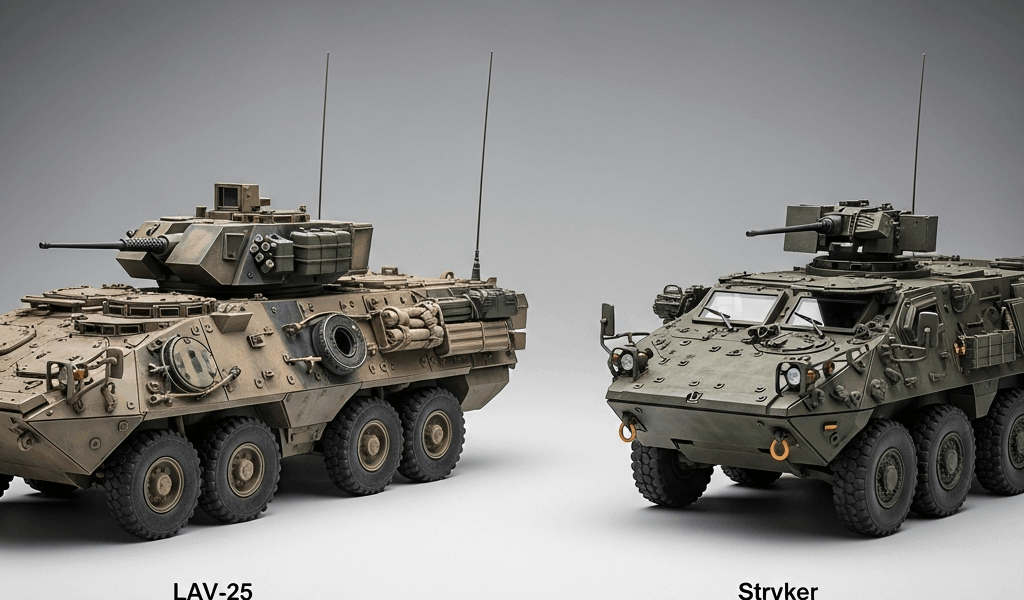
LAV-25 vs Stryker — Why They Look Alike but Do Different Jobs
The LAV-25 vs Stryker debate comes up constantly in military enthusiast circles, and honestly, I get why. Both are eight-wheeled wheeled armored fighting vehicles. Both can move infantry fast over roads. Both sit in that awkward middle ground between a heavy tank and a thin-skinned truck. From a distance — or from a photograph taken at a weird angle — they look like cousins. Maybe brothers. The thing is, once you dig into what each vehicle was actually built to do, the comparison starts to dissolve. These aren’t rivals. They’re tools designed for different hands, doing different work.
The visual similarity trips people up for a legitimate reason. Eight large run-flat tires. Sloped hull. Roughly boxy silhouette. Both sit around 7 feet tall and stretch past 20 feet long. If you’ve only ever seen them in thumbnails or background shots in a documentary, they genuinely look interchangeable. They’re not. The LAV-25 is a Marine Corps scout and infantry fighting vehicle with a 25mm autocannon mounted on a one-man turret. The Stryker ICV — Infantry Carrier Vehicle — is an Army transport platform. One is armed for a fight. The other is designed to carry soldiers to one.
That distinction matters more than any spec sheet comparison. Branch differences, mission profiles, and doctrine all shaped these vehicles before a single weld was laid. Keep that in mind through everything below.
LAV-25 — The Marine Recon and IFV
The LAV-25 entered Marine Corps service in 1983, built by General Dynamics Land Systems on a design derived from the Swiss MOWAG Piranha. The Marines needed something fast, light enough to be air-transported, and capable of operating with reconnaissance and light armor units. What they got was a genuine infantry fighting vehicle with real offensive punch.
The main armament is the M242 Bushmaster 25mm autocannon — the same gun on the Bradley IFV, which should tell you something about how seriously the Marines take the LAV’s fighting role. That gun can engage light armored vehicles, low-flying helicopters, and infantry in the open. Co-axially mounted is an M240C 7.62mm machine gun. The LAV-25 carries a crew of three: commander, gunner, and driver. It also carries six dismount passengers, seated in the rear hull. So the total occupancy is nine people, but the combat identity of this vehicle is firmly fighter-first, transport-second.
The numbers are worth sitting with. Combat weight is approximately 14.4 tons — significantly lighter than the Stryker. Road speed tops out around 100 km/h (62 mph). Cross-country it manages roughly 60 km/h. Range is about 660 kilometers on a full tank of diesel. And here’s the capability that defines the LAV-25 in Marine doctrine: it’s fully amphibious. No preparation needed. The vehicle swims using two waterjets at approximately 10 km/h. For a Marine Corps that plans amphibious assaults as a core mission, that isn’t a nice-to-have. It’s non-negotiable.
Probably should have opened with this section, honestly, because the amphibious capability is the single most important physical fact about the LAV-25. Everything about Marine Corps doctrine around this vehicle flows from it.
The LAV family includes a dozen or so variants — anti-tank (LAV-AT, with TOW missiles), mortar carrier (LAV-M), logistics (LAV-L), command (LAV-C2), and the recovery variant (LAV-R). The base LAV-25 is the fire-and-maneuver backbone. It operates in LAV companies attached to Marine Expeditionary Units and Marine Expeditionary Forces, doing the scouting and screening work that defines mobile, fast warfare.
Stryker ICV — The Army Infantry Carrier
The Stryker entered Army service in 2002, also built by General Dynamics Land Systems on the same MOWAG Piranha III platform that underpins the LAV family. That’s the reason they look so similar. They share DNA. The Stryker program was designed around the Army’s need for a rapidly deployable medium-weight force — something deployable by C-130 (at least originally) that could bridge the gap between heavy Abrams/Bradley units and light infantry.
The ICV variant carries a crew of two — driver and vehicle commander — plus nine fully equipped infantry soldiers. That’s the point. Getting nine riflemen somewhere fast, protected from small arms and shell fragments, ready to dismount and fight on foot. The base ICV is not an offensive weapon. The standard armament package is a remote weapon station mounting an M2 .50-caliber heavy machine gun or an Mk 19 40mm grenade launcher. Effective, but fundamentally defensive — covering the dismount, suppressing immediate threats, not prosecuting armored engagements.
Combat weight runs between 17 and 19 tons depending on configuration and appliqué armor packages. The Stryker hit the same 100 km/h road speed as the LAV-25. Here’s where it diverges hard from the LAV-25: the Stryker ICV is not amphibious. Early configurations had a flotation screen that allowed limited swimming capability, but the V-hull upgrade introduced after IED pressure in Iraq added weight that eliminated water crossing without engineering support. The Stryker needs a bridge or a ford.
Misled by the surface similarity, a lot of people assume the Stryker carries less firepower because it’s somehow a lesser vehicle. That’s the wrong read. It carries less firepower in the ICV variant because firepower wasn’t the job assigned to that variant.
The Stryker family is enormous. The Mobile Gun System (MGS) mounts a 105mm M68A1E4 cannon — the same caliber as older M60 Patton tanks. The Anti-Tank Guided Missile (ATGM) variant carries the BGM-71 TOW. The Mortar Carrier, Nuclear/Biological/Chemical Recon vehicle, Engineer Squad Vehicle, and Fire Support Vehicle round out a system that covers nearly every ground combat function. The Army built a whole combined-arms ecosystem out of this platform.
Key Differences That Matter Operationally
- Amphibious capability — LAV-25 swims. Stryker ICV does not. For Marine Expeditionary operations, this is a decisive difference. The Stryker was never designed to beach-assault.
- Main armament — LAV-25 carries the M242 Bushmaster 25mm autocannon as standard. Stryker ICV carries an HMG or grenade launcher. The LAV-25 can kill armored vehicles. The base Stryker ICV cannot.
- Passenger capacity — Stryker ICV carries nine dismounts versus LAV-25’s six. The Stryker is more of a bus; the LAV is more of a scout car that happens to carry troops.
- Weight — LAV-25 at 14.4 tons is meaningfully lighter, which supports its air-transportability and amphibious performance. Stryker’s heavier protection trades against strategic mobility.
- Branch and doctrine — USMC doctrine emphasizes speed, amphibious entry, and aggressive forward reconnaissance. Army Stryker Brigade Combat Team doctrine emphasizes rapid ground deployment and combined-arms flexibility at the brigade level.
- Family size and modularity — The Stryker family is more expansive at the system level, with the MGS 105mm variant giving the platform fire support the LAV family approaches differently through the LAV-AT’s TOW missiles.
The Verdict — Which Is Better?
Asked to compare these two early in my reading on armored vehicles, I made the mistake of treating the question as a straight performance competition — like comparing two quarterbacks. Wrong frame entirely. The honest answer is that “better” depends entirely on the mission, and the missions aren’t the same.
Fascinated by the amphibious question specifically, most analysts land in the same place: the LAV-25 is the more capable individual vehicle in terms of combined firepower and operational flexibility. It fights, it scouts, it swims, it moves fast. For a small unit operating independently in a contested littoral environment, the LAV-25 does more jobs per vehicle than the Stryker ICV.
But the Stryker system — the full family across a Stryker Brigade Combat Team — is more capable as an organizational force. The Army didn’t build a single multirole vehicle. They built an ecosystem of specialized platforms that work together. The MGS brings direct fire. The ATGM variant handles armor. The ICV delivers infantry. No single Stryker does everything; the brigade does.
So here’s the clean verdict: if you’re a military enthusiast asking which vehicle you’d rather have in a one-on-one scenario, take the LAV-25. It has a real gun, it swims, and it’s lighter. If you’re asking which program built a more complete ground combat system, the Stryker family wins by volume and modularity. If you’re a Marine planning an amphibious assault, the Stryker isn’t even in the conversation. These vehicles aren’t competitors. They’re answers to different questions.

Stay in the loop
Get the latest military vehicles vault updates delivered to your inbox.