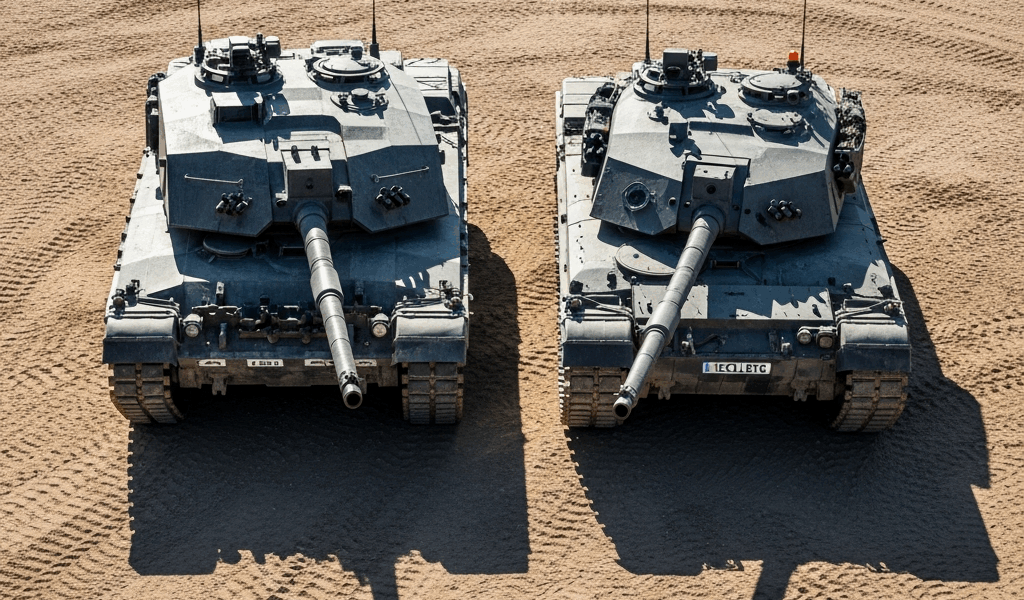
Challenger 2 vs Leclerc — How They Differ in Battle
The Challenger 2 vs Leclerc debate has grown more complex with the spec-sheet noise flying around. Most people frame this matchup completely wrong — they open a spec sheet, compare horsepower figures and armor thickness in millimeters, and call it settled. That misses almost everything that matters.
These two tanks weren’t built to solve the same problem. That shapes how they fight, how crews live inside them across days of continuous operations, and how each one holds up when things go badly wrong. So, without further ado, let’s dive in.
Two Tanks Built Around Different Priorities
But what is the Challenger 2, really? In essence, it’s a British main battle tank engineered around one obsession: keeping the crew alive. But it’s much more than that. The entire development program — overseen by Vickers Defence Systems in the late 1980s and formally accepted into British Army service in 1998 — was built on a single assumption: a tank will get hit, and it still needs to fight afterward. Survivability first. Everything else negotiates from there.
France took the opposite bet with the Leclerc. GIAT Industries, now known as Nexter, built a tank around speed, automation, and a reduced crew of three instead of four. The logic was clean enough — a faster tank that shoots accurately and relocates quickly is harder to kill than a heavily armored one parked in a hull-down position waiting to absorb punishment. Both philosophies are defensible. Both carry real trade-offs that show up under fire.
That split — survivability versus agility — cascades into every subsystem on both vehicles. Gun choice. Armor composition. Engine selection. Even turret geometry. Understanding that divide is the only honest way to evaluate how these tanks differ in actual battle conditions.
Firepower and How Each Tank Uses It
Here’s where things get genuinely interesting — and where most articles gloss over something critical. The Challenger 2 runs the L30A1 rifled 120mm gun. The Leclerc runs the CN120-26 smoothbore. Britain is the last NATO member still using a rifled main gun on a frontline main battle tank. That’s not stubbornness. It’s a calculated choice tied to the HESH round — a projectile the British Army values for defeating bunkers, light vehicles, and field fortifications. HESH doesn’t work well out of a smoothbore barrel. That matters in places where the target isn’t always another tank.
The downside is real, though. NATO’s standard 120mm smoothbore ammunition — the kind American M1A2 crews and German Leopard 2 crews draw from the same supply chain — is incompatible with the Challenger 2’s rifled gun. In coalition operations, British armored units can’t pull from a shared ammo pool. That logistical headache has surfaced repeatedly in joint exercises. It was also a significant driver behind the Challenger 3 upgrade program, for whatever that’s worth.
The Leclerc’s CN120-26 fires standard NATO smoothbore rounds, which simplifies resupply considerably. It also runs an autoloader — a carousel system that handles loading automatically and trims the crew from four down to three. On paper, that delivers a sustained rate of fire around six rounds per minute without a dedicated loader getting worn down mid-engagement.
The autoloader question deserves honest treatment, though. When it works, it’s a genuine edge. When it jams — and early Leclerc units in UAE service experienced serious autoloader reliability problems in desert conditions — a three-man crew has a much harder time recovering than a four-man crew with a human loader who can improvise on the spot. There’s no elegant workaround when a carousel system fails mid-firefight. The Challenger 2’s human loader is slower on paper, but considerably more adaptable under the kind of stress that doesn’t show up in exercise reports.
Protection and Survivability in the Field
Important part first — this is where real-world evidence is most stark.
Challenger 2’s Dorchester armor — a composite package from Chobham’s second-generation development program — remains one of the most closely held military secrets in the NATO alliance. Specific composition isn’t publicly confirmed. What is known: during the 2003 Iraq War, Challenger 2s absorbed multiple RPG hits, at least one MILAN anti-tank missile engagement, and in one documented incident, a single tank took over 70 RPG strikes plus a HESH round from another Challenger 2 in a friendly fire incident. The crew survived. The tank was repaired and returned to service. That was 2003.
One Challenger 2 was lost in Iraq — to friendly fire from another Challenger 2, which tells you more about battlefield confusion than armor weakness. That combat record in high-intensity urban combat is exceptional by any serious measure.
Leclerc’s combat record comes primarily from UAE service in Yemen, and it’s underreported in Western defense coverage. The UAE operates approximately 388 Leclercs and deployed them in the Yemen conflict starting around 2015. Results were mixed. Several Leclercs were destroyed or disabled by Houthi anti-tank guided missiles — 9M133 Kornet strikes, specifically. Some losses pointed directly to the tank’s lighter armor profile. Leclerc sacrificed protection weight for mobility, and in an environment saturated with modern ATGMs, that trade-off showed up in ways the spec sheets don’t capture.
To be fair — and I want to be fair here — the Yemen operational context involved brutal terrain, fragmented command structures, and complex urban ambushes that stress any armored vehicle regardless of pedigree. But compared against Challenger 2’s Iraq record when facing modern anti-armor threats, the gap in protection level is hard to argue away.
Mobility and Operational Logistics
The Leclerc wins this category without much contest. Its SACM V8X-1500 Hyperbar engine — a combined diesel and gas turbine setup producing 1,500 horsepower — delivers a top road speed around 72 km/h with considerably better acceleration than the Challenger 2 manages. In a rapid advance or a fighting withdrawal, that power-to-weight advantage is tangible. You feel it in tactical decisions, not just on performance charts.
The Challenger 2 runs a Perkins CV12 TCA diesel producing 1,200 horsepower in a vehicle weighing roughly 62.5 tonnes. Top road speed sits around 59 km/h. That’s not slow in any objective sense. But British crews have complained consistently about fuel consumption — the CV12 drinks diesel at a rate that strains forward logistics during high-tempo operations. Range on internal fuel is approximately 450 km under ideal conditions. Operational range in actual combat cycles runs considerably shorter.
Frustrated by recurring fuel complaints during extended exercises, British Army logistical planners have historically built more frequent resupply cycles into Challenger 2 deployments than comparable Leclerc operations require. The Leclerc’s powerpack is more fuel-efficient relative to its performance output — and the entire engine can be swapped in the field in roughly thirty minutes under ideal conditions. That maintainability feature matters enormously in sustained operations. Skip past the mistake I made of treating those numbers as trivia until you’ve watched an armored unit run dry twelve kilometers short of an objective.
I’m apparently wired to fixate on logistics first, and understanding that gap changed how I read every armored vehicle comparison afterward. Range and speed on a data sheet describe the vehicle in isolation. Operational mobility describes what the vehicle can actually do inside a supply chain that has to feed it, fix it, and move it across contested terrain simultaneously.
Which Tank Fits Which Mission
There is no universal answer here — at least not an honest one. Anyone who gives you one is selling something.
The Challenger 2 is the right tool for defensive operations in high-threat environments where protection is the overriding priority. Hull-down engagements at range, where the L30A1’s accuracy and Dorchester’s resilience can be maximized — that’s where this tank was born to operate. It was built for a European land war against Soviet armored columns. That DNA still shows. If you’re holding ground and expect to absorb punishment before delivering it, Challenger 2 is one of the most capable platforms NATO fields. Full stop.
The Leclerc makes more sense in rapid offensive maneuver — expeditionary operations where speed of deployment, logistical efficiency, and sustained rate of fire matter more than taking hits and driving away. The three-man crew is a real limitation in prolonged combat. For fast-moving combined arms operations where the tank’s job is exploiting breakthroughs rather than anchoring a defensive line, though, the Leclerc’s performance envelope fits the mission cleanly.
- High-threat defensive environment — Challenger 2
- Rapid expeditionary offensive — Leclerc
- Coalition interoperability — Leclerc (smoothbore ammunition compatibility)
- Long-duration crew survivability — Challenger 2
- Forward logistics simplicity — Leclerc
Both tanks are more capable than their public profiles suggest, and both have been consistently underestimated by analysts fixated on the Abrams and Leopard 2. If this comparison raised questions about how doctrine shapes hardware decisions, the site’s breakdown of the LAV 6.0 and the Abrams operational history covers similar ground from a different angle — worth reading alongside this one.

Stay in the loop
Get the latest military vehicles vault updates delivered to your inbox.