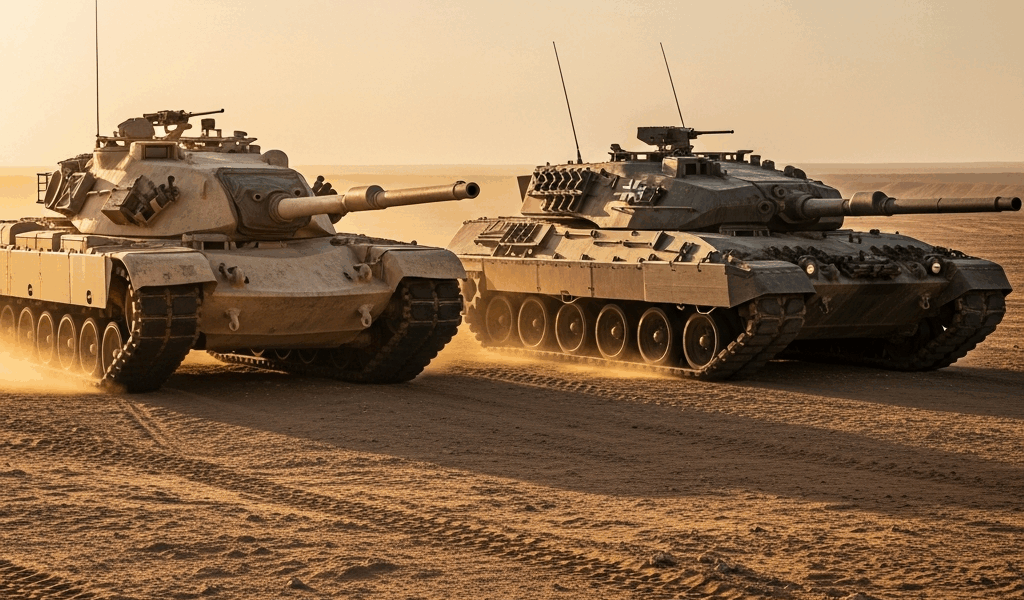
M60 Patton vs Leopard 1 — Which Came Out Ahead
Two NATO Tanks Built for the Same War
The M60 Patton vs Leopard 1 debate has started getting harder to follow with all the spec-sheet noise flying around. Everyone has a number to throw at you — armor thickness, horsepower ratios, gun penetration values — and somewhere in the middle of all that, the actual story gets lost. Both tanks entered service in the early 1960s with identical job descriptions: stop a Soviet armored column from punching through the North German Plain before it hit the Rhine. But the Americans and West Germans arrived at two genuinely different answers. The US wanted something that slotted into an existing logistics machine and hit hard. West Germany wanted a tank that moved fast, used terrain like a weapon, and never needed to win a slugging match to win a fight. Same war. Different philosophies entirely.
Armor, Firepower, and What the Numbers Actually Mean
Both tanks carried a 105mm gun derived from the British Royal Ordnance L7. That part everyone agrees on. What gets glossed over is that the fire control systems wrapped around those guns were nowhere near equivalent — at least not in their early production years. The M60 went into service with a coincidence rangefinder. Skilled crews in favorable conditions could work with it. Everyone else struggled. The Leopard 1 eventually moved to a far more capable setup, and later variants — the 1A3 and 1A4 specifically — introduced welded turrets and improved fire control that closed the target acquisition gap considerably.
But what is the real armor story here? In essence, it’s a doctrine argument. But it’s much more than that. People look at the Leopard 1’s turret face — roughly 70mm of steel versus the M60’s more substantial protection — and call it underarmored. That reading misses the point entirely. West German planners made a deliberate call. A tank sitting still long enough to get hit by a T-62’s 115mm gun is already losing. A tank fast enough to reposition before the Soviet gunner can track it — that tank changes the whole equation. The Leopard 1’s MTU MB 838 engine pushed 830 horsepower, giving it a power-to-weight ratio around 19.6 hp per ton. The M60 managed roughly 14.4 hp per ton. On paper, that’s just a number. Across the Harz Mountains or through the Fulda corridor, it’s the difference between being exactly where the enemy expects you and being somewhere else entirely.
The M60 was heavier, better protected against direct fire, and a logistical dream for American planners who already had spare parts, training pipelines, and fuel infrastructure built around its predecessors. Armies run on familiarity as much as they run on diesel. That’s not a small thing.
How Each Tank Performed When It Actually Mattered
Worth mentioning before anything else — real field data tells you more than any armor thickness table ever will. So, without further ado, let’s dive in.
Israel ran M60s hard. October 1973, Yom Kippur War — IDF armor, including M60 and upgraded M48 Patton units, absorbed a shock assault from Egyptian and Syrian forces equipped with Soviet AT-3 Sagger ATGMs and T-55/T-62 tanks. The Sagger was devastating in those opening hours. M60 losses were significant. The IDF adapted mid-battle, developing infantry-armor coordination techniques that military schools still study today. The M60 itself proved it could take hits, keep crews alive in some cases, and stay in the fight after battlefield repairs. Not fragile. Heavy, predictable, and maintainable under fire.
Leopard 1 combat history is thinner on dramatic engagements. Canada, Belgium, the Netherlands, Norway, Denmark, and Australia all ran them — but no large-scale peer conflict came during the Cold War. Partly luck. Partly geography. The most useful operational data came from Australian Leopard 1s in exercises and Canadian units deployed in Germany with NATO’s 4 Canadian Mechanized Brigade Group. Operator feedback kept emphasizing the same things: ride quality, mechanical reliability, how straightforward crew training was compared to heavier platforms. Australian crews apparently valued the gun handling particularly. I’m apparently someone who trusts that kind of feedback over contractor brochures, and consistently that approach works for me while pure spec comparisons never quite capture the full picture.
Export Market Showdown — Who Bought What and Why
Here’s the angle that almost never gets covered properly. When NATO allies went shopping for a main battle tank through the 1960s and 1970s, the choice between the M60 and Leopard 1 wasn’t purely technical. It was political, financial, and in some cases entirely personal.
Frustrated by dependence on American hardware, West Germany actively promoted the Leopard 1 as a European alternative — using straightforward pitch meetings with allied defense ministries and cold hard delivery timelines. The argument was simple: buy European, support German industry, get a tank genuinely optimized for the terrain your soldiers will actually fight on. Belgium chose the Leopard 1. The Netherlands followed. So did Norway, Denmark, and eventually Canada — operating alongside British and German forces in the BAOR structure. Canada’s procurement of 114 Leopard C1 tanks in the mid-1970s at approximately $1.5 million CAD per unit locked in decades of training schedules, spare parts contracts, and operational doctrine. That was a generational commitment.
Countries that stayed with the M60 generally had stronger ties to American military aid programs or already had deep M48 logistics infrastructure making transition costly. Iran under the Shah purchased over 900 M60A1 tanks before 1979 — a fleet decision driven as much by the US Foreign Military Sales program and political alignment as by any head-to-head performance review. Jordan, Saudi Arabia, and Egypt landed in the M60 column through similar pathways. Skip past the mistake I made of assuming those procurement decisions reflected purely military judgment.
The Leopard 1 ultimately reached around 14 operators worldwide. The M60 family — counting all variants — exceeded that in sheer unit volume. Volume is its own argument. The M60 came with a support network smaller buyers simply couldn’t replicate with a German platform in 1974.
Which Tank Actually Came Out Ahead
— including the part where I refuse to give a clean single answer, but also refuse to give a non-answer.
The Leopard 1 was the more elegant design. It aged better through successive upgrades, exported cleanly across alliance politics, and reflected coherent doctrine from the ground up. Nations that bought it generally came away satisfied. The Leopard 1A5 variant — still fielded into the 1990s — remained a credible platform decades after the original left the drawing board.
The M60 was the more consequential tank. More were built. More were fought. It proved itself against modern ATGMs in 1973 — actual combat, not exercises — and its logistical backbone across the US Army and allied forces was without peer. Not glamorous. Dependable at industrial scale.
If the mission was a fluid NATO defense across West Germany’s terrain, the Leopard 1 probably fit that doctrine better. If the mission was equipping a dozen allies with a tank they could actually sustain in the field for thirty years, the M60 wins. Neither answer is wrong. Both tanks served as bridges to the generation that followed — the M1 Abrams and Leopard 2 — platforms that absorbed everything learned from these two and redefined what a main battle tank could do. This new idea took off several years later and eventually evolved into the armored dominance enthusiasts know and study today.

Stay in the loop
Get the latest military vehicles vault updates delivered to your inbox.