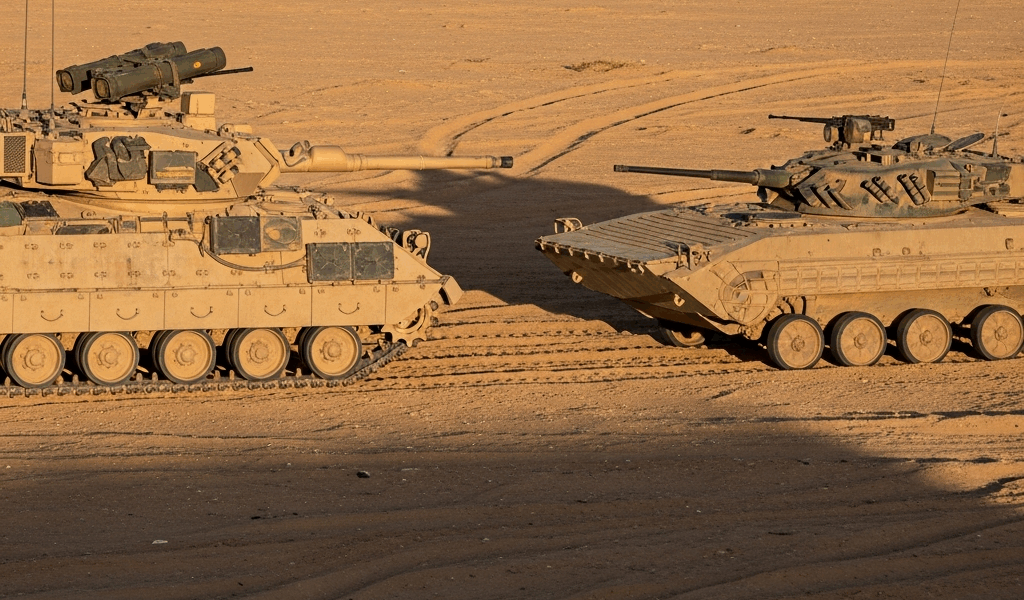
M2 Bradley vs BMP-2 — How They Stack Up in Battle
The M2 Bradley vs BMP-2 debate has shifted noticeably with all the spec-sheet arguments and armchair analysis flying around. — including the part most comparisons skip entirely, which is that these machines actually fought each other. In the Iraqi desert. In 1991. That’s not hypothetical. That has a body count attached to it.
Two IFVs Built for the Same War, Different Armies
But what is an infantry fighting vehicle, really? In essence, it’s a armored platform designed to move troops across a contested battlefield while keeping them alive and ready to fight. But it’s much more than that — it’s a compressed argument about what a particular army believes war actually looks like.
Both the Bradley and the BMP-2 grew out of the same Cold War anxiety. What happens when mechanized infantry has to push across a heavily defended European battlefield without becoming a slow, predictable target? The U.S. Army introduced the M2 Bradley in 1981 — after a development process that dragged, painfully, across most of the 1970s. The Soviet BMP-2 entered service in 1980, itself a direct response to problems the original BMP-1 exposed in actual combat.
Same problem. Completely opposite solutions.
The Bradley was expensive. Complex. Built around the idea that a squad of trained soldiers is worth protecting at significant cost. The BMP-2 was meant to roll off production lines in enormous numbers and push forward hard. Neither approach is wrong — they reflect genuinely different theories about what winning a war requires. So, without further ado, let’s dive in.
Firepower — 25mm Chain Gun vs 30mm Autocannon
On paper, the BMP-2 edges ahead on caliber. Its 2A42 30mm autocannon throws a heavier round than the Bradley’s M242 Bushmaster 25mm chain gun — maximum rate of fire around 550 rounds per minute in high-rate mode, effective against light armor out to roughly 1,500 meters. Genuinely impressive numbers.
Here’s where it gets more complicated, though.
The M242 Bushmaster — firing M791 APDS-T or M919 APFSDS-T rounds — reaches the same 1,500-meter effective range against light armor. And its fire control system is substantially more sophisticated than what the BMP-2 originally carried. The Bradley’s AN/VVS-2 driver’s vision system paired with the gunner’s integrated sight means that 25mm is being aimed accurately under conditions where the 2A42 is essentially pointed by feel and training discipline alone. Fire control closes a lot of caliber gaps. Probably should have led with that point, honestly — I initially got distracted by the 30mm vs 25mm argument and completely missed the targeting picture. Save yourself the trouble I had.
Both vehicles carry anti-tank missiles for reach beyond the autocannon envelope. The BMP-2 fires the 9M113 Konkurs — NATO designation AT-5 Spandrel — a wire-guided missile ranging out to 4,000 meters with penetration enough to threaten older main battle tanks. The Bradley carries the BGM-71 TOW system. The TOW-2B variant stretches to 4,500 meters with tandem warhead options. Neither crew wants to be on the receiving end of either missile. That’s the short version.
Protection and Survivability Under Fire
This is where the gap becomes significant — and where the two design philosophies stop being abstract.
The BMP-2’s armor was always a deliberate tradeoff. It protects against small arms and shell fragments across most of the hull. But its aluminum and steel construction tops out at roughly 33mm equivalent protection in the most generous assessments. The vehicle weighs about 14.3 tons. It was built to move fast and disperse, not absorb punishment. “Don’t get hit” is a valid doctrine — until you can’t maneuver out of the kill zone.
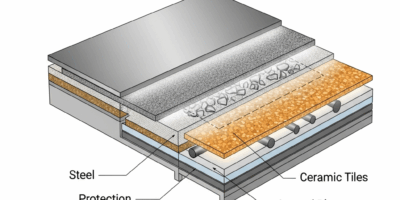
The M2A2 ODS configuration Bradley sits at around 27.6 tons, with appliqué steel armor added after the Gulf War surfaced some hard lessons. Its spall liner is a genuine crew-protection feature — when the outer hull takes a hit, the liner dramatically cuts fragmentation inside the crew compartment. The BMP-2 has no equivalent. That’s not a minor spec difference. That’s the gap between a vehicle that says “don’t get hit” and one that says “if you get hit, your crew should still function.”
The BMP-2 does win in one real dimension — its silhouette. It sits noticeably lower than the Bradley, making it a harder target at distance and better suited to hull-down positions behind natural terrain. In open desert or steppe, that matters. The Bradley’s height — roughly 2.97 meters — is a documented vulnerability that Army crews compensate for through positioning and discipline. It’s a real tradeoff, not a footnote.
Combat Record — Iraq, Chechnya, and Ukraine
Important part first. This is where the abstract comparison turns into something real.
Frustrated by decades of theoretical vehicle comparisons with no actual resolution, military analysts got their answer in February 1991 when U.S. Army Bradley units engaged Iraqi BMP-1s and BMP-2s across multiple engagements using the same doctrine and equipment both sides had trained on for years. The numbers from those after-action reports were striking. Army assessments credited Bradley IFVs with destroying more Iraqi armored vehicles than M1 Abrams tanks did — over 200 confirmed kills attributed to Bradley 25mm fire and TOW missiles. Iraqi BMP crews found themselves outmatched in nearly every exchange. Fire control disparities played a significant role. Degraded Iraqi equipment readiness played another. Those caveats matter — it wasn’t a clean laboratory test.
This new data point took on additional context several years later and eventually evolved into the broader survivability picture analysts know and reference today. In Chechnya, 1994–1996 and again in 1999, Russian BMP-2s operating in Grozny proved badly vulnerable to fighters using RPGs at close range. The armor held against small arms — as designed — but urban canyon terrain negated the low-profile advantage entirely and gave RPG teams the angles they needed on thinner side and rear armor. Dozens of BMP-2s were destroyed or abandoned in the first Grozny battle alone. A painful demonstration of what “don’t get hit” doctrine actually costs when you can’t maneuver.
In Ukraine since 2022, both vehicle types are in active use. Ukrainian forces received Bradley deliveries beginning in 2023. Russian and Russian-aligned forces continue fielding BMP-2s in significant numbers. Documented footage and battlefield reporting show Bradley survivability holding up under conditions that have mission-killed multiple BMP-2s — and that pattern lines up with what the 1991 Gulf War data suggested thirty years earlier.
Which One Would You Rather Be In
I’m apparently someone who reads too many after-action reports, and the Bradley works for me as the answer while the BMP-2 never quite makes the case for crew survivability. The honest answer — if someone is actively pointing weapons at you — is the Bradley. The protection philosophy, fire control integration, and spall liner represent a genuine advantage in the kinds of engagements both vehicles have actually faced. That’s not nationalism. That’s what documented outcomes across Iraq and Ukraine consistently show.
The BMP-2 wins on completely different terms. It was manufactured in enormous quantities — exported to dozens of armies across four continents — and costs a fraction of what a Bradley program costs to sustain. It’s faster in some configurations, lower-profile, and far easier to build at scale. Soviet doctrine never used IFV crew survival as the primary metric. Offensive tempo and raw numbers were the measure. By that measure, the BMP-2 has been a genuinely successful platform on a global scale.
While you won’t need to choose between them in any practical sense, you will need a handful of context to understand why this comparison still matters. First, you should recognize what each vehicle was actually optimized for — at least if you want the comparison to mean anything. The Bradley might be the best option for crew survivability, as modern combined-arms combat requires trained soldiers who survive to fight again. That is because replacing a vehicle is easier than replacing the crew experience inside it. Soviet doctrine disagreed. Neither position was irrational given the broader strategic math each army was working with.
The reason this comparison keeps coming up in 2024 is straightforward — both vehicles are on active battlefields right now. New data is being added to a comparison that has been running since 1991. The spec sheets stopped being theoretical a long time ago.

Stay in the loop
Get the latest military vehicles vault updates delivered to your inbox.