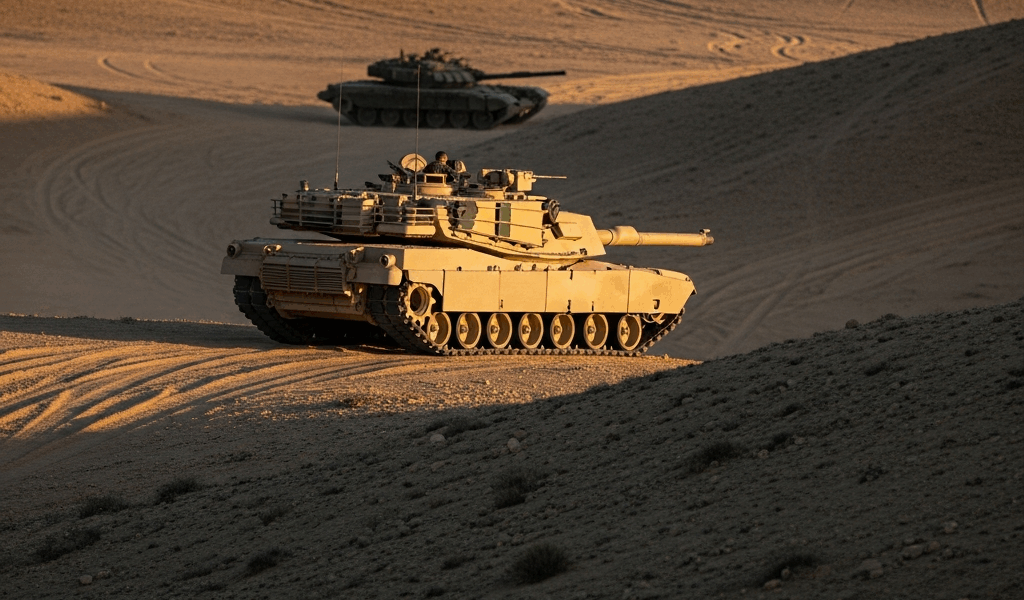
Two Tanks Built for Two Different Wars
The M1 Abrams vs T-72 debate has evolved with all the armchair analysis and YouTube breakdowns flying around.
Here’s the thing most people miss: the hardware comparison matters less than you’d think. The philosophy behind the hardware is everything.
The M1 Abrams was designed in the 1970s around one very specific nightmare scenario — stopping a Soviet armored thrust across the North German Plain. NATO planners expected outnumbered American crews grinding against sheer mass. So the M1 was built to keep those crews alive and let them shoot first. Chobham composite armor. A sophisticated fire control system. A 1,500-horsepower turbine engine that could push 68 tons faster than anyone had a right to expect.
The T-72 came from an entirely different set of demands. The Soviets needed something they could build by the thousands, load onto rail cars, and send anywhere in the Warsaw Pact — crewed by conscripts with weeks of training, not months. Low profile. Simple systems. An autoloader to shave off one crew member. It was a platform optimized for production volume and logistics, not for the guy sitting inside it.
Those two design philosophies — survivability versus scalability — collided in the Iraqi desert in 1991. The results were not subtle.
Armor and Survivability Side by Side
But what is Chobham armor? In essence, it’s a layered ceramic and steel construction developed at the British Royal Armament Research and Development Establishment in the late 1960s. But it’s much more than that — the specific composition is still classified, and the effect it produces on penetrating rounds has been documented extensively in ways the raw material list never could capture. The M1A1 variant fielded in Desert Storm also incorporated depleted uranium mesh into the armor package, which pushed protection against shaped charges and kinetic energy penetrators into a different category entirely.
The T-72 ran steel construction in its base form. Later variants — the T-72A, the T-72M1 — added more layers and eventually Kontakt-1 explosive reactive armor tiles bolted to the hull and turret. Iraqi T-72s in 1991 were a mixed fleet. Some had ERA packages. A lot didn’t.
The survivability gap that shows up most brutally in the after-action reports, though? It wasn’t about raw armor thickness. It was the autoloader.
The T-72’s autoloader carousel sits directly beneath the turret crew — 22 propellant charges and projectiles arranged in a ring under the commander and gunner. When a round penetrates the hull or turret and reaches that carousel, the result is catastrophic. Propellant ignites. Pressure builds faster than any blowoff panel can handle. The turret separates violently from the hull. American soldiers walking the battlefields after 73 Easting and the Kuwait City corridor reported T-72 turrets sitting 30 to 40 feet from their hulls. The phrase “jack-in-the-box effect” appears in multiple Gulf War after-action reports — shorthand for exactly this failure mode.
The M1 stores its main gun ammunition in a separate compartment at the rear of the turret, behind blast doors. A hit to that compartment triggers blowoff panels that vent the explosion upward and away from the crew. The crew compartment stays intact. M1 crews have walked away from direct hits that gutted their ammo supply entirely. That one engineering decision — propellant isolated from crew — saved lives in ways no millimeter rating ever will.
Fire Control Was the Real Gap
Here’s the part worth saying first. Because when you actually read through what happened in Desert Storm engagements, armor versus armor becomes almost secondary to what the fire control systems were doing.
The M1A1’s AN/GAS-1 thermal imaging system — the Gunner’s Primary Sight — operates in the 8–12 micron infrared band. Heat signatures. At night, through dust, through smoke pouring off burning oil wells, it produces a clear targeting picture. The ballistic computer pulls inputs from a laser rangefinder, a crosswind sensor, ammunition type, and cant angle, then generates a firing solution in milliseconds. In documented Desert Storm engagements, M1A1 crews were landing first-round hits at ranges exceeding 3,000 meters.
The T-72M1’s primary sight is the 1G46 — it includes a laser rangefinder, sure. But its night capability relied on active infrared illumination, which essentially meant shining a spotlight at whatever you wanted to shoot. In a contested environment, that’s a targeting beacon for the other guy. Iraqi T-72 crews during Desert Storm were frequently stuck on their TPD-K1 day sight, working optically, in darkness — trying to identify targets by shape and movement while American gunners were watching them in high-contrast thermal from two miles out.
This is not a marginal difference. Iraqi crews often didn’t know they were in an engagement until rounds were already hitting them. Multiple 2nd Armored Cavalry Regiment veterans described T-72s that never traversed their turrets before being destroyed — the Iraqi crews never acquired the threat that killed them.
The T-72’s 125mm 2A46 gun is genuinely capable — fires a potent APFSDS round that could penetrate M1 armor at close range under the right conditions. “Close range” is the operative phrase, though. Iraqi T-72 crews needed to close distance to be dangerous. American fire control systems turned that approach into a fatal journey.
What Actually Happened in the Gulf War
The 100-hour ground campaign in February 1991 produced engagement data that still shapes armored warfare doctrine. The Battle of 73 Easting on February 26, 1991 is the most studied single engagement. Elements of the 2nd Armored Cavalry Regiment — Eagle Troop, under Captain H.R. McMaster — hit a reinforced Iraqi armored brigade in a running fight through reduced visibility. In roughly 23 minutes, Eagle Troop destroyed approximately 28 T-72s, 16 other armored vehicles, and 30 trucks. American losses: zero tanks destroyed.
That was one troop, in one engagement, in 23 minutes.
Across the entire ground campaign, Coalition M1A1s destroyed over 3,000 Iraqi armored vehicles — T-72s, T-62s, T-55s, various APCs. No M1 Abrams was destroyed by enemy tank fire during Desert Storm. None. Several took RPG hits or mine damage. A small number were destroyed by friendly fire — tragic, and a genuinely separate issue from the tank-on-tank comparison.
Here’s the caveat that honest analysis requires, though. Iraqi tank crews in 1991 were not Soviet-trained professionals executing Warsaw Pact combined arms doctrine. Many were poorly trained, under-supplied, and had spent months in static defensive positions absorbing air strikes before the ground war ever started. Morale was broken in large portions of the Iraqi Army before armor ever met armor.
I’m apparently someone who gets accused of defending Soviet hardware — and that’s not what this is. Steer clear of where I went wrong of reading these numbers and concluding the T-72 was simply a bad tank. It wasn’t. It was a competent design that performed adequately in other conflicts. It was badly employed in 1991 by an army that had been misused, outmaneuvered, and isolated from its logistics. The hardware gap was real — but the human gap was at least as large.
Which Tank Would You Want to Crew
Ask any Gulf War veteran who crewed an M1 and you’ll get a fast answer.
The survivability architecture alone settles it. Separated ammunition storage. Blast doors between the fighting compartment and the ammo bustle. A crew of four with defined roles — rather than three people managing an autoloader that could kill them on a bad day. Thermal imaging that worked before dawn and through smoke. An escape hatch arrangement — driver’s hatch up front, two rear hatches on the turret bustle — that gave damaged crews multiple ways out.
The T-72’s three-man crew arrangement sounds efficient right up until the autoloader carousel catches a penetrating round. The crew compartment and the ammunition are neighbors. That proximity saved production cost and kept the silhouette low — and it left turrets on the sand 40 feet from their hulls.
It shows up not in spec sheets but in what’s still standing after the engagement ends.
What the Gulf War really demonstrated wasn’t just that the M1 outclassed the T-72 — it demonstrated that when the fire control gap is large enough, armor ratings become almost academic. The fights that defined 1991 were frequently decided before opposing crews even knew contact had been made.
So, without further ado, here’s the honest conclusion: equipment matters, but training, doctrine, logistics, and crew proficiency shape outcomes as much as any spec sheet ever will. The M1 was genuinely superior in fire control and survivability design. American crews were also better trained, better supported, and fighting with initiative. Separating those variables cleanly is impossible — and that complexity is the real lesson sitting in the sand of every armor engagement from that desert campaign.

Stay in the loop
Get the latest military vehicles vault updates delivered to your inbox.