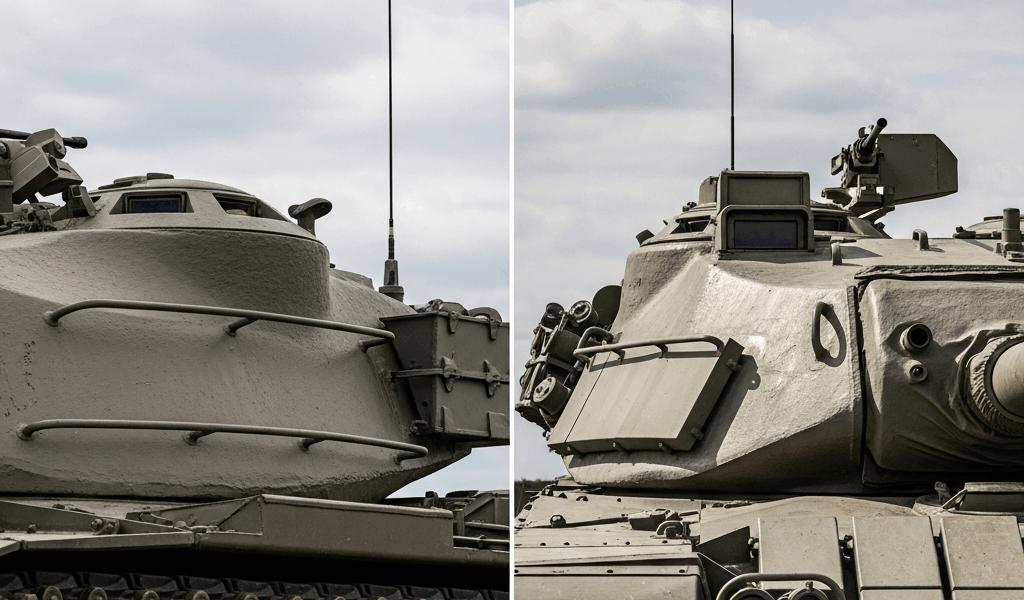
M60 Patton vs M48 Patton — What Changed and Why
The M48 Was Good Until It Wasn’t
The M60 Patton vs M48 Patton debate has started getting harder to follow with all the spec-sheet noise flying around.
The honest answer? The M48 wasn’t a failure. It just got overtaken by a problem nobody fully saw coming. The M48 entered service in 1952 — built around a simple assumption. A medium tank, a 90mm gun, a gasoline engine. Good enough for whatever the Soviets might push across the Fulda Gap. For a few years, that was reasonable thinking. Then the T-54 showed up. Not on paper — in Hungary, 1956, photographed and torn apart analytically by Western intelligence. The T-54 carried a 100mm gun. Lower silhouette. Mass production already underway. The M48’s 90mm M41 could punch through a T-54 under favorable conditions. Favorable conditions in actual combat are rare. That math started bothering people at the Pentagon, and honestly, it should have bothered them sooner.
What the M60 Actually Fixed
The jump from M48 to M60 wasn’t cosmetic. So, without further ado, let’s dive into the four changes that made real differences — not on paper, in the field.
The Gun — 105mm vs 90mm
But what is the M68 105mm rifled cannon, really? In essence, it’s a straight replacement for the old 90mm M41. But it’s much more than that. The M68 fired the M392 APDS round — penetration figures around 390mm of rolled homogeneous armor at 1,000 meters. Roughly 100mm better than the best rounds the M48’s 90mm could manage. Against a T-54’s 200mm frontal armor, that margin wasn’t academic. M48 crews needed a good angle and a close shot. M60 crews had more room for error. It wasn’t ambition, it was math.
Diesel Over Gasoline — This One Saved Lives
Worth saying out loud. The M48 ran a Continental AV-1790 gasoline engine. The M60 switched to the Continental AVDS-1790-2A diesel. Most writeups mention this and move on. They shouldn’t. Gasoline ignites at a flash point around 280°F lower than diesel’s real-world autoignition threshold — and crews knew exactly what that meant. “Brew-ups.” Korea. World War II. A penetrating hit in the M48’s engine compartment was a categorically different emergency than the same hit on a diesel vehicle. The switch to diesel wasn’t a fuel efficiency decision dressed up in engineering language. It was a survivability decision dressed up in logistics language. Save yourself the trouble I had of glossing over this point the first time you read about it.
Hull and Armor Geometry
The M60 wasn’t dramatically heavier — about 52 tons versus the M48’s 47 tons, depending on configuration. The hull was redesigned with a more pronounced glacis slope. The commander’s cupola was reworked to reduce that high-profile silhouette problem tankers genuinely hated on the M48. The original M48 cupola sat high. Visible. A billboard. The M60A1’s modified profile wasn’t perfect — nothing ever is — but it was lower and gave commanders better protected sightlines without advertising their position to everyone in the valley.
Range and Fuel Capacity
The M48 had an operational range of roughly 70 to 80 miles on internal fuel. The M60 pushed that to around 300 miles — partly because diesel is more energy-dense, full stop. For logistics planning across European terrain, that difference was enormous. Tankers don’t fight in isolation. They fight inside formations that need fuel trucks running behind them, and every extra mile of operational range shrinks that vulnerability window considerably.
Where the M48 Still Had the Edge
The M60 wasn’t a clean win across every category — and pretending otherwise is how you lose credibility with people who actually know these platforms.
The M48 was lighter. In export configurations, that mattered enormously. Bridges across the Middle East and Southeast Asia had load ratings where a 52-ton M60 became a logistical headache that a 47-ton M48 simply wasn’t. West Germany operated M48s deep into the Cold War period — maintenance infrastructure already established, crews trained, institutional knowledge baked in.
Crew familiarity was real. Trained M48 crews didn’t automatically become better tankers just because they climbed into an M60. Retraining took time, and in the short term, a well-drilled M48 crew outperformed a green M60 crew. That’s not an argument against upgrading. It’s a reminder that hardware doesn’t win fights by itself.
I’m apparently the kind of researcher who fixates on acquisition costs, and the M48’s lower price point in international arms deals works for that analysis while the M60’s premium never quite disappears. Jordan, Greece, South Korea — all operated M48s effectively well into the 1980s because budget was the binding constraint, not capability on paper.
How They Performed in Real Operations
The clearest real-world laboratory was Israel. The Israeli Defense Forces ran both tanks — M48A3s and M60A1s — in 1967 and 1973, often inside the same formations, against the same opponents.
Frustrated by the M48’s 90mm limitations against Soviet-supplied armor, Israeli engineers retrofitted the M48 with the same L7-derived 105mm cannon the M60 carried. Smart call. In 1967, those modified M48s performed well in the Sinai against Egyptian T-54s and T-55s — short, fast engagements at ranges where the 105mm was decisive. The gun mattered more than the platform in that conflict.
By 1973, the calculus had shifted. Egyptian and Syrian forces used ATGMs and Soviet anti-tank tactics that exposed the vulnerabilities of both platforms under sustained fire. The M60A1 showed better crew survivability in documented engagements — partly attributed to the diesel powerplant reducing post-penetration fires. Israeli after-action analysis specifically cited fuel system fire risk as a factor in M48 loss statistics. That’s a documented conclusion. Not speculation.
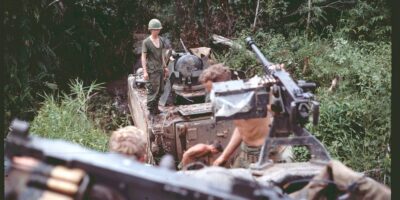
U.S. M48s in Vietnam operated in a context where anti-armor capability was largely irrelevant — no enemy tanks worth mentioning. Infantry support roles, 90mm effective enough, weight penalty manageable. No direct M60 vs M48 comparison ever emerged from that theater. Different war entirely.
Which One Deserves More Credit
The M60 deserves more credit — not because it was revolutionary, but because it was correct at a genuinely difficult moment in armored doctrine history. The Army identified specific, documentable weaknesses in the M48 and addressed them without waiting for a catastrophic combat failure to force the issue. That’s rarer than it sounds. The diesel engine decision alone reflected serious institutional acknowledgment that crew survivability after a hit mattered as much as avoiding the hit in the first place.
This new approach to tank design took off through the early 1960s and eventually evolved into the platform that Cold War armor enthusiasts know and study today. Designed against the T-54 threat, built before the hard lessons of 1973 were even available — the M60 still anticipated most of what those lessons would confirm. The M48 was a capable tank that did its job. The M60 was a capable tank that did a harder job better. That’s the distinction. The M48 gets the nostalgia. The M60 gets the more interesting engineering history. That’s the right outcome.

Stay in the loop
Get the latest military vehicles vault updates delivered to your inbox.