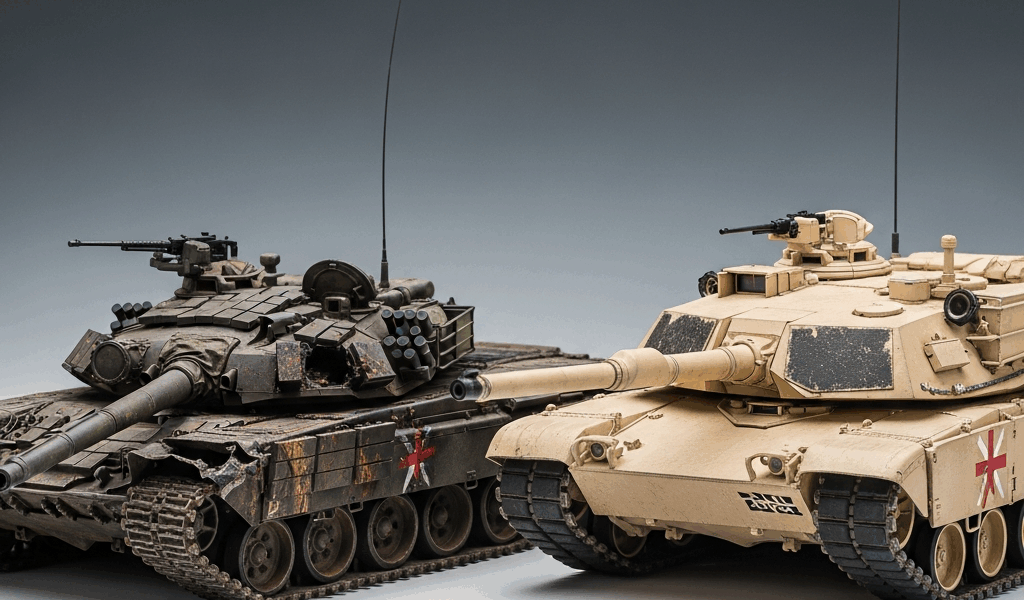
T-72 vs M1 Abrams — Why the Gulf War Was Not Even Close
The T-72 vs M1 Abrams matchup is probably the most studied tank engagement in modern military history, and I’ve spent a significant portion of my career going back through the after-action reports, crew testimonies, and engagement logs trying to understand exactly what happened in the desert in February 1991. What I found wasn’t just a story about better technology. It was a story about a mismatch so complete, so total, that it still shapes how Western armies think about armor doctrine today. The numbers alone are staggering — Coalition armor losses in the entire war were 36 M1s, none destroyed by Iraqi tanks. Iraq lost somewhere between 3,000 and 4,000 armored vehicles. That’s not a battle. That’s a rout.
I’ve made the mistake before of leading with kill ratios before explaining the context. Bad move. Because without understanding what the T-72 actually was in Iraqi hands — and what the M1 Abrams actually was by 1991 — those numbers look like an accident instead of an inevitability. So let’s start with the specs, then get into the dirt at 73 Easting and Medina Ridge, where everything became real.
On Paper — Specs That Mattered and Specs That Did Not
The main gun comparison sounds close on paper. The M1A1 carried the 120mm M256 smoothbore, a licensed version of the German Rheinmetall gun. Iraq’s T-72s were armed with the 125mm 2A46 smoothbore. Bigger caliber. Sounds like a wash, maybe even an Iraqi advantage. It wasn’t.
The M256 firing an M829A1 APFSDS round — the “Silver Bullet,” as crews called it — could penetrate over 600mm of rolled homogeneous armor equivalent at combat ranges. The 3BM17 and 3BM22 rounds available to Iraqi crews were significantly behind that standard, and the export variants of the T-72 sent to Iraq had further degraded ammunition compared to what Soviet crews would have used. That gap matters at 2,000 meters. It matters a lot more at 3,000.
The armor story is where it gets brutal. The M1A1 fielded during Desert Storm used a steel-encased depleted uranium matrix in its composite Chobham-derived armor package. Not all M1A1s had this — the variant was designated M1A1 HA (Heavy Armor), and units like 3rd Armored Division and 1st Armored Division were priority-equipped with it. The T-72M and T-72M1 variants in Iraqi service used steel and rubber composite armor. Effective, for its era. Against DU-penetrator rounds fired by an M256? The protection equivalence figures don’t hold.
Fire control is where the spec sheet stops being interesting and starts being decisive. The M1A1’s thermal imaging system — the AN/TAS-4 commander’s sight and the gunner’s primary sight — gave American crews the ability to acquire, identify, and engage targets in complete darkness at ranges exceeding 2,500 meters. The T-72’s night vision equipment was a combination of active infrared and image intensification. Decent technology for 1975. Irrelevant in a desert in 1991 against an enemy who could see you clearly while you were functionally blind.
There’s one spec I used to dismiss as secondary that I no longer do — crew ergonomics and reload time. The T-72 uses an autoloader for its 125mm gun, cycling at roughly 6 to 8 rounds per minute. Sounds competitive. But the autoloader was notorious for reliability issues in field conditions, and it completely removed the human loader who could, in a manual-loading tank, adjust for malfunctions. American crews with practiced loaders were hitting 10 to 12 rounds per minute in combat conditions at 73 Easting. Seconds matter when you’re the one being shot at.
Battle of 73 Easting — Where the T-72 Was Exposed
Probably should have opened with this section, honestly. Because 73 Easting is where abstraction ended and physics began.
On February 26, 1991, the 2nd Armored Cavalry Regiment was pushing northeast through the Iraqi desert in a blinding sandstorm, visibility under 1,000 meters for the human eye. Ghost Troop, Eagle Troop, and Iron Troop hit the 18th Brigade of the Tawakalna Division of Iraq’s Republican Guard somewhere around grid line 73 — hence the name. What followed lasted roughly 23 minutes for the initial engagement.
Eagle Troop, under Captain H.R. McMaster — yes, that H.R. McMaster, later National Security Advisor — made first contact. Nine M1A1s and twelve M3 Bradleys. They ran into approximately 28 T-72s and 16 BMPs dug into defensive positions, supported by infantry. In different conditions, dug-in armor with infantry support is a serious defensive problem. These weren’t different conditions.
The thermal sights on the M1A1s saw through the sandstorm and the smoke of burning vehicles as though it wasn’t there. Iraqi crews, relying on optical sights, couldn’t acquire the Americans at all at ranges beyond 800 to 1,000 meters. The M1A1s were engaging at 1,500 to 2,500 meters. Eagle Troop destroyed all 28 T-72s and all 16 BMPs. They lost zero M1A1s. The entire 2nd ACR engagement that day resulted in approximately 160 Iraqi armored vehicles destroyed.
The engagement range issue cannot be overstated. In the debriefs, American tank commanders described firing at T-72s that had no idea they were under fire until the round hit. The Iraqis weren’t cowards — many of them held their positions and kept trying to fight. They simply could not see their enemy. One crew account I found in the 2nd ACR after-action compilation described engaging a T-72 at approximately 2,200 meters, watching it brew up, and then engaging the tank next to it before the explosion had finished propagating. The second crew still hadn’t identified the threat.
The DU penetrator effect on the T-72 was also something that didn’t make it into many public discussions at the time. The M829A1 round didn’t just penetrate — it created a spalling and secondary fire effect inside the T-72’s crew compartment that was catastrophic. The T-72’s ammunition stowage in the carousel autoloader beneath the turret meant that a penetrating hit frequently cooked off stored rounds. The characteristic “Jack-in-the-box” effect — turrets blown completely off T-72s — was visible across dozens of vehicles at 73 Easting and became one of the defining images of the ground war.
Battle of Medina Ridge — The Largest Tank Battle Since WWII
February 27, 1991. One day after 73 Easting. The 1st Armored Division engaged the Medina Luminous Division — one of the most capable units in the Republican Guard — along a seven-kilometer ridge line near the Basra highway. This was the largest tank battle since the Yom Kippur War in 1973, and some historians argue it was the largest since Kursk if you count all armored systems engaged.
The 2nd Brigade of the 1st Armored Division made primary contact. They were equipped with M1A1 HA tanks — the heavy armor variant with the DU matrix. What they found on Medina Ridge was a prepared defensive position with approximately 300 Iraqi armored vehicles including T-72s, T-55s, BMPs, artillery, and anti-tank systems. This was not a disorganized force caught on the move. This was a defense-in-depth set up by people who knew how to fight armor.
The battle lasted roughly 40 minutes. The 1st Armored Division destroyed approximately 186 T-72s, 155 APCs, and 48 artillery pieces. American losses — zero M1A1s destroyed by enemy fire. There were some mobility kills from mines and one or two vehicles damaged by friendly fire incidents, but the Medina Division’s armor was effectively annihilated before most of their crews could get a clean shot at their attackers.
The kill ratio at Medina Ridge is what drives defense analysts to keep studying this engagement. The 1st Armored Division achieved something close to 300-to-0 in armor-on-armor kills. That is not a combat result that happens by accident, and it doesn’t happen purely from technology. Something systemic was different between these two forces.
Why the Gap Was So Large
Technology explains maybe 60 percent of the outcome. The other 40 percent is harder to quantify and gets ignored in most spec-sheet comparisons.
Start with training. American tank crews in 1991 were products of the National Training Center at Fort Irwin, California, where OPFOR units using Soviet doctrine had been hammering U.S. Army crews for a decade. NTC rotations were brutal, realistic, and specifically designed to simulate fighting against Soviet-equipped forces. Crews came out of NTC rotations knowing exactly how a T-72-equipped enemy would fight, how they would deploy, and where the vulnerabilities were. Iraqi crews had no equivalent preparation for fighting a thermally-equipped enemy at night.
The Iraqi T-72s were export variants — T-72M and T-72M1. Not the T-72B that Soviet divisions were actually fielding. The export models lacked the Soviet composite armor, lacked the latest fire control updates, and used downgraded ammunition. This distinction gets lost when people talk about “T-72 vs M1 Abrams” as though Iraq was fielding the same vehicle the Soviets had. They weren’t. The best Soviet T-72Bs had reactive armor packages and improved penetrators that might have changed some of the engagement calculations. The Iraqi versions had none of that.
Doctrine mattered enormously. Iraqi armor was used in static, dug-in defensive positions — exactly the employment method that maximizes American thermal-sight advantages at long range and minimizes the Iraqi ability to use terrain and movement for survivability. American AirLand Battle doctrine emphasized maneuver, combined arms integration, and deep operations. Iraqi doctrine was essentially static attrition from fixed positions. Against an enemy who can see through darkness and sandstorms from 3,000 meters, sitting still is a death sentence.
Ammunition quality is worth its own paragraph. American DU penetrators versus steel-core Iraqi rounds against Chobham-derived composite armor is simply not a fair fight. I went back through the vehicle damage assessments compiled post-war and found documented cases of T-72 rounds impacting M1A1 hulls and turrets at combat ranges and failing to penetrate. Meanwhile, M829A1 rounds were going through the glacis plate of T-72s like they weren’t there. Quality of ammunition may be the single largest contributing factor that pure spec comparisons miss.
T-72 Descendants Today — Has the Gap Closed?
Russia has not stood still. The T-72B3, which entered service around 2012 and received further upgrades through the 2016 B3M variant, is a meaningfully different vehicle from the T-72M Iraq was fielding in 1991. The Kontakt-5 explosive reactive armor package changes the calculus against older APFSDS rounds. The Sosna-U thermal gunner’s sight finally gives Russian crews a genuine thermal imaging capability. The 2A46M-5 gun with improved 3BM60 Svinets-2 ammunition closes some — not all — of the munitions gap.
But Ukraine has shown us something important about what happens when T-72B3s meet modern anti-tank systems and Western-supplied armor. Russian armor losses in Ukraine since February 2022 have been catastrophic by any historical standard. The Oryx open-source tracking project had documented over 2,000 Russian armored vehicle losses — including hundreds of T-72 variants — by mid-2023. The “Jack-in-the-box” turret-blow phenomenon is being documented regularly on T-72 variants that should have addressed that vulnerability.
The M1A2 SEPv3 — which incorporates improved Chobham armor, a Trophy active protection system option, upgraded electronics, and networking capabilities — represents a generational leap beyond what the Iraqis faced in 1991. Against a T-72B3, the thermal sight gap has narrowed, the ammunition gap has narrowed, but the doctrine and training gaps remain, and active protection systems represent an entirely new layer of survivability the T-72 family hasn’t adequately answered.
Fascinated by the Ukraine footage, I spent time comparing engagement distances and outcomes against the Gulf War data. The ranges are completely different — Ukraine is a closer-range, drone-dominated, anti-tank missile-saturated environment where the thermal sight dominance that decided 73 Easting matters less. That’s not evidence that the T-72 has closed the gap against the M1. It’s evidence that the battlefield itself has changed around both platforms.
The T-72 is not a bad tank. It was never a bad tank. In 1991, Iraq had bad T-72s, badly trained crews, bad doctrine, and faced one of the best-trained armored forces in the world equipped with technology that was simply beyond anything Iraq could counter. The M1 Abrams didn’t win because it was American. It won because every layer of the system — training, doctrine, ammunition, optics, crew quality — was pointed in the same direction at the same time. That’s the lesson of 73 Easting. That’s the lesson of Medina Ridge. And it’s one that defense planners are still learning from today.

Stay in the loop
Get the latest military vehicles vault updates delivered to your inbox.