The Short Answer Before We Break It Down
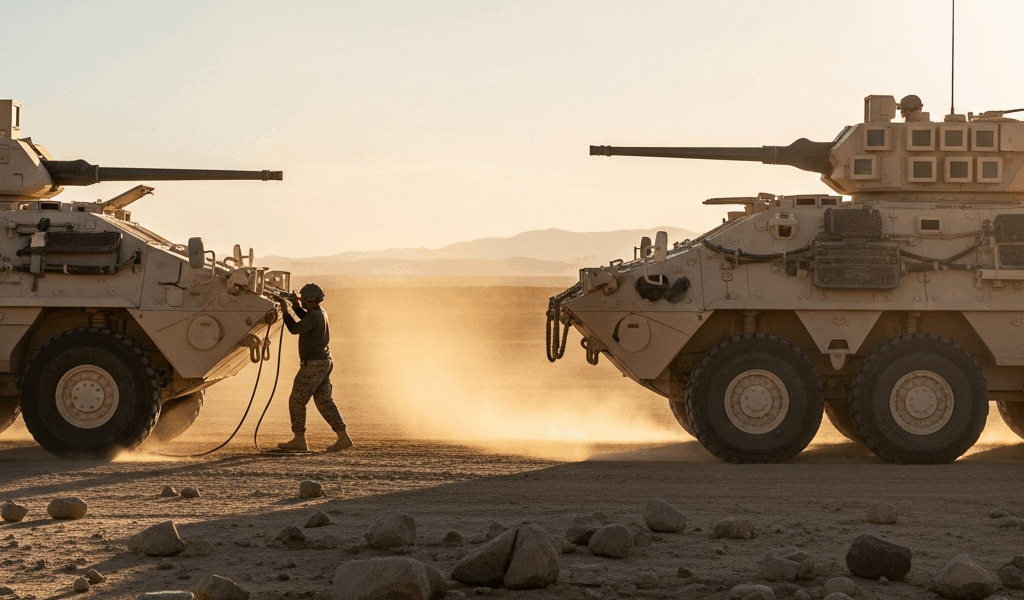
The LAV-25 vs Stryker debate has gotten complicated with all the half-baked comparisons flying around. So let’s just settle it. The Stryker ICV is the vehicle you want for sustained ground combat — where protection and infantry capacity are the variables that keep people breathing. The LAV-25 is what you want when speed matters, when there’s water between you and the objective, and when your bird is a C-130 leaving at 0300. Those aren’t the same fight. Treating them like they are produces a useless answer.
Everything else in this article justifies that call across five concrete dimensions. By the end, you’ll know which vehicle you’d actually want to be riding in — and why that answer flips completely depending on whether you’re rolling through Fallujah or staging for a Pacific littoral operation on 72-hour notice.
Mobility and Deployment — Where the LAV-25 Has a Real Edge
Both platforms are 8×8 wheeled systems, which already gives them a meaningful advantage over tracked vehicles on road networks and in fuel consumption. That’s where the similarity ends. The LAV-25 comes in around 14 tons combat-loaded. The Stryker ICV runs closer to 19 tons in theater configuration once you’ve bolted on the armor packages. Five tons sounds like a footnote. It isn’t. That’s a bridge rating. That’s a soft-soil crossing gone wrong. That’s the difference between a CH-47 lending a hand or banking away to find something lighter.
The LAV-25 swims. No preparation required — no inflation kits, no rigging, no waiting on an engineer assessment. It enters the water and moves at roughly 10 km/h on propellers. The Stryker does not do this. Full stop. That amphibious capability wasn’t an afterthought — it was the whole point for Marine expeditionary planners who need to cross rivers, conduct ship-to-shore movements in permissive conditions, and push through terrain that would stop anything heavier cold.
The C-130 compatibility piece is what actually closes the argument for rapid deployment missions. A single C-130J carries one LAV-25. That sounds modest — until you’re trying to stage a recon or light screening element into a forward location where C-17 access doesn’t exist. The Stryker needs a C-17 or sealift. That’s not a knock against it. It’s just a different category of vehicle for a different category of mission. I’ll be honest: I spent more time than I should have figuring out why Marine expeditionary planners still reach for the LAV-25 when the Stryker exists. The airlift math explains most of it.
Firepower — The 25mm Is the Same, but the Platform Changes Everything
This is where comparisons go sideways fast — mostly because writers keep conflating the entire Stryker family instead of picking a lane. The Stryker ICV, the Infantry Carrier Vehicle, is a troop mover. Its whole purpose is nine dismounts and a ride. The standard weapon fit is an M2HB .50-caliber or a Mk 19 grenade launcher on a remote weapon station. Self-defense, not fire support. It’s a battlefield taxi with teeth, not a fighting vehicle in the direct-fire sense.
The LAV-25 carries a two-man turret housing the M242 Bushmaster 25mm chain gun and a coaxial 7.62mm M240C. Three crew, four dismounts. The firepower is organic — it lives in the vehicle itself. Against light armor, crew-served positions, soft-skin vehicles — a section of LAV-25s delivers substantially more than an ICV section can match with an M2.
Now — the Stryker M1128 Mobile Gun System runs a 105mm cannon. That’s a completely different conversation and not what we’re doing here. Comparing an LAV-25 to an MGS is like comparing a linebacker to a field gun. The honest one-to-one is LAV-25 versus Stryker ICV, and on organic direct fire, the LAV-25 wins clearly. The XM813 30mm upgrade being fielded on newer Stryker variants is closing that gap. But the baseline ICV comparison still favors the LAV-25 — at least if the metric is what the vehicle itself can put downrange without calling for additional fires.
Crew Protection and Survivability in Combat
Probably should have opened with this section, honestly. It’s the one that determines whether anyone goes home.
The LAV-25 baseline protection is STANAG Level 3. It stops 7.62mm ball and fragmentation. It does not reliably stop RPGs. It does not stop EFPs. That wasn’t a theoretical finding — it came out of after-action reporting from Marines running LAV-25s in urban environments where the threat wasn’t what the vehicle was built to handle. Uncomfortable lessons, documented in writing.
The Stryker’s protection story is different, and it got that way through direct contact with an enemy who had RPG-7s and knew how to use them. After combat operations in Iraq starting in 2003, Stryker brigades started accumulating survivability data the hard way. What followed was a series of real upgrades: RPG slat armor — the cage armor you’ve seen in photos — the LASSO system, BUSK survivability kits adding belly protection against IED threats. None of that was on the original production vehicle. All of it came from operators who needed their platform to survive a threat environment nobody had fully anticipated in 2001.
Stryker brigades logged millions of operational miles in Iraq and Afghanistan under fire. Post-upgrade survivability numbers were credible. Crews walked away from contact that would have killed them in something lighter. The weight penalty is real — vehicles got heavier, and some of the original mobility advantages contracted. That’s the honest tradeoff.
The LAV-25 can accept add-on armor packages — the Marine Corps has fielded exactly that in certain configurations. But no add-on kit rewrites the vehicle’s original design priority. The LAV-25 was built to be fast and deployable. The Stryker, after Iraq, was built to keep people alive in sustained contact. Different hierarchies. Neither one is wrong for what it was designed to do.
Which One You’d Want Depends Entirely on the Fight
Sustained counterinsurgency in urban terrain, route security through a contested theater, a conventional fight against a near-peer force somewhere in Eastern Europe — take the Stryker ICV. The protection upgrades are real. Nine dismounts is real. Millions of operational miles across Iraq and Afghanistan is a documented record. You want that armor between you and an EFP buried in a culvert at grid reference nobody saw coming.
Rapid reaction deployment, Pacific littoral operations, riverine crossings, a mission where your vehicle needs to fit on a C-130 and be in the water within an hour of landing — take the LAV-25. Nothing else in the U.S. inventory at that weight class gives you that combination: amphibious without preparation, C-130 compatible, and a 25mm chain gun in an organic turret. That’s a specific capability set that the Stryker ICV simply wasn’t built to replicate.
- Stryker ICV wins on survivability, infantry capacity, and sustained operations
- LAV-25 wins on amphibious capability, strategic deployability, and organic direct fire
- Neither vehicle is obsolete — they answer genuinely different operational questions
The vehicle you’d want is the one that matches the mission — and if nobody has told you the mission before asking you to choose, that’s the problem to solve first. The LAV-25 and the Stryker aren’t fighting over the same job. They’re answering different questions about how to get protected firepower where it needs to be, fast. Don’t make the mistake of forcing a winner before you’ve defined what winning actually looks like.


Stay in the loop
Get the latest military vehicles vault updates delivered to your inbox.