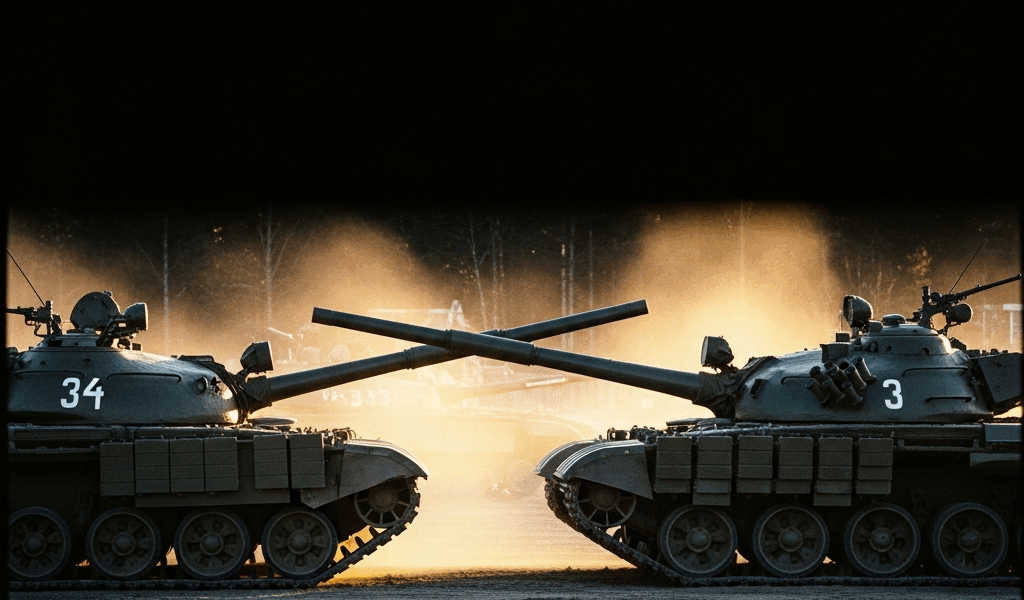
Two Tanks, One Army — Why the Soviets Did It
The T-72 vs T-80 debate has turned into a moving target with all the myths and misinformation flying around.
The puzzle that kept nagging at me: why would any defense establishment fund two separate MBTs, built by rival factories, running completely different engines, creating a logistical nightmare that cost billions of rubles? The Kharkov Locomotive Factory in Ukraine had spent the 1960s developing the T-64, and those engineers were convinced they owned the future of Soviet armor. The Ural Vagonzavod plant up in Nizhny Tagil had other ideas. They gave the world the T-72 — cheaper, simpler, and far easier to produce at scale. Instead of picking a winner, Moscow funded both. Classic committee logic.
But what is this two-tank strategy, really? In essence, it’s institutionalized rivalry dressed up as strategic planning. But it’s much more than that. There was actual doctrine underneath the bureaucratic mess. The T-80, carrying the Kharkov bloodline, went to elite front-line formations — specifically the units pointed at NATO’s central European axis. The T-72 was the mass-production workhorse, the tank you stamped out by the thousands for second-echelon armies and export customers. NATO analysts in the 1970s genuinely couldn’t figure out what they were looking at. That confusion was, apparently, the point.
Engine and Mobility Side by Side
So, without further ado, let’s dive into where these two tanks actually split in ways that mattered. The T-72 runs a V-84 diesel making around 840 horsepower. The T-80 uses a GTD-1000T gas turbine pushing 1,000 horsepower. On paper, turbine wins every time. In a Ukrainian field in February, it was a different story entirely.
Top road speed sits at roughly 70 km/h for the T-80 against the T-72’s 60 km/h. Acceleration is noticeably better. For a Soviet doctrine built around punching through the Fulda Gap at full sprint, that gap mattered. The turbine also fires up reliably at minus 40 — sounds great until you see the fuel bills.
The GTD-1000T burns approximately 1.8 to 2 times the fuel of the V-84 diesel at comparable speeds. Push a T-80 hard and its internal fuel load is gone in under two hours. Meanwhile the T-72 diesel delivers 450–500 km of operational range on internal tanks. The T-80 was closer to 335 km under real conditions. That’s not a minor footnote — that’s the difference between reaching your objective and sitting dead on the side of a highway waiting for a fuel truck that may never arrive.
Worth saying out loud. The fuel gap is the single most underreported reason the T-72 outlasted the T-80 as a program. You can bolt on new armor packages. You can swap out the fire control suite. Rebuilding your entire forward fuel supply chain is a fundamentally different and far uglier problem.
Armor and Firepower — Where They Actually Diverged
Both tanks fire the same 125mm 2A46 smoothbore gun. Both run a three-man crew using an autoloader — a distinctly Soviet solution that cut the turret profile down and eliminated the loader position entirely. That’s where the similarities start getting thinner.
The T-80U — the most capable Cold War production variant — received Kontakt-5 explosive reactive armor earlier and more thoroughly than any T-72 series variant. That matters because Kontakt-5, unlike the older Kontakt-1, works against kinetic energy penetrators, not just HEAT rounds. When British L26 or American M829 APFSDS rounds are flying downrange, that distinction is not academic. The T-80U also carried the 1G46 gunner’s sight with genuine thermal capability and a laser rangefinder that left early T-72 fire control in the dust.
The T-72B — the main Soviet-use upgrade package from the mid-1980s — closed some of that gap with its own Kontakt-1 ERA and improved fire control. Then the T-72B3 arrived post-2012, adding the Sosna-U thermal imaging sight, better ammunition handling, and a V-92S2F engine upgrade pushing 1,130 horsepower. Different machine entirely.
Here’s the misconception worth killing outright. Gulf War T-72 loss footage gets recycled constantly as proof the T-72 was a death trap. Those were T-72M and T-72M1 export variants sold to Iraq — deliberately downgraded fire control, deliberately reduced armor compared to what Soviet units kept for themselves. Judging the T-72 family by the Iraqi export version is like reviewing a car brand based exclusively on the decade-old rental fleet. Side-step the error I made of accepting that framing before digging into the actual variant specifications.
Autoloader Differences
The T-72 uses a carousel autoloader mounted in the hull floor. The T-80, in later variants, runs a conveyor-style system in the rear turret bustle. Neither is perfect — not even close. The T-72 carousel is faster under ideal conditions, but penetrate that hull floor and the stored propellant turns the tank into a brief, violent fireball. The “jack-in-the-box” effect — turret launching skyward — became a grim signature of T-72 combat losses. The T-80’s configuration offered marginally better ammunition separation in some configurations, though catastrophic kills stayed common on both platforms.
Combat Record — What the Wars Actually Showed
Frustrated by contradictory after-action reports, I spent months cross-referencing Grozny data from 1994–95 using Russian military journals and declassified Western assessments. The T-80BV losses in that first urban push were catastrophic — dozens of tanks gone in days. But calling that an engineering failure misreads everything that happened.
Russian forces entered Grozny in column formation, at night, without infantry support, into an urban environment where Chechen fighters had spent weeks pre-positioning RPG teams in basements and on rooftops above the approach routes. No tank — not an M1A1 Abrams, not a Leopard 2A6, not anything — survives that scenario without combined arms support. The Grozny losses were a tactical catastrophe built from command failures, not a verdict on the T-80BV’s engineering.
The Gulf War pattern runs parallel. Iraqi T-72M1s, crewed by undertrained personnel, were destroyed in volume by M1A1 Abrams tanks firing M829A1 APFSDS rounds. M829A1 would have punched through Soviet-spec T-72B armor at those ranges too — but the fire control gap between the M1A1’s second-generation thermal sights and what the Iraqi crews were working with was already decisive before the first round flew. Training and doctrine beat hardware. That’s what the data actually shows.
The honest read: neither tank underperformed its design specifications in these engagements. Both got let down by the operational conditions wrapped around them.
Which One Held Up Better in the Long Run
Surprised by the T-80’s near-total disappearance from Russian Army inventories during the 2000s, I went back through the actual retirement decisions. After the Soviet collapse, Russia’s defense budget fell off a cliff. Sustaining two completely separate MBT logistics pipelines — different engines, different spare parts ecosystems, different fuel requirements — was simply not financially survivable. The T-72 won that argument almost entirely on economics. That’s what makes it endearing to defense analysts who study how real military procurement works versus how people assume it works.
By 2010, the T-80 had been largely pulled from Russian ground forces — remaining stocks heading to storage, naval infantry units, or Pacific-facing formations. The T-72B3 modernization program, meanwhile, ran into the thousands of hulls. Not boutique upgrades. Genuine mass modernization at Soviet-era scale applied to a post-Soviet budget reality.
Ukraine shifted the T-80 story slightly. Ukrainian forces have operated T-80BVM variants — substantially updated with new fire control and current-generation ERA — with real effectiveness. I’m apparently wired to find that genuinely interesting, and tracking T-80BVM engagements works for me in a way that purely theoretical capability comparisons never do. But one conflict doesn’t reverse the overall program arc. The T-72 lineage became the global export standard, the foundation for the T-90 series, and Russia’s primary armor modernization path. Soviet-era production alone reached over 20,000 T-72 hulls. Total T-80 production landed somewhere around 5,000 to 6,000.
The T-80 was the more technically ambitious machine. The T-72 was the one that actually won — in production volume, export reach, and long-term relevance. This new two-track idea took off in the mid-1970s and eventually evolved into the sprawling T-72 export empire that arms dealers and defense ministries know and argue about today.
The Soviets built two tanks for two purposes. One became a Cold War footnote. The other is still being upgraded and destroyed in Eastern Ukraine in the same week. That’s not a quirk of history. That’s logistics winning, the way logistics almost always does when the shooting finally stops.

Stay in the loop
Get the latest military vehicles vault updates delivered to your inbox.