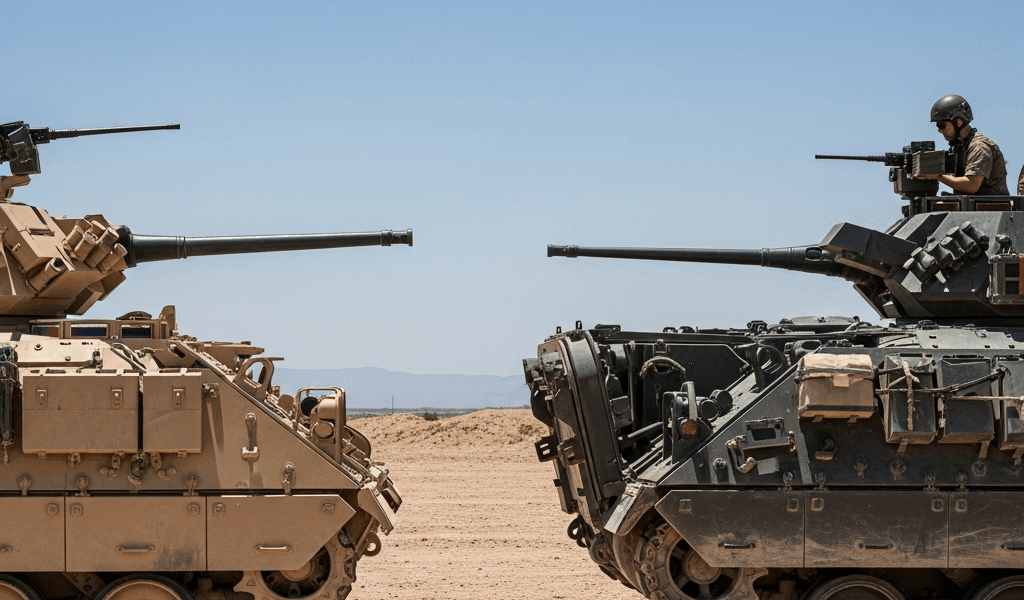
Same Hull — Different Purpose
The M2 Bradley vs M3 Bradley debate has evolved with all the half-answers and spec-sheet regurgitation flying around. As someone who spent years digging into Cold War armor doctrine — and who sat across from veterans who actually crewed these things — I figured out how to handle what separates these two variants. Today, I will share it all with you.
Both ride the same hull. Both mount the 25mm M242 Bushmaster chain gun, a coaxial 7.62mm M240C machine gun, and that twin-tube TOW launcher. Standing fifty feet away on a flight line, you cannot tell them apart. That’s where the similarity ends — and the interesting part begins.
The Bradley Fighting Vehicle program started in the 1970s as a replacement for the aging M113. What came out wasn’t one vehicle. It was two vehicles wearing the same uniform. The M2 existed to carry infantry into battle and fight beside them. The M3 existed to find the enemy before infantry ever got close. One is a delivery system with a gun. The other is an observation platform that fights when it absolutely has to. The doctrinal gap between those two sentences is enormous.
Crew and Dismount Differences
The piece that matters most here — because the crew numbers alone explain the entire philosophy behind each vehicle.
The M2 Bradley carries three crew: commander, gunner, driver. Behind them, six dismount soldiers ride in the rear troop compartment. Those six are the point. They exit, take ground, hold positions, clear terrain no tank can touch. The M2 exists to deliver them and then cover them with the Bushmaster and TOW if armor shows up.
The M3 also runs a crew of three. But the troop compartment holds only two scouts instead of six infantrymen. That’s not a flaw. It’s a deliberate trade. Four fewer passengers means room for additional 25mm ammunition and extra TOW rounds — the M3 carries ten TOW missiles versus the M2’s seven. More ammo. Fewer bodies. The vehicle is built to sit in one position for hours, watching, reporting, and when it does engage, sustaining that fight without resupply.
The two scouts in an M3 aren’t passengers in any meaningful sense. They dismount to set up observation posts, call for fire, mark positions, confirm what the vehicle’s sensors are picking up. It’s a specific job. Quiet. Small footprint. Skip past the mistake I made of glossing over this — understanding what those two scouts actually do explains every other hardware difference that follows.
Sensors, Optics, and Reconnaissance Equipment
But what is the M3’s optical advantage, exactly? In essence, it’s an enhanced day/night observation package the baseline M2 never received. But it’s much more than that.
This isn’t about a fancier screen in the turret. A cavalry scout crew needs to identify enemy formations, determine direction of movement, estimate strength, and transmit that information — ideally without ever being spotted themselves. The improved thermal imaging and long-range day optics on the M3 support exactly that. You pick up an enemy battalion moving south along a ridgeline at four kilometers. You do not shoot. You report. You track. You let the commander build a picture before anyone commits to anything.
The M2 crew can observe and report — absolutely. But their primary sensor is the infantryman who climbs out and looks. The M3 crew’s primary sensor is the vehicle itself. That single distinction shapes how crews train, how they position on terrain, how they communicate back to higher. I’m apparently wired toward the reconnaissance mindset after years of reading cavalry unit histories, and that framing works for me when explaining this — while “better optics” alone never really captures it.
How Each One Gets Used in Doctrine
Most writeups skip this section entirely. That’s a mistake. The hardware differences only make sense once you understand what each vehicle is actually supposed to accomplish on a battlefield.
The M2 lives in mechanized infantry battalions. In the Cold War scenario — Central Europe, specifically the NATO covering force problem that drove nearly every U.S. armor decision through the 1980s — M2s moved with tanks, suppressed enemy positions, and delivered infantry to seize key terrain. Infantry dismounts, clears buildings and treelines, holds ground tanks cannot hold. The M2 covers them. It is a combined arms machine, and it only makes sense as part of that combined arms team.
Frustrated by vague Gulf War accounts that never distinguished between variants, I started pulling unit records from 1991. What I found: both M2 and M3 variants were credited with kills during the ground campaign, but M3s were predominantly operating in cavalry squadrons — doing deep reconnaissance, screening VII Corps’ flanks during the left hook into Iraq. They found the Republican Guard formations. Fixed their positions. Told the heavy brigades what was coming. That was February 1991, and the M3 did exactly what it was designed to do.
The M3 fits into cavalry squadrons and armored cavalry regiments. It screens the force, conducts route reconnaissance, guards flanks, develops the situation ahead of the main body. It fights when necessary — not as the primary mission. One vehicle is the punch. The other is the eyes. That’s what makes this distinction endearing to armor historians who care about doctrine rather than just hardware specs.
Which One Matters More Today
This question gets framed as a competition constantly. So, without further ado, let’s push back on that framing directly.
The M2 and M3 aren’t competing designs. They’re complementary ones. The Army built both precisely because you cannot optimize the same vehicle for assault and reconnaissance simultaneously — the trades required pull in opposite directions. More dismounts versus more ammunition. Delivery platform versus observation instrument.
Both variants went through substantial upgrades across the decades. The M2A3 and M3A3 configurations introduced digital command and control systems, improved thermal sights, and better situational awareness displays — significant capability jumps over the original 1981 fielding. The core role separation survived all of it intact. An M3A3 in a cavalry troop today still does fundamentally what that original M3 was built to do.
The Bradley replacement program — specifically the XM30 Mechanized Infantry Combat Vehicle — is targeting the M2 mission first. Reconnaissance force replacement is a separate, messier problem. Unmanned systems are already performing parts of what M3 crews used to do on foot, which makes the future cavalry vehicle question genuinely complicated in ways the original M2/M3 split never was.
This new idea of disaggregated, sensor-heavy reconnaissance took off several years after the original Bradley fielding and eventually evolved into the integrated cavalry doctrine enthusiasts know and study today. The hardware was always downstream of the concept.
The real answer to the M2 versus M3 question isn’t the ammunition count or the optics package. It’s the doctrinal logic that made two vehicles out of one design — assault and reconnaissance require different tools, the Army figured that out forty years ago, and they built the solution into the same hull twice.

Stay in the loop
Get the latest military vehicles vault updates delivered to your inbox.