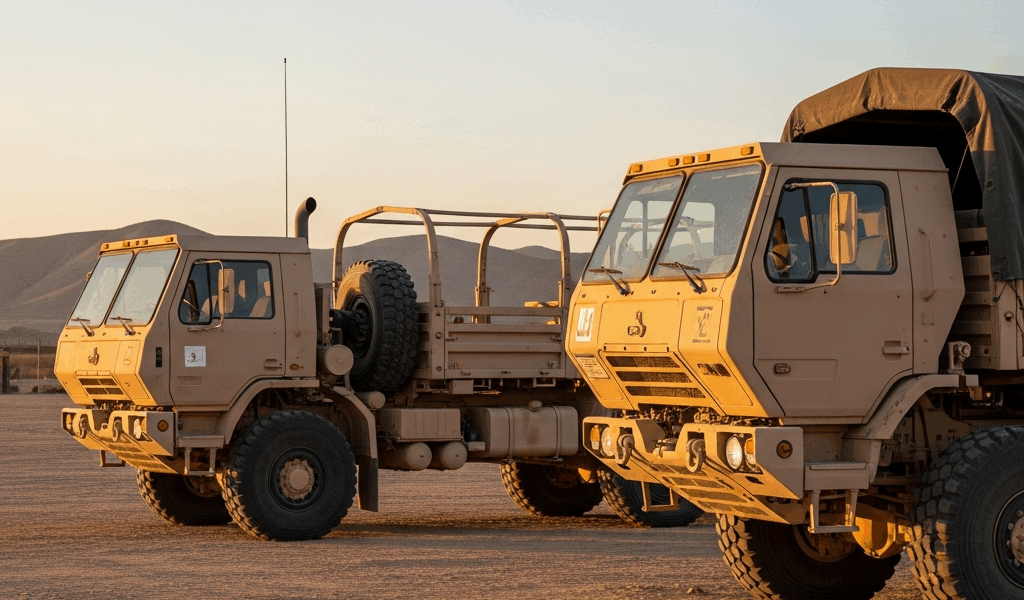
HEMTT vs FMTV — Why the Army Needs Both Trucks
The HEMTT vs FMTV debate has become tricky with all the misinformation flying around — especially among surplus buyers who stumble onto GovPlanet listings and assume these two trucks are basically the same thing in different sizes.
I cannot count how many times I heard someone call an FMTV “the big truck” or assume a HEMTT was just a heavier version of the same vehicle. They are not the same truck. Not even close. The Army didn’t accidentally end up with two massive tactical truck fleets — it needed both, badly, and that need hasn’t gone away.
Different Trucks, Different Jobs — The Army Logistics Chain
The Army’s logistics chain runs in tiers. Ships, C-17s, and rail networks handle the strategic layer — moving enormous quantities of equipment across oceans. At the other end sits a soldier at a forward operating base waiting on fuel, water, ammunition, and spare parts. Everything in between is tactical logistics. That space is enormous.
But what is the FMTV? In essence, it’s a medium tactical truck covering the 2.5 to 5-ton payload class. But it’s much more than that. Frustrated by the aging M35 “Deuce and a Half” and M809 series trucks left over from Vietnam, the Army pursued a modern replacement using a design derived from the Austrian Steyr 12M18 — a platform developed in the late 1980s. AM General won the original U.S. contract. Fielding started in 1996. The FMTV became the workhorse that keeps forward elements running — hauling ammunition pallets, carrying troops, towing artillery, running convoys from distribution points to company trains. It shows up everywhere.
The HEMTT — Heavy Expanded Mobility Tactical Truck — operates at a completely different tier. It’s a 10-ton payload, 8-wheel-drive machine that entered service in 1982, more than a decade before the FMTV ever existed. Oshkosh Defense built it specifically to handle loads that would destroy anything lighter. Patriot missile components. Fuel bladders carrying thousands of gallons. Wreckers capable of recovering other large vehicles. The HEMTT doesn’t run the same routes — it works further back in the chain, at the heavy end, moving things with no other viable transport option.
Here’s the simplest picture. The port opens. Equipment comes off the ship. HEMTTs and Heavy Equipment Transports move the heavy stuff — tracked vehicles, missile systems, large generator sets — inland to logistics bases. From there, FMTVs take over, running the distribution network forward to brigade and battalion-level units. Neither truck can fully replace the other. The FMTV is too light for what the HEMTT carries. The HEMTT is too large and too thirsty to efficiently run the high-frequency, shorter-distance routes the FMTV handles every single day.
That geographic split — port to logistics base versus logistics base to forward operating base — is the cleanest way to understand why both trucks exist. So, without further ado, let’s dive in.
Payload and Hauling Capacity Compared
The FMTV family breaks into two main weight classes. The LMTV — Light Medium Tactical Vehicle — covers the 2.5-ton payload range and runs a single rear axle. The FMTV proper covers the 5-ton class on a tandem rear axle. Within those classes you’ll find cargo variants, van bodies, wreckers, dump trucks, and the LTAS — a variant with an expanded cargo bed and Load Handling System that swaps flatracks without a crane. Total FMTV fleet numbers across U.S. service alone have exceeded 50,000 vehicles, plus exports to dozens of allied nations.
FMTV Variants Worth Knowing
- M1078 LMTV Cargo — standard 2.5-ton cargo truck, the most common sight in any motor pool
- M1083 FMTV Cargo — 5-ton cargo, tandem rear axle, backbone of company-level resupply
- M1085 Long Wheelbase Cargo — stretched version for larger pallet loads
- M1084 FMTV with Material Handling Crane — adds a 2,000-pound capacity crane for self-loading
- M1087 Expandable Van — enclosed body used for command posts, medical units, and maintenance shops
- M1088 Tractor — fifth-wheel semi configuration for pulling trailers
- M1093 LTAS — Load Handling System variant that interfaces with flatracks for rapid cargo exchange
But what is the HEMTT at its core? In essence, it’s a purpose-built heavy hauler on an 8×8 drivetrain with a transfer case feeding all four axles. But it’s much more than that — the platform delivers mobility on surfaces that would swallow a conventional truck whole. Payload sits at 10 tons on-road, somewhat less off-road depending on terrain classification.
HEMTT Variants Worth Knowing
- M977 HEMTT Cargo — baseline configuration, flatbed with drop sides
- M978 HEMTT Tanker — 2,500-gallon fuel tanker, one of the most critical platforms in any heavy logistics package
- M984 HEMTT Wrecker — recovery vehicle capable of lifting and towing other HEMTTs and similar-weight vehicles
- M985 HEMTT Cargo with Material Handling Crane — crane-equipped version for autonomous load operations
- M983 HEMTT Tractor — semi configuration used to tow the M870 trailer, which carries the Patriot missile launcher
- HEMTT A4 — modernized version with updated cab, improved suspension, and Caterpillar C15 engine
- HEMTT LHS — Load Handling System variant mirroring the FMTV LTAS concept but at 10-ton scale
The payload gap between these platforms is significant — a standard M1083 FMTV at 5 tons versus a standard M977 HEMTT at 10 tons, a clean 2:1 difference. For heavy engineering equipment, bulk artillery ammunition, or fuel-intensive operations, that difference is the deciding factor. Two FMTVs can technically carry the same weight as one HEMTT. But they need two drivers, two cabs worth of maintenance, twice the convoy spacing. At scale, that math favors the HEMTT for heavy loads. Every time.
Engine, Drivetrain, and Off-Road Performance
Here’s the part worth saying first — the performance numbers are where the real differences jump out.
Both trucks use cab-over designs, meaning the cab sits above or forward of the engine rather than behind it. Military packaging requirements drive that choice — shorter overall length improves strategic lift capacity, gets more trucks onto a rail car, and simplifies certain terrain navigation. Beyond that shared philosophy, the powertrains are completely different animals.
The FMTV runs a Caterpillar 3116 turbocharged diesel in early production — specifically the 6-cylinder 3116 producing around 225 horsepower. Later A1 and A2 variants moved to the Caterpillar C7, pushing output closer to 330 horsepower in some configurations. Transmission is an Allison 3000-series automatic, which makes the truck manageable for soldiers without extensive CDL backgrounds, though military licensing still applies. Gross vehicle weight on the M1083 cargo runs roughly 26,000 pounds depending on load and variant.
The HEMTT’s powertrain history is messier. Early production ran the Detroit Diesel 8V-92TA — a two-stroke V8 producing around 445 horsepower, notorious for both its punch and its appetite. The A2 variant switched to the Detroit Diesel Series 60, a four-stroke inline-six with meaningfully better efficiency. The A4 update brought the Caterpillar C15 at 600 horsepower, paired with an Allison 4500SP automatic. Gross vehicle weight on a loaded HEMTT cargo runs north of 62,000 pounds. That’s not a typo. Over 30 tons, loaded.
Head-to-Head Performance Numbers
- Road speed — FMTV — governed to approximately 65 mph, though most operators report comfortable cruising around 55 mph on improved roads
- Road speed — HEMTT — governed to approximately 55–58 mph, with the sheer mass making higher speeds impractical
- Fording depth — FMTV — 48 inches without preparation, up to 60 inches with deep water fording kit installed
- Fording depth — HEMTT — 48 inches standard, similar to the FMTV despite the weight difference, owing to higher engine and electrical component placement
- Grade climbing — FMTV — rated for 60% grades, a steep 31-degree slope
- Grade climbing — HEMTT — rated for 60% grades as well, impressive given the weight, made possible by the 8×8 drivetrain pushing torque to all four axles simultaneously
- Side slope — FMTV — 30% lateral slope rating
- Side slope — HEMTT — 30% lateral slope, same standard
- Ground clearance — FMTV — approximately 16 inches
- Ground clearance — HEMTT — approximately 20 inches
The HEMTT’s off-road capability genuinely surprises people who haven’t seen it operate. Near Fort Sill in 2011, I watched an M978 tanker drive straight into a muddy artillery firing position across terrain that had already swallowed two HMMWVs whole. The 8×8 drivetrain distributes weight and traction in a way that lets the truck self-recover in soft soil that would permanently mire a conventional vehicle. The driver — a Specialist whose name I unfortunately no longer remember — barely slowed down crossing a drainage ditch that had stopped smaller trucks cold.
The FMTV’s 4×4 drivetrain handles most tactical terrain adequately. It’s not in the same league cross-country as the HEMTT — deep mud, loose sand, steep unprepared slopes all expose its limits. But for the convoy routes and improved dirt roads it primarily operates on, the capability is entirely sufficient. Combat engineers prepare those routes specifically so the FMTV can run them. That’s the arrangement. It works.
Surplus Market — What Buyers Need to Know
Both trucks appear regularly on GovPlanet, the online surplus auction platform handling a large share of U.S. military vehicle disposals. I’m apparently the kind of person who spends an embarrassing amount of time browsing those listings, and GovPlanet works for me while other surplus channels never quite deliver the same inventory depth. The markets for these two platforms are completely different — different buyers, different prices, different headaches.
FMTV surplus pricing varies widely depending on variant, mileage, and condition. M1078 LMTV cargo trucks in running condition have sold in the $8,000 to $20,000 range at auction recently, with lower-mileage or newer-variant examples occasionally pushing above $25,000. The M1083 5-ton typically runs slightly higher. Van body variants — the M1087 — command a premium from buyers wanting enclosed space for mobile workshops or expedition builds. Crane-equipped M1084s go either direction depending on whether the crane actually functions.
HEMTT pricing sits considerably higher and the buyer pool is smaller. M977 cargo trucks in serviceable condition have sold anywhere from $25,000 to $60,000 depending on variant. M978 tankers, even with empty tanks, attract stronger bids — bulk liquid transport utility drives that demand. Wreckers and crane variants price case-by-case and can spike above $80,000 when serious buyers compete. The HEMTT A4 series commands a meaningful premium over earlier variants given the C15 engine and updated cab.
Practical Considerations for Civilian Buyers
The FMTV is the more practical civilian acquisition. Most configurations fall under 26,000 pounds gross vehicle weight — at least if you’re looking at standard cargo variants — meaning many buyers can operate them without a Commercial Driver’s License. Check your specific state regulations though, and don’t take my word as legal advice. Parts availability has improved substantially as the platform ages into surplus numbers. Caterpillar 3116 and C7 parts are well-supported by the civilian aftermarket. Allison 3000-series transmission components come through standard commercial channels. The truck runs on standard diesel and most shops familiar with heavy equipment can service it.
The HEMTT is a different commitment entirely. Gross vehicle weight above 62,000 pounds loaded puts it firmly in CDL territory — Class A with appropriate endorsements. Beyond licensing, the size alone creates practical problems. Approximately 30 feet long, 8 feet wide, over 9 feet at the cab roof. You need a serious facility to work on it and serious tire equipment to handle the 16.00R20 rubber it runs. Early variants with the Detroit Diesel 8V-92TA two-stroke are entertaining to operate but return approximately 3–4 miles per gallon under load. Budget accordingly.
First, you should verify wrecker boom certification before bidding — at least if you’re looking at M984 variants. That boom assembly involves hydraulics and structural certifications that expire and require specialized inspection. A wrecker with a condemned boom is essentially a very expensive cargo truck carrying extra weight. Steer clear of where I went wrong of assuming functional appearance equals certified operation.
Common issues on used FMTVs: inspect the air brake system specifically — slack adjusters and brake chambers — and check the cab tilt mechanism for hydraulic cylinder leaks. On HEMTTs, verify transfer case selector engagement, inspect all eight wheel ends for bearing wear, and examine the frame rails near the rear tandem axles where stress cracking occasionally develops on high-mileage trucks. Technical manuals for both platforms are publicly available through the official Army publications repository. Pull them before you inspect anything.
Which One Matters More to the Army?
Neither. That’s the whole point.
The HEMTT does things the FMTV physically cannot. Moving a Patriot missile system requires an M983 HEMTT tractor to haul the launcher and radar components on their respective trailers. No FMTV variant fills that role — the loads are too heavy, the trailers too large, the strategic consequences of failure too significant. Bulk fuel operations at scale, heavy recovery, long-range artillery support — the M270 MLRS, the M109 Paladin, the AN/TPY-2 radar — all require HEMTT-class transport somewhere in their logistics tail.
But the FMTV does things the HEMTT would do poorly. Running daily resupply convoys to a company patrol base 15 miles from the brigade support area is not an HEMTT mission. The fuel cost alone would be prohibitive. The convoy signature excessive. The road damage on unimproved surfaces substantial. FMTVs handle these runs — hundreds of them, every day, across every theater the Army operates in — with an efficiency the HEMTT simply cannot match at that scale.
The relationship is complementary and hierarchical. Heavy logistics runs on HEMTTs. Distribution forward of that runs on FMTVs. Supporting fires and air defense run on HEMTTs. Keeping infantry battalions fed, fueled, and armed runs on FMTVs. Neither truck is redundant. Each one owns its tier.
The Army maintains roughly 17,000 HEMTTs in active inventory across all variants, compared to over 50,000 FMTVs in various configurations. That ratio reflects operational reality — medium tactical requirements occur at higher frequency and greater dispersion than heavy tactical requirements. But when the heavy requirement appears, there is no substitute. You cannot convoy 10 FMTVs to replace 5 HEMTTs when a Patriot battery needs to redeploy inside six hours.
For surplus buyers, the answer is almost always the FMTV — more practical, cheaper to operate, easier to license and maintain, available in more useful configurations for civilian applications. For military planners, the answer is always both. The logistics chain that wins wars requires coverage at every tier, and gaps at either end create vulnerabilities that adversaries will find. The HEMTT and the FMTV were never competing for the same role. This new two-platform approach took off several years into the post-Cold War drawdown and eventually evolved into the force structure Army logisticians know and depend on today.


Stay in the loop
Get the latest military vehicles vault updates delivered to your inbox.