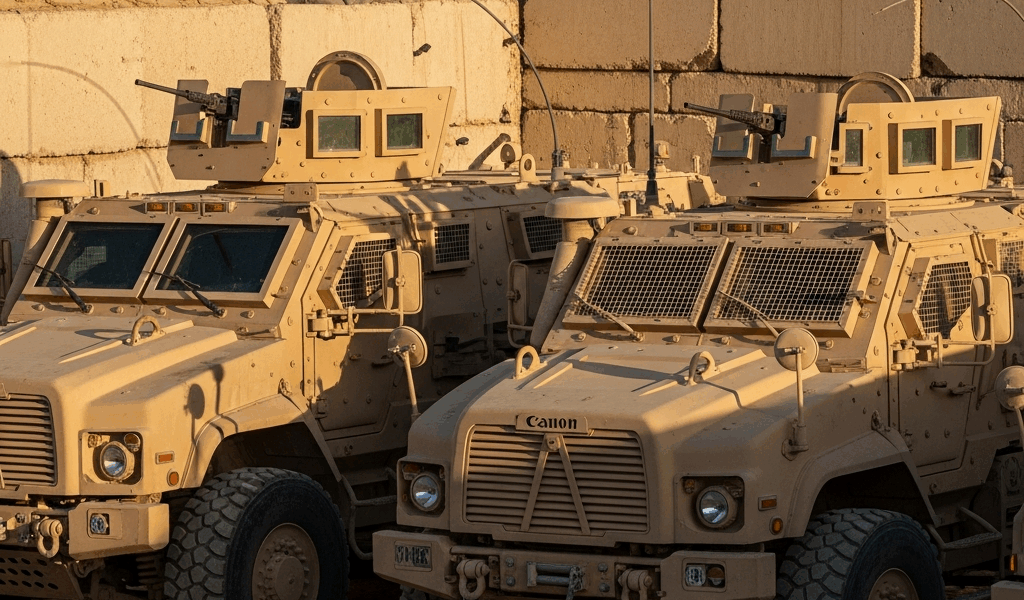
MaxxPro vs Cougar MRAP — Which Protected Troops Better in Iraq?
The MaxxPro vs Cougar MRAP debate has become tricky with all the mythology and spec-sheet noise flying around. Which is strange, honestly, when you consider that these two vehicles collectively absorbed thousands of IED blasts and brought soldiers home alive who had no business surviving those roads. I’ve spent years digging through after-action reports, procurement documents, and firsthand crew accounts — trying to figure out why the U.S. military ended up running two dominant MRAP designs simultaneously, and which one actually held up when it counted. The answer isn’t on any spec sheet. And it matters well beyond military history trivia.
Both vehicles saved lives. That’s the baseline. But they saved them differently — for different units, on different terrain — and the choices baked into their design and procurement reveal something real about how the military balances innovation against urgency against sheer logistical scale.
Design Philosophy — Why Two Different MRAPs?
The Cougar came first. Full stop.
Force Protection Industries developed it in the early 2000s, drawing heavily on South African mine-protected vehicle experience. Specifically, lessons learned from Rhodesian and South African military engineers who’d been dealing with landmines in bush warfare since the 1970s. The core insight those engineers hammered out — sometimes literally — was the V-hull: a steeply angled undercarriage that deflects blast energy outward instead of channeling it straight up through the floor and into whoever’s sitting above it.
But what is a V-hull, really? In essence, it’s a geometric solution to a physics problem. But it’s much more than that. Force Protection built the entire Cougar around that concept from the ground up. The vehicle’s monocoque construction — a single integrated shell rather than a body bolted onto a separate frame — extended the protective geometry all the way into the engine bay. Not an afterthought. The whole vehicle was engineered as a blast-deflection system that happened to also function as a truck.
The MaxxPro came from a completely different direction. Navistar Defense — a subsidiary of International Truck and Engine Corporation — developed it on a commercial truck chassis, specifically adapted from their proven International medium-duty platform. The design used bolted rather than welded construction for several components. That created some durability concerns crews noticed in the field, no question. But it also made the MaxxPro dramatically easier to manufacture at scale and repair in theater. Those aren’t small advantages when you’re running vehicles into IED-saturated routes six days a week.
The procurement numbers tell the story bluntly. The military ordered roughly 1,560 Cougar H variants. They ordered 7,474 MaxxPros. The MaxxPro represented approximately 45 percent of all MRAP orders placed under the 2007 emergency procurement surge — the largest single-vehicle emergency buy in U.S. military history. Force Protection simply couldn’t build at that volume. Navistar could. When the Pentagon needed tens of thousands of mine-protected vehicles in under two years, the choice wasn’t really about theoretical superiority. It was about which company had the manufacturing infrastructure to actually deliver.
That procurement context shapes everything that followed. You can’t evaluate these vehicles fairly without it. The Cougar was a purpose-built, relatively low-volume specialist vehicle. The MaxxPro was a mass-production solution to an immediate crisis. They were solving slightly different problems — and that distinction matters before you start comparing anything else.
Blast Protection — V-Hull Designs Compared
Worth mentioning before anything else. The blast protection numbers are what made these vehicles famous in the first place, and everything else flows from them.
Force Protection Industries tracked IED attacks on Cougar vehicles systematically. Their internal data — later cited in Congressional testimony and GAO reports — documented over 300 IED attacks on Cougars with zero crew fatalities directly attributable to the blast. Zero. That’s the number that circulated through the Army and Marine Corps and eventually forced the entire MRAP procurement program into existence. Soldiers and Marines were dying in Humvees from roadside bombs that a Cougar would have walked away from.
The monocoque V-hull is what made that possible. When a shaped charge or large IED detonates beneath a vehicle, it generates an overpressure wave and fragmentation pattern that travels along predictable vectors. A flat-bottomed vehicle — the Humvee, essentially — presents a large horizontal surface that catches that energy and transfers it directly into the crew compartment. The V-hull redirects it laterally. Steeper angle, more effective deflection. Basic geometry with life-or-death consequences.
The Cougar’s monocoque design meant the V-hull geometry ran continuously from the nose of the vehicle through the crew area — no joints, no transition points where blast energy could find a weak seam. The entire lower body acted as a single deflection surface. That’s the engineering detail that separated it from competitors trying to bolt V-shaped panels onto existing platforms.
The MaxxPro uses a V-hull as well, and it’s effective — no question there. But the bolted construction raised concerns about structural integrity across multiple blast events. A single catastrophic IED? Both vehicles performed. Multiple smaller blasts over a full deployment? The Cougar’s monocoque construction gave it an edge in sustained structural integrity that showed up in testing and, reportedly, in the field.
MaxxPro crews did survive IED attacks that would have killed them in Humvees. The vehicle fulfilled its core protective mission. But in side-by-side evaluations run by Marine Corps and Army testing units, the Cougar consistently absorbed blast energy with slightly less crew compartment intrusion and lower floor acceleration — the measurement that correlates most directly with spinal injuries and traumatic brain injury from underbelly blasts. That’s not a minor distinction. That’s the difference between a soldier walking off the vehicle or getting medevaced.
The MaxxPro also rode higher off the ground, which created a different dynamic entirely. Higher ground clearance means more standoff distance between the blast and the crew — a genuine advantage. But it also raised the center of gravity significantly, which created rollover risk on Iraqi roads and Afghan mountain tracks. Several MaxxPro rollovers resulted in casualties that the vehicle’s blast protection had nothing to do with. Height as a blast mitigation strategy has real limits, and those limits showed up in the casualty reports.
Size, Weight, and Mobility Trade-offs
The Cougar came in two primary configurations — a 4×4 and a 6×6 — with the 4×4 being the more common variant deployed to Iraq. The 4×4 Cougar weighed approximately 36,000 pounds in standard configuration and stretched about 21 feet long. Manageable, for an armored vehicle. It could navigate most Iraqi urban streets without becoming a liability — narrow alleys near Fallujah’s market districts, the tight intersections around Ramadi’s government center — and drivers didn’t dread tight turns the way they did in heavier platforms.
The MaxxPro — specifically the MaxxPro Plus and standard MRAP variants — weighed in at around 38,000 to 40,000 pounds depending on configuration and added armor. That’s not a dramatic difference on paper. In practice, on the road network around Ramadi or in the older neighborhoods of Mosul, those extra tons mattered. The MaxxPro’s commercial truck heritage showed in its ride height and track width, which created handling characteristics that took real adjustment — and not everyone got enough time to adjust before they were already on route.
Iraq’s infrastructure compounded everything. Bridges rated for local traffic weren’t rated for 40,000-pound American armored vehicles — a fact that became obvious the first time a unit tried to cross one. Roads that looked solid on satellite imagery turned into problems in person, particularly after rain. The MaxxPro’s weight distribution — heavier over the front axle than the Cougar — contributed to road surface damage and made certain routes effectively off-limits for the vehicle class.
Afghanistan presented a more severe version of the same problem. Mountain roads and narrow valleys in Helmand and Kandahar exposed the weight and width limitations sharply. The vehicle’s wheelbase and overall dimensions made it genuinely difficult to operate in areas where the Cougar’s smaller footprint would have been manageable. Some routes became MaxxPro-restricted because the road engineering simply couldn’t support the vehicle — not because of enemy activity, but because the roads were built for donkey carts and small trucks, not 40,000-pound armored vehicles.
That’s what makes the Cougar’s design adaptability endearing to the engineers and crews who worked with it. The 6×6 variant — longer, heavier, higher payload capacity — traded some maneuverability for additional mission capability, particularly in route clearance and EOD support roles. EOD teams, frustrated by the limitations of existing platforms and improvising with whatever they had on hand, adapted the 6×6 Cougar into the Buffalo MRAP variant — eventually the primary route clearance vehicle of the entire conflict. That lineage matters when you’re evaluating the original design’s flexibility.
One detail that doesn’t get nearly enough attention: the MaxxPro’s doors. Large, heavy blast doors that require significant effort to open from the inside after a blast — when hinges may be distorted from the explosion, when occupants may be injured, when every second matters. Multiple crew members noted in after-action interviews that egress after an IED strike was harder in a MaxxPro than in a Cougar. The Cougar’s doors, while still substantial, were engineered with post-blast egress as a specific design consideration from the start. Small difference, maybe. Could matter enormously at exactly the wrong moment.
Crew Experience and Field Reliability
Side-step the error I made. Early on, I treated crew preference as purely subjective data — the kind of anecdotal noise you discount in favor of controlled test results. That was wrong. Crew preference in sustained combat operations reflects accumulated practical knowledge about vehicle behavior under stress that no controlled test fully replicates. The mechanics and the drivers knew things the test reports didn’t capture.
The Cougar cost approximately $730,000 per vehicle. The MaxxPro was cheaper to produce per unit, though exact per-unit costs varied by contract and configuration across multiple emergency procurement tranches. That cost difference reflected the manufacturing approach as much as capability differences — the Cougar’s monocoque construction required more specialized fabrication labor, slower production, higher per-unit cost.
Surveyed during and after deployments, MaxxPro crews were generally positive about protection but consistently flagged visibility limitations as a real operational problem. The MaxxPro’s armored glass — meeting protection standards, yes — provided a narrower field of view than crews wanted. In urban Iraq, where threat detection depended on spotting unusual behavior in crowds or noticing disturbed road surfaces from a moving vehicle, restricted visibility wasn’t a minor inconvenience. It was a tactical liability that showed up in the quality of the patrol, not just in how well the vehicle absorbed a blast.
Cougar crews tended to rate their vehicles more positively overall — blast confidence and visibility both scoring higher in surveys. The window placement and size gave a better observation envelope, which experienced crews valued enormously. You can’t engage a threat you didn’t see coming.
Reliability statistics from Iraq told a mixed story for both platforms. The MaxxPro’s commercial truck heritage meant parts were relatively available through normal military supply chains — International Truck had an established logistics network, and many mechanical components were shared with other vehicles already in theater. When a MaxxPro broke down outside of Tikrit at 0300, fixing it was usually faster than fixing a Cougar in the same situation.
The Cougar, being a more specialized vehicle with fewer units in the field, sometimes faced longer waits for specific components. Force Protection’s support infrastructure in theater was thinner than Navistar’s, and units operating Cougars in forward positions occasionally waited longer for parts that simply weren’t stocked locally. For a vehicle that exists to protect troops on patrol, downtime is a real operational cost — a vehicle sitting in the motor pool isn’t protecting anyone.
Maintenance crews — the mechanics actually doing the repair work at 0200 under fluorescent lights in a dusty FOB — generally preferred the MaxxPro’s more conventional mechanical architecture. The commercial truck platform meant the engine, transmission, and drivetrain components were familiar territory for anyone with experience on military medium trucks. The Cougar required more specialized knowledge, and training the maintenance pipeline to support it took longer than anyone had anticipated.
Desert heat — Iraqi summer temperatures that regularly exceeded 120 degrees Fahrenheit in the shade, if you could find shade — stressed both vehicles’ cooling systems consistently. The MaxxPro’s higher power-to-weight ratio gave it a slight edge in maintaining performance under sustained heavy load in extreme heat, though this varied by specific variant and configuration. Cold weather performance showed minimal differences between the two platforms, for whatever that’s worth in a conflict fought mostly in desert terrain.
The Verdict — Which MRAP Earned Its Reputation?
The honest answer is this: the Cougar earned the better technical reputation, and the MaxxPro won the war.
That’s not a contradiction — it reflects the reality of what these vehicles were and what they were actually asked to do.
The Cougar pioneered the concept. Force Protection Industries, drawing on South African engineering lineage and their own development work, built a vehicle that demonstrated definitively that V-hull geometry could protect troops from IED attacks that would have been fatal in anything the U.S. military was then fielding. That zero-fatality record across 300-plus IED attacks wasn’t marketing copy. It was a data point that changed the entire strategic calculus of the Iraq War’s middle years and forced a procurement revolution that the Pentagon had been resisting for years.
The Cougar’s blast protection was measurably superior in controlled testing. Its crew ergonomics were better. Visibility was better. Egress design was better. If you were putting troops on the most dangerous roads in Anbar Province in 2006 and 2007 and could choose any vehicle without constraint, you’d choose the Cougar — and most experienced NCOs knew it.
But you couldn’t choose without constraint. The military needed tens of thousands of protected vehicles immediately — not eventually, not after a two-year production ramp, immediately. The MRAP program moved faster than any comparable vehicle buy in recent history, and it needed a manufacturer who could actually deliver at that scale. Navistar delivered. The MaxxPro flooded into Iraq and Afghanistan at a volume the Cougar simply couldn’t match, and that volume saved lives that would have been lost waiting for sufficient Cougar production to materialize.
Seven thousand-plus vehicles built, fielded, and absorbed into units across every major operating area. Each one replaced a Humvee on a route clearance mission or a convoy run. Each one offered dramatically better blast protection than what it replaced. Imperfect blast protection at 7,000 vehicles saves more lives in aggregate than perfect blast protection at 1,500 — that’s not a complicated calculation.
This new idea — that commercial-derived platforms could be rapidly scaled to meet emergency force protection requirements — took off several years later and eventually evolved into the JLTV development approach that defense planners know and reference today. That lineage runs directly through the MaxxPro procurement experience.
The Cougar’s legacy is different but equally important. It exists in the Buffalo route clearance vehicle, which served as the primary platform for arguably the most dangerous job in theater for years. It exists in the design standards it established, which influenced every subsequent MRAP and JLTV development program. And it exists in that data — the zero-fatality record — that made the entire MRAP program politically and strategically possible in the first place. Without the Cougar’s documented performance breaking through institutional resistance, skeptical budget officials and generals wedded to lighter force structures would have delayed the program further. The MaxxPros never get built in those numbers without the Cougar proving the concept was worth the emergency expenditure.
So: which MRAP protected troops better in Iraq? The Cougar protected its crews better, vehicle for vehicle. The MaxxPro protected more troops in total, through sheer scale. Depending on which question you’re actually asking — tactical performance or strategic impact — both answers are correct. And neither vehicle deserves the obscurity that typically attaches to military hardware once a conflict fades from the news cycle.
The soldiers and Marines who rode in both would probably tell you the same thing: either one beat the hell out of a Humvee, and you were glad to have whichever one was assigned to your unit. Apparently some lessons are obvious in hindsight and impossible to see in the moment. The MRAP program was one way of making sure the same lesson didn’t have to be learned twice — paid for again in the same currency.

Stay in the loop
Get the latest military vehicles vault updates delivered to your inbox.