M109 Paladin vs PzH 2000 — Which Self-Propelled Howitzer Wins?

The M109 Paladin and the Panzerhaubitze 2000 are the two most widely fielded NATO self-propelled howitzers, and they represent fundamentally different approaches to the same problem: putting 155mm rounds on target fast and accurately. One has been in service since Vietnam and keeps getting upgraded. The other was built from scratch in the 1990s with every modern artillery concept baked into the design from day one.

Both have seen real combat. Both have proven themselves. But if you had to pick one for a modern artillery battalion, the answer is not as simple as comparing spec sheets — doctrine, logistics, and what you already have in your motor pool matter as much as range and rate of fire.

M109 Paladin vs PzH 2000 at a Glance

SpecificationM109A7 PaladinPzH 2000
Caliber155mm L/39155mm L/52
Rate of Fire (sustained)~4 rounds/min~10 rounds/min
Rate of Fire (burst)~4 rounds/min12+ rounds in first minute
Max Range (standard)~24 km (14.9 mi)~40 km (24.9 mi)
Max Range (assisted)~30 km (18.6 mi) with RAP~56 km (34.8 mi) with Vulcano
MRSI CapabilityNoYes (5 rounds simultaneous)
Loading SystemSemi-automaticFully automatic
Crew45 (3 in automated mode)
Combat Weight~36 tons~55 tons
Engine600 hp (Bradley drivetrain)986 hp MTU diesel
Road Speed61 km/h60 km/h
On-board Ammo39 rounds60 rounds
Shoot-and-scoot Time~60 seconds~30 seconds

The numbers favor the PzH 2000 in almost every performance category. But numbers and battlefield reality are two different conversations, as both Ukraine and decades of operational experience have demonstrated.

Firepower and Range

The PzH 2000 carries a 52-caliber barrel — thirteen calibers longer than the Paladin’s L/39 tube. That extra barrel length translates directly into range and muzzle velocity. With standard NATO rounds, the PzH 2000 reaches 40 kilometers. With the Vulcano extended-range guided munition, it pushes past 56 kilometers. The M109A7 tops out around 24 kilometers standard, 30 with rocket-assisted projectiles. In a counter-battery fight where the enemy is shooting back, that range gap is not academic — it determines whether your guns are inside or outside the other side’s artillery envelope.

Rate of fire tells an even starker story. The PzH 2000’s fully automated loading system delivers 10 rounds per minute sustained. In burst mode, the crew can pump 12 rounds downrange in under a minute. The M109A7’s semi-automatic system manages roughly 4 rounds per minute with a well-drilled crew. That means a battery of six PzH 2000s puts the same volume of steel on target as fifteen M109s.

The PzH 2000 also has MRSI — Multiple Rounds Simultaneous Impact. By firing five rounds at different elevations in rapid sequence, all five arrive on the target at the same moment. The effect on the receiving end is devastating because there is no warning between the first and fifth impact. The M109 cannot do this. MRSI requires the combination of high rate of fire and precise computerized fire control that the PzH 2000 was designed around from inception.

Mobility and Logistics

Both vehicles are tracked and move at roughly 60 km/h on roads. But the similarity ends at the scale. The PzH 2000 weighs 55 tons — heavier than many main battle tanks. It requires heavy equipment transporters for strategic moves, stresses bridges that lighter vehicles cross without concern, and demands more fuel per kilometer. The M109A7 at 36 tons is almost twenty tons lighter, which changes the logistics math dramatically.

The M109A7’s biggest logistics advantage has nothing to do with artillery. When the US Army upgraded from the M109A6 to the A7, they replaced the drivetrain with the Bradley Fighting Vehicle’s engine, transmission, and suspension components. That decision means every M109A7 in the motor pool shares parts with every Bradley in the brigade. Mechanics trained on one system can work on the other. Supply chains overlap. Spare parts are already in theater because the Bradley is everywhere the US Army operates.

The PzH 2000 has no equivalent parts commonality with other vehicles in the German or NATO inventory. Its MTU 986-horsepower diesel is powerful but unique to the platform. Every specialized component requires its own supply line, its own mechanics, its own training pipeline. For an army fighting far from home depots — which is the scenario NATO actually trains for — that logistical independence is a genuine vulnerability.

Shoot-and-scoot capability is where the PzH 2000 claws back an advantage. From a complete stop, the PzH 2000 can fire its first round within 30 seconds and displace before counter-battery radar has a solution. The M109A7 needs roughly 60 seconds. In an era where counter-battery fire is increasingly drone-directed and fast, those 30 seconds matter.

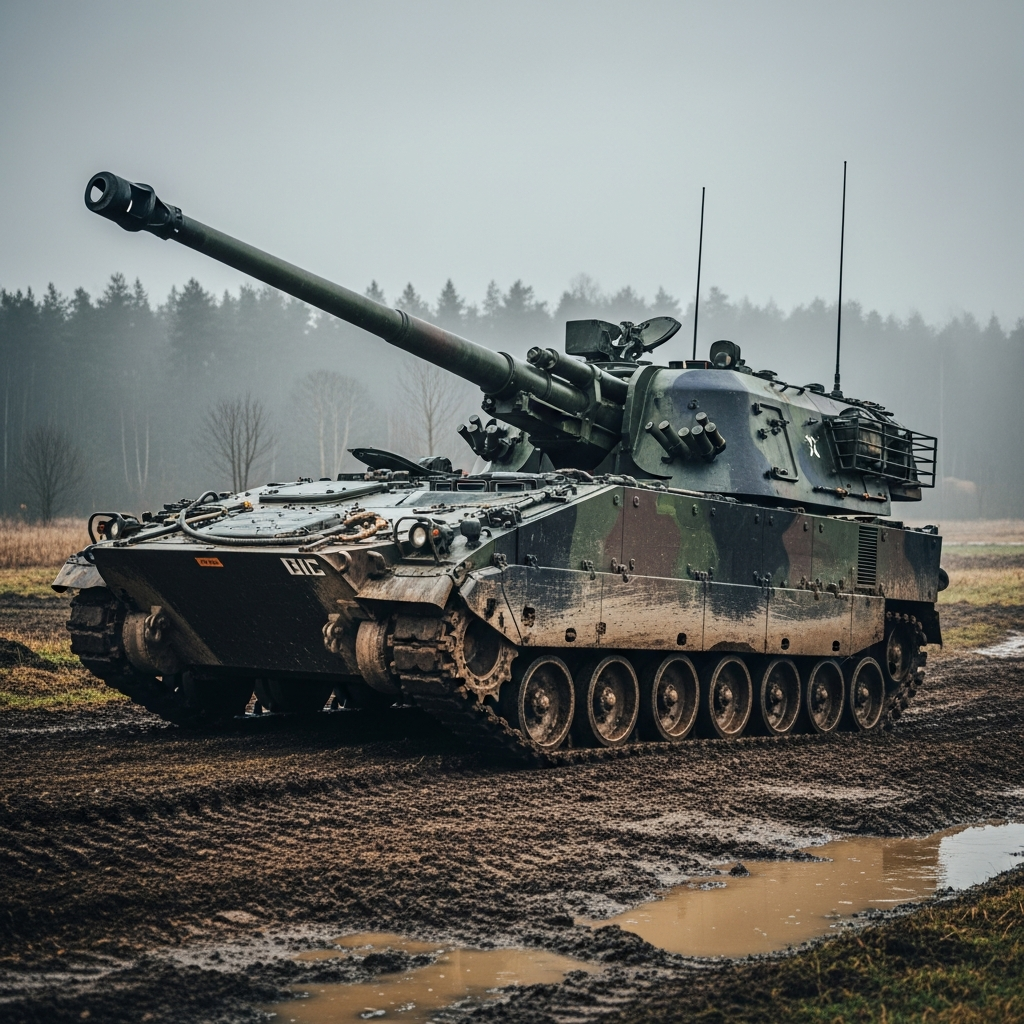
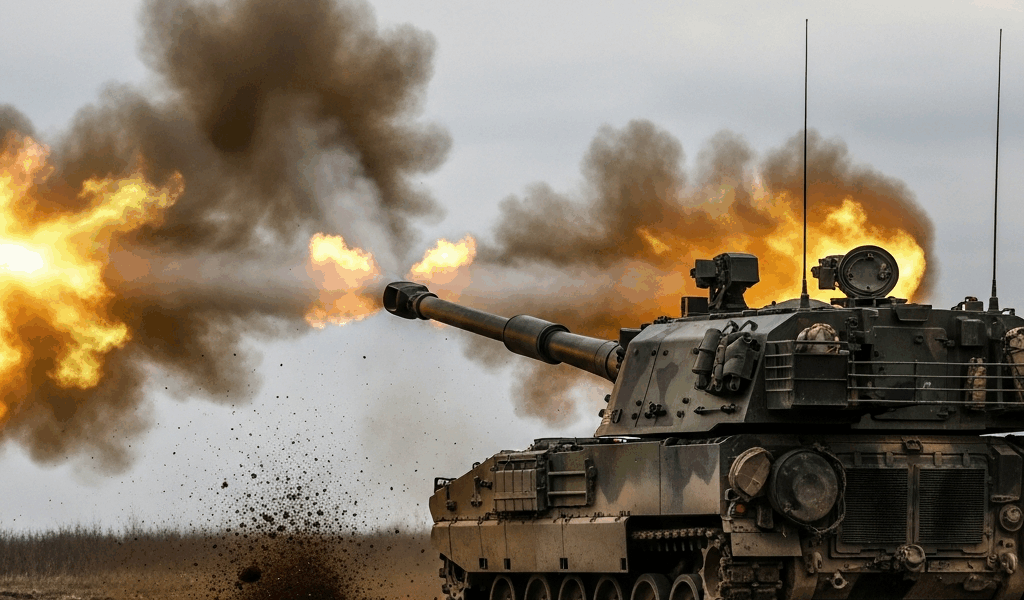
Self-propelled artillery vehicle on muddy terrain showing the tracked armored platform used by modern howitzer systems

Combat Performance in Ukraine

Ukraine has given both howitzer families their most intense operational test since their designs were conceived. The PzH 2000 arrived in Ukraine in 2022 as part of Germany’s military aid package, and Ukrainian crews put it through sustained fire rates that peacetime testing never approached.

The results were mixed in a revealing way. The PzH 2000 proved its firepower advantage decisively — Ukrainian artillerymen reported being able to service targets at ranges Russian guns could not answer. The rate of fire and MRSI capability made it a feared system on the front lines. But the sustained operational tempo exposed barrel wear issues that peacetime planners had not anticipated. Barrels designed for training-level firing schedules degraded rapidly under combat-level usage, requiring replacement far sooner than maintenance schedules predicted. Germany had to rush spare barrels to the front.

M109 variants — primarily older A3 and A5 models donated by various NATO countries — also served in Ukraine. They performed reliably at their more modest range and rate of fire. The simpler mechanical design proved easier for Ukrainian mechanics to maintain in field conditions without extensive factory-trained specialists. What the M109 lacked in peak capability, it partly compensated for in availability and maintainability under sustained combat stress.

The lesson from Ukraine is not that one system is better. It is that sustained high-intensity combat punishes complexity differently than it punishes limited capability. The PzH 2000 can do more but demands more in return. The M109 does less but keeps doing it.

The Verdict

The PzH 2000 is the superior artillery platform on pure capability. It shoots farther, faster, and more accurately than the M109A7. MRSI gives it a tactical option no variant of the M109 can match. If you are building an artillery force from scratch and logistics are not a constraint, the PzH 2000 is the better howitzer.

The M109A7 wins on sustainability. Its Bradley-common drivetrain, lower weight, simpler maintenance, and massive global installed base make it the practical choice for any army already operating US equipment. Replacing an M109A6 fleet with A7s is a logistics-neutral upgrade. Replacing it with PzH 2000s means rebuilding your entire support infrastructure.

For NATO allies already in the US supply chain — which is most of them — the M109A7 is the smart buy. For nations with independent logistics and a focus on peak lethality, the PzH 2000 is the benchmark that everything else is measured against. Ukraine proved both points simultaneously: the PzH 2000 hit harder, and the M109 kept shooting when the sophisticated systems needed downtime.

James Morrison

James Morrison

Author & Expert

James Morrison is a passionate content expert and reviewer. With years of experience testing and reviewing products, James Morrison provides honest, detailed reviews to help readers make informed decisions.

5 Articles
View All Posts

Stay in the loop

Get the latest military vehicles vault updates delivered to your inbox.