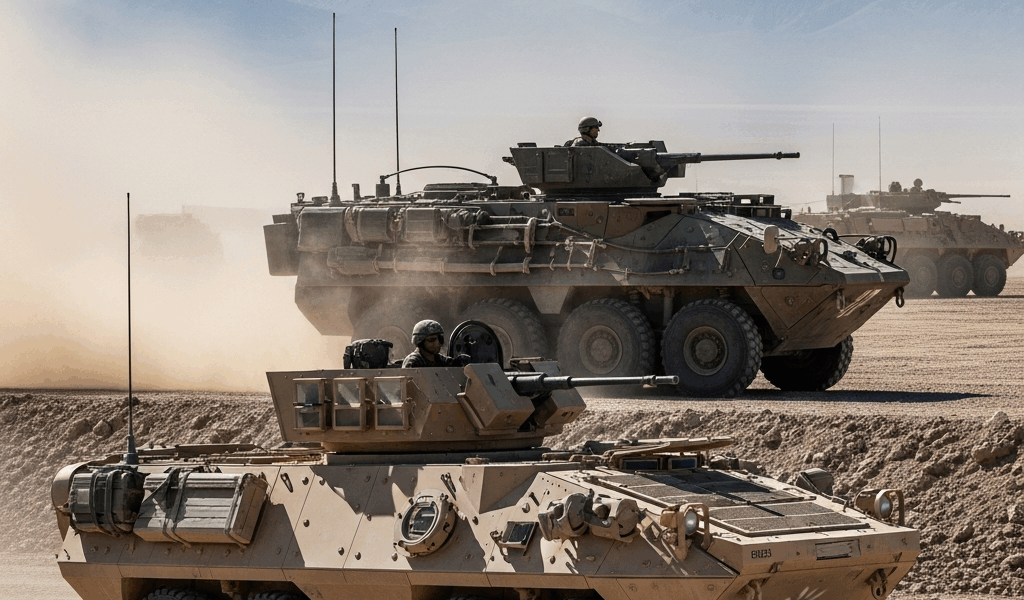
Stryker vs LAV-25 — Which One Actually Wins
The Short Answer — Different Jobs, One Clear Edge
The Stryker vs LAV-25 debate has gotten complicated with all the spec-table noise flying around. Someone posts horsepower numbers and armor ratings, declares a winner, and the thread explodes. I’ve spent years grinding through after-action reports, doctrinal manuals, and unit histories on both platforms. Today, I will share it all with you — including the part most comparisons skip entirely.
The honest answer: the Stryker is the more capable and survivable vehicle for sustained ground combat. The LAV-25 wins on strategic mobility and amphibious flexibility. Write that down. Everything else here is just the explanation.
What most comparisons get wrong — these vehicles were never real competitors. The Army built the Stryker to replace aging M113 infantry carriers and give brigade combat teams a wheeled platform that could move fast without the logistical nightmare of tracked vehicles. The Marine Corps kept the LAV-25 because they need something that swims off a ship, fits in a C-130, and supports a Marine Expeditionary Unit running on minimal infrastructure. Different branches. Different problems. Different solutions.
Arguing Stryker versus LAV-25 is like arguing whether a utility knife or a fillet knife is the better blade. Depends entirely on what you’re cutting. So, without further ado, let’s dive in.
Firepower and Armor — Where the Numbers Actually Matter
This is where a lot of military enthusiasts get tripped up. Honestly, I made the same mistake early on. Don’t make my mistake.
But what is the LAV-25’s core armament? In essence, it’s the 25mm M242 Bushmaster chain gun — the same main gun riding on the M2 Bradley. That’s a genuinely capable weapon, effective against light armor, crew-served positions, and low-flying aircraft. On paper, the LAV-25 looks well-armed for its weight class. That’s what makes it endearing to us armored vehicle enthusiasts.
The base Stryker ICV carries no main gun. None. Eight soldiers, a .50 cal or Mk 19 on a remote weapon station — that’s the loadout. The M1128 Mobile Gun System variant adds a 105mm M68A2 rifled cannon, but that’s a specialized vehicle. Not the standard Stryker most people picture when they type out these forum arguments.
So on raw firepower for the base platform, the LAV-25 wins. It has a main gun. The ICV doesn’t. Simple math.
Armor is a different story — at least if you care about surviving a real fight. The Stryker’s survivability profile after the combat-driven upgrades running roughly from 2003 through 2011 in Iraq is substantially better. The SLAT cage armor — those metal grilles bolted around the hull — was specifically engineered to defeat RPG warheads by triggering premature detonation before the shaped charge ever touches the vehicle’s skin. Add-on ceramic and steel appliqué packages pushed protection further still. The LAV-25 has no equivalent upgrade path for RPG defense. Its armor stops 7.62mm rounds and shell fragments. Not anti-armor weapons.
The combat record backs this up. Strykers took RPG hits in Mosul and kept rolling. That’s not a brochure claim. That’s documented.
Mobility and Deployability — Where the LAV-25 Punches Back
As someone who spent years reading deployment logistics breakdowns, I learned everything there is to know about how weight actually matters at the strategic level. Convinced once by an article that the Stryker’s size disadvantage was overstated, I was wrong. The gap is significant — and it plays out in real operations, not just on spec sheets.
The LAV-25 comes in at roughly 12.8 tons combat loaded. The Stryker ICV runs over 19 tons in standard configuration. Slap armor packages on it and that number climbs higher. That’s not a rounding error. That’s a strategic difference.
The LAV-25 fits in a C-130 Hercules — one vehicle per aircraft, standard configuration, no exotic rigging required. For the Marines’ rapid-response model, that matters enormously. A MEU loads LAVs on amphibious shipping, sails to a crisis point, and puts vehicles directly in the water. The LAV-25 is amphibious without modification, swimming at roughly 6 mph in calm water using two propellers mounted at the rear of the hull. Ship to shore. No port. No infrastructure. That was 1983 engineering and it still holds up.
The Stryker is not amphibious. Getting one across water requires bridging assets, ferries, or a functioning port — deliberate theater entry, in Army doctrine terms. That’s not a flaw. Army Stryker Brigade Combat Teams are built around the assumption of established logistics chains. The 3rd SBCT didn’t roll into Mosul by swimming the Tigris.
For Marines, the LAV-25’s deployability isn’t a nice-to-have. It’s the whole point.
Combat Record — What Actually Happened Downrange
Probably should have opened with this section, honestly, because real-world performance cuts through spec-sheet noise faster than anything else.
The Stryker’s combat record is extensive and recent. The 3rd Stryker Brigade Combat Team deployed to Mosul in late 2003 — operated there through 2004 in one of the most sustained urban combat environments American forces faced that entire war. The platform’s performance, particularly its ability to move quickly, evacuate casualties fast, and survive IED and RPG attacks after armor upgrades, reshaped how the Army thinks about wheeled infantry carriers. From 2003 to 2011, Strykers accumulated thousands of combat hours across Iraq and later Afghanistan. That’s a long test cycle under genuinely brutal conditions.
The LAV-25’s most significant combat deployment was Operation Desert Storm in 1991. Marine LAV units ran screening operations and performed well in their intended role — fast-moving reconnaissance and flank security across open desert terrain. But Desert Storm also included a painful lesson. A friendly-fire incident on February 25, 1991 killed seven Marines when a TOW missile from another LAV-25 struck their vehicle after misidentification. It reshaped Marine Corps doctrine on LAV employment and identification procedures. It’s part of the record — and it matters.
The Stryker has more recent, more sustained, and better-documented combat data. That counts for something when you’re actually evaluating a platform instead of just ranking specs.
The Verdict — Which Vehicle Would You Actually Want
Here’s where this lands.
If you’re an Army infantryman preparing for sustained urban or combined-arms combat — Mosul, Fallujah, any high-intensity city fight — you want the Stryker. Better protection. Modular weapon stations. Organic integration into a BCT with artillery, aviation, and logistics built around the same operational rhythm. The Double V-Hull variants address underbelly blast threats that earlier models couldn’t handle as well. The platform has been upgraded continuously since fielding. It’s not the same vehicle that rolled off the line in 2000.
If you’re a Marine on a MEU — or you need a vehicle that operates ship to shore without a port, without a runway rated for heavy aircraft, without weeks of theater-entry preparation — the LAV-25 is the right tool. It does exactly what the Marine Corps needs it to do, and has done so reliably since the early 1980s. That’s endurance. That counts.
I’m apparently the kind of reader who obsesses over platform upgrade timelines, and the Stryker’s modernization arc works for me while the LAV-25’s ceiling never quite kept pace. The Marines themselves seem to agree — the LAV-25 is being phased out in favor of the Amphibious Combat Vehicle, which tells you exactly where the design’s limits sit.
The Stryker wins the comparison. The LAV-25 wins its mission. Those are not the same thing — and confusing the two is precisely what makes this debate spin in circles. It ends here.


Stay in the loop
Get the latest military vehicles vault updates delivered to your inbox.