Stryker vs LAV-25: Complete Comparison of US Military Wheeled Combat Vehicles
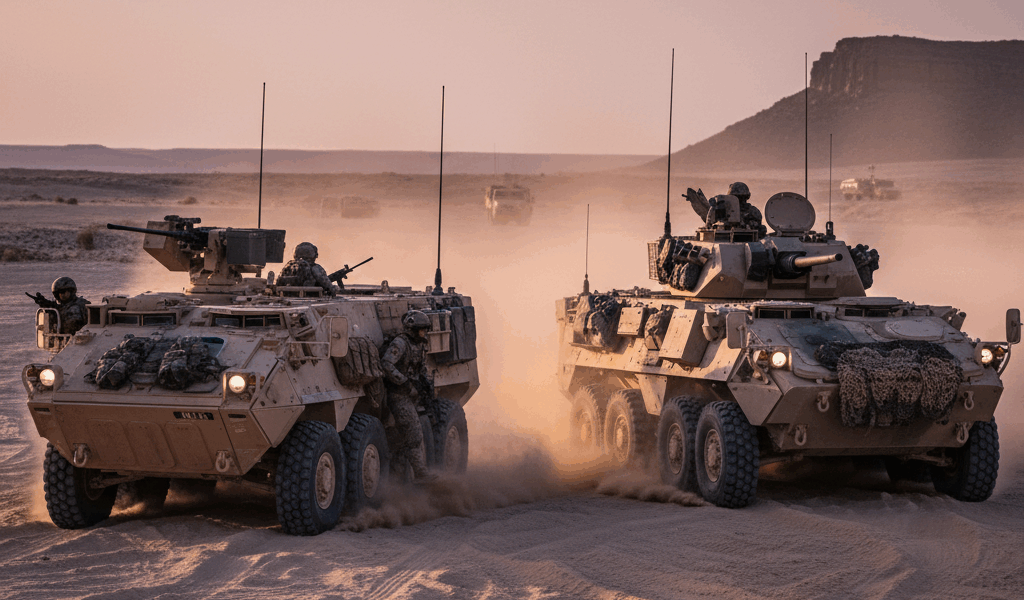
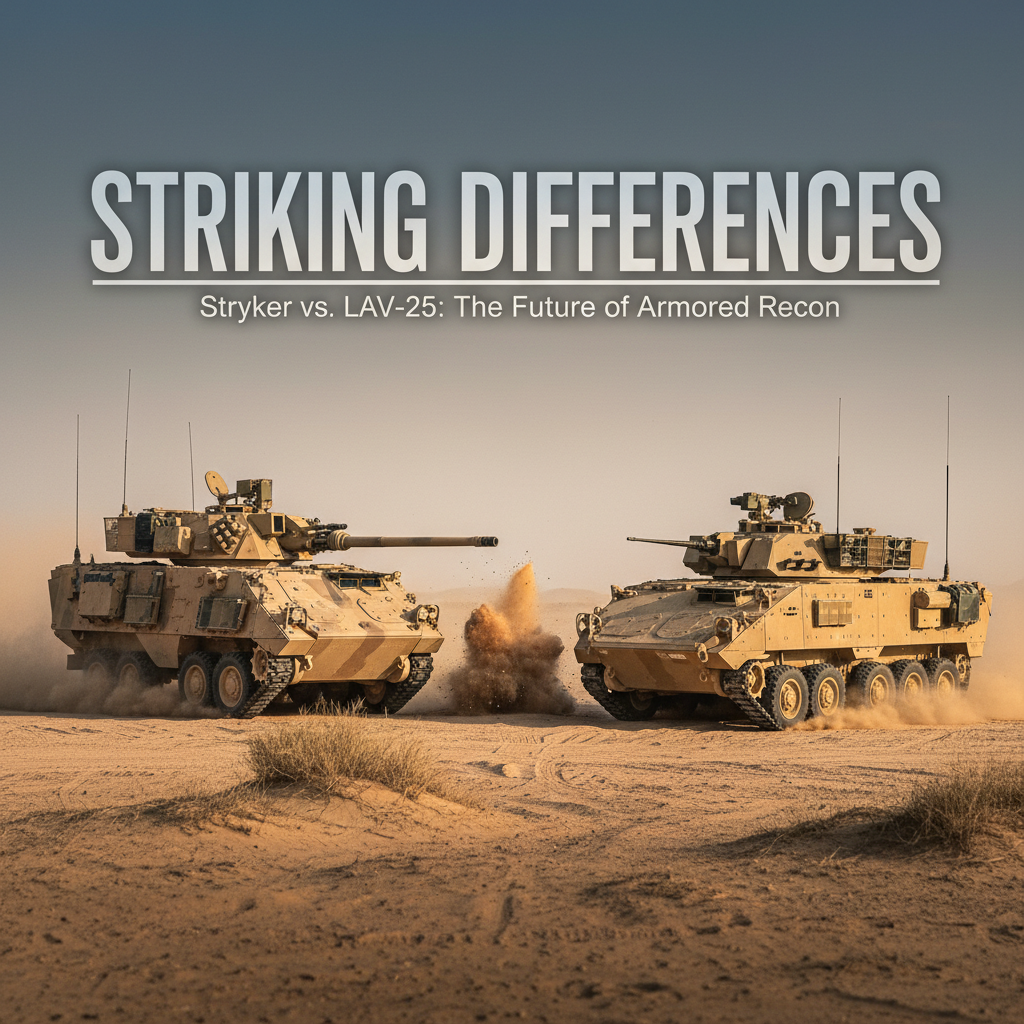
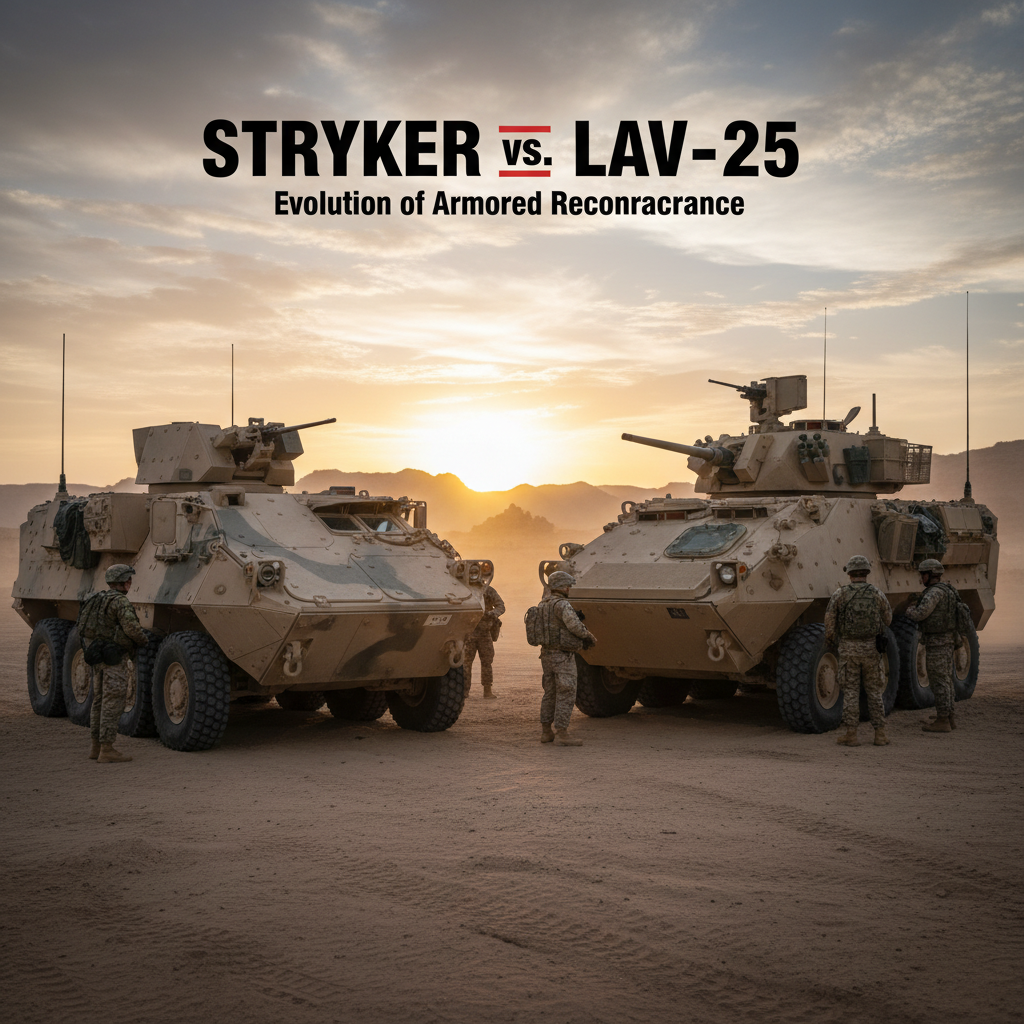
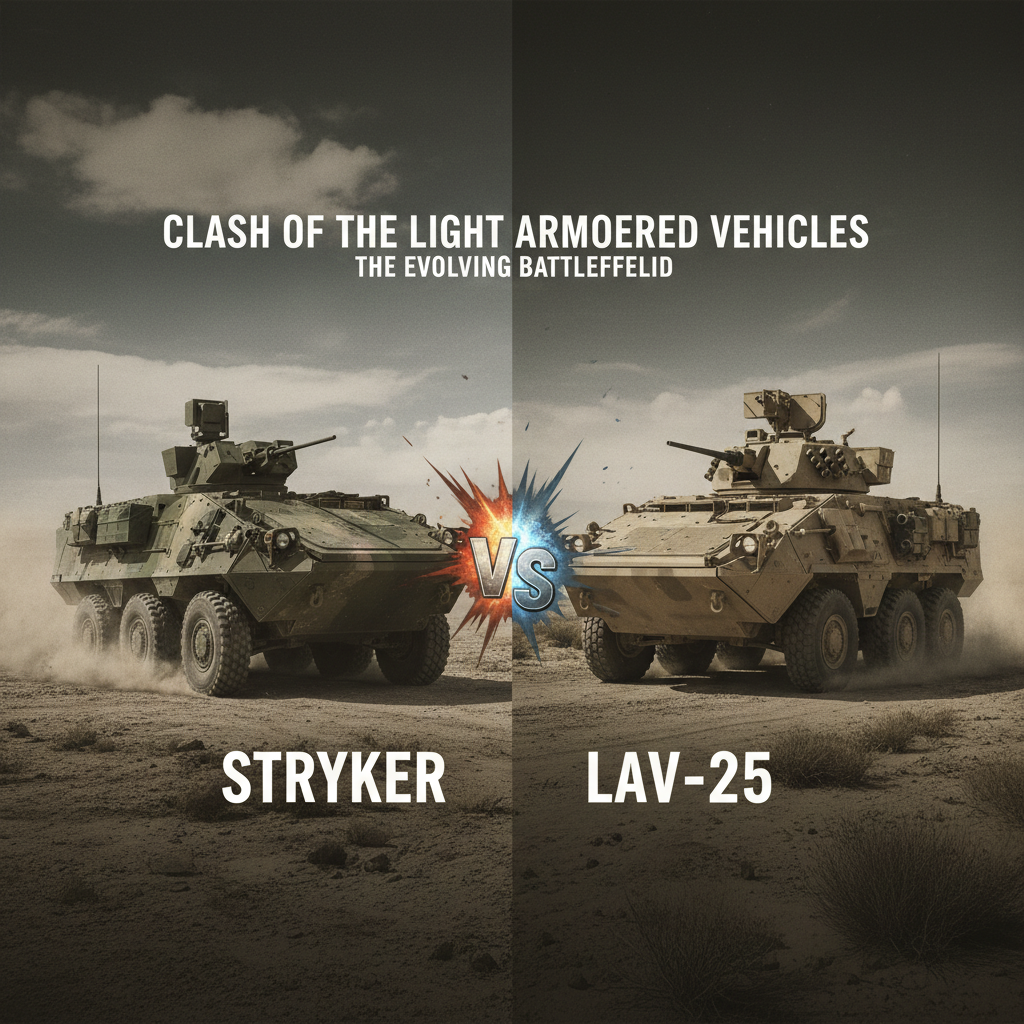
The Stryker and LAV-25 (Light Armored Vehicle) are both eight-wheeled armored fighting vehicles that have served the US military for decades. While they may look similar at first glance, these vehicles were designed for different roles and have distinct capabilities. This comprehensive comparison breaks down the key differences between these iconic military vehicles.
Quick Comparison Overview
| Feature | Stryker | LAV-25 |
|---|---|---|
| Primary User | US Army | US Marine Corps |
| Introduction | 2002 | 1983 |
| Weight | 18.16 tons | 12.8 tons |
| Crew | 2 + 9 troops | 3 + 6 troops |
| Main Armament | Various (by variant) | M242 25mm Bushmaster |
| Top Speed | 60 mph (road) | 62 mph (road) |
| Range | 330 miles | 410 miles |
| Cost | ~$4.9 million | ~$1.6 million |
Development and History
LAV-25: The Veteran
The LAV-25 entered service with the US Marine Corps in 1983, based on the Swiss MOWAG Piranha design. It was developed to provide the Marines with a fast, mobile platform for reconnaissance and fire support. The LAV-25 saw extensive action in the Gulf War (1991), where its speed and firepower proved invaluable in desert operations.
The vehicle’s name comes from its primary weapon – the M242 25mm Bushmaster autocannon. Over 40 years of service, the LAV-25 has been continuously upgraded with improved armor, electronics, and weapons systems.
Stryker: The Modern Platform
The Stryker was introduced in 2002 as part of the US Army’s transformation to a more rapidly deployable force. Named after two Medal of Honor recipients (PFC Stuart S. Stryker and SPC Robert F. Stryker), the vehicle was also based on the MOWAG Piranha family, specifically the Piranha III.
The Stryker was designed to fill the capability gap between light infantry and heavy armor, providing protection, firepower, and strategic mobility. It saw its combat debut in Iraq in 2003 and has since served in numerous conflicts.
Design and Protection
Armor and Protection
LAV-25:
- Aluminum armor hull
- Protection against small arms fire and shell splinters
- Resistant to 7.62mm rounds
- Add-on armor available for urban operations
- Lighter weight prioritizes mobility over protection
Stryker:
- Thicker steel armor
- Better baseline protection than LAV-25
- Slat armor available for RPG protection
- Optional ceramic appliqué armor
- Better IED protection (lessons learned from Iraq/Afghanistan)
- Can be fitted with reactive armor
Winner: Stryker – The Stryker offers significantly better protection, especially with add-on armor packages developed during the Iraq and Afghanistan wars.
Weight and Mobility Trade-off
The LAV-25’s lighter weight (12.8 tons vs 18.16 tons) gives it advantages in certain situations:
- Better acceleration
- Lower ground pressure (less likely to get stuck)
- Easier air transportability
- Better for amphibious operations
However, the Stryker’s additional weight provides:
- Better survivability
- More stable firing platform
- Room for upgrades and additional equipment
Armament and Firepower
LAV-25 Armament
Primary Weapon: M242 25mm Bushmaster autocannon
- Effective against light armor and personnel
- 200 rounds ready to fire
- Can penetrate 2.5 inches of armor at 1,000 yards
- Dual-feed system (AP and HE rounds)
Secondary Weapon: Coaxial 7.62mm M240 machine gun
Anti-tank: Usually carries AT-4 or Javelin missiles
Stryker Armament (Varies by Variant)
The Stryker comes in 10 different variants with different armament:
Infantry Carrier Vehicle (ICV):
- .50 cal M2 Browning or Mk 19 grenade launcher
- Remote Weapon Station (RWS)
Mobile Gun System (MGS):
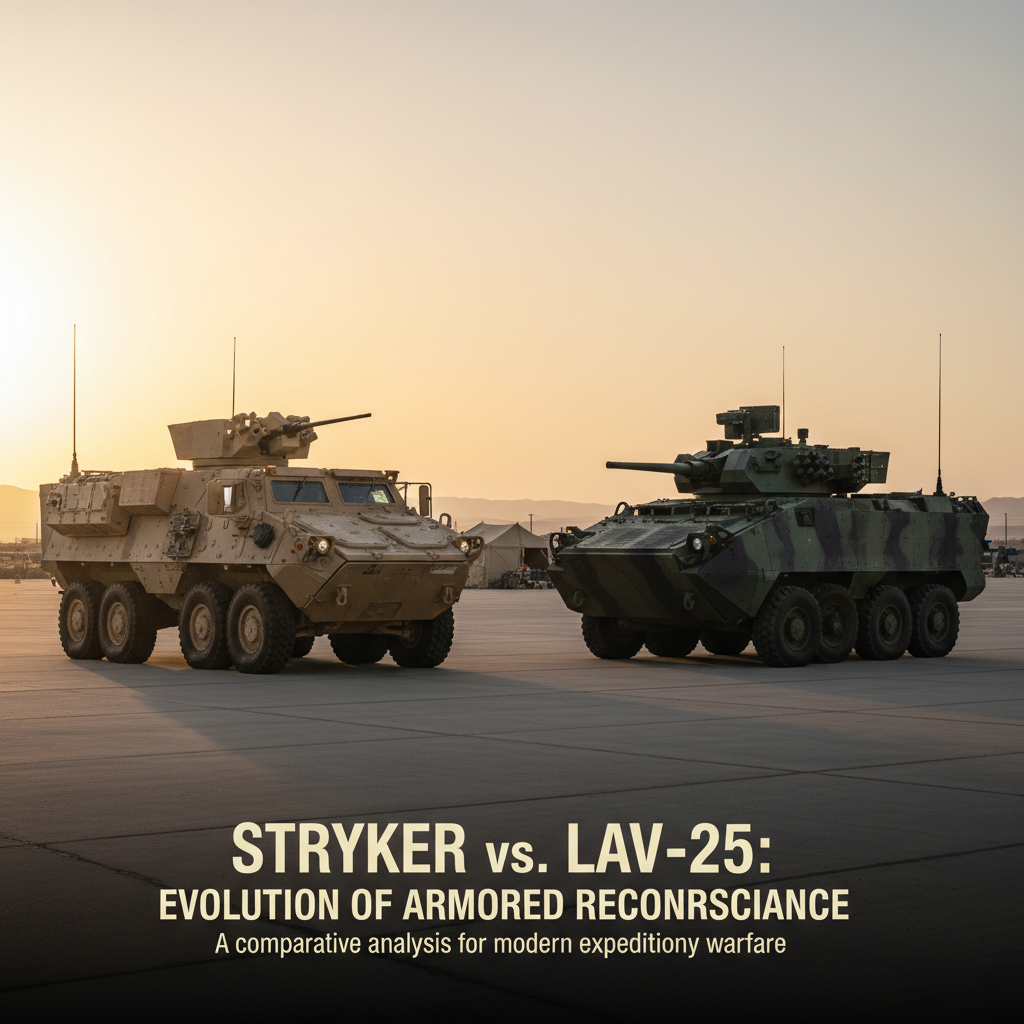
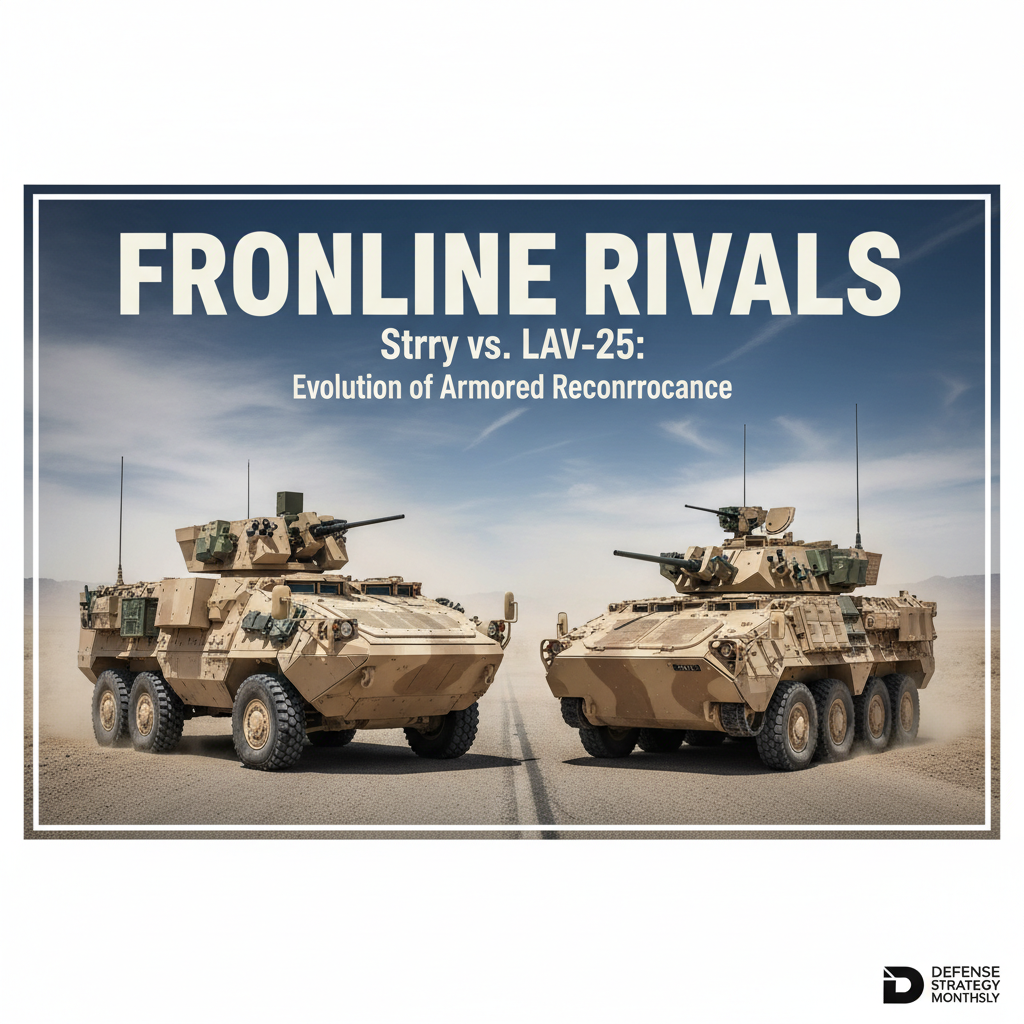
- 105mm M68A1E4 rifled gun
- Much heavier firepower than LAV-25
Dragoon Variant:
- 30mm XM813 Bushmaster II autocannon
- More powerful than LAV-25’s 25mm
Winner: Stryker MGS/Dragoon – While the standard Stryker ICV has lighter armament than the LAV-25, the MGS and Dragoon variants provide superior firepower.
Mobility and Performance
On-Road Performance
Both vehicles excel on paved roads:
- LAV-25: 62 mph top speed, 410-mile range
- Stryker: 60 mph top speed, 330-mile range
The LAV-25 has a slight edge in range and top speed due to its lighter weight.
Off-Road Performance
Both vehicles use 8×8 drive systems with central tire inflation systems, allowing crews to adjust tire pressure for different terrain.
LAV-25 advantages:
- Better power-to-weight ratio
- More agile in tight situations
- Lower ground pressure
Stryker advantages:
- More stable in rough terrain
- Better traction due to weight
- More ground clearance (some variants)
Amphibious Capability
LAV-25: Fully amphibious with minimal preparation. Can swim at 6 mph using propellers.
Stryker: Can ford water up to 3 feet deep, but is NOT amphibious in standard configuration. The Stryker Double-V Hull variant sacrifices water fording for better IED protection.
Winner: LAV-25 – Critical advantage for Marine Corps amphibious operations.
Crew and Troop Capacity
LAV-25
- Crew: Driver, gunner, commander (3 total)
- Passengers: 6 Marines
- Total: 9 personnel
Stryker ICV
- Crew: Driver, vehicle commander (2 total)
- Passengers: 9 soldiers
- Total: 11 personnel
Winner: Stryker – Can carry more troops, which is important for its infantry carrier role.
Operational Role and Doctrine
LAV-25: Marine Corps Reconnaissance
The LAV-25 serves primarily in Marine Corps Light Armored Reconnaissance (LAR) battalions. Its roles include:
- Reconnaissance and screening
- Security operations
- Offensive operations (limited)
- Raids and ambushes
- Supporting amphibious assaults
The LAV-25 prioritizes speed and firepower for reconnaissance missions, operating ahead of main forces to gather intelligence.
Stryker: Army Medium Brigade Combat Team
The Stryker forms the backbone of Army Stryker Brigade Combat Teams (SBCTs). Its roles include:
- Infantry transport and fighting
- Direct fire support
- Anti-tank operations (MGS variant)
- Command and control
- Medical evacuation
- Engineer support
The Stryker is designed to deploy quickly worldwide while providing better protection than trucks but more strategic mobility than tracked vehicles like the M2 Bradley.
Variants and Flexibility
LAV Family
The Marines operate several LAV variants:
- LAV-25: Infantry fighting vehicle
- LAV-AT: Anti-tank (TOW missiles)
- LAV-L: Logistics
- LAV-M: Mortar carrier (81mm)
- LAV-C2: Command and control
- LAV-R: Recovery vehicle
Stryker Family
The Army operates 10 Stryker variants:
- ICV: Infantry Carrier Vehicle
- MGS: Mobile Gun System (105mm gun)
- RV: Reconnaissance Vehicle
- FSV: Fire Support Vehicle
- CV: Commander’s Vehicle
- MC: Mortar Carrier
- ESV: Engineer Squad Vehicle
- MEV: Medical Evacuation Vehicle
- NBC RV: Nuclear, Biological, Chemical Reconnaissance
- ATGM: Anti-tank Guided Missile (Javelin)
Winner: Stryker – More variants provide greater flexibility for different missions.
Combat Experience
LAV-25
- Gulf War (1991): Excellent performance in desert warfare
- Somalia (1993): Urban combat experience
- Iraq (2003-2011): Reconnaissance and security operations
- Afghanistan (2001-2021): Limited use due to terrain
Stryker
- Iraq (2003-2011): Extensive combat in urban environments
- Afghanistan (2001-2021): Mountain and valley operations
- Syria (2017-present): Counter-ISIS operations
- Europe (2015-present): Deterrence operations
Both vehicles have proven effective but faced challenges with IED threats, leading to armor upgrades.
Cost and Logistics
Acquisition Cost
- LAV-25: ~$1.6 million per vehicle
- Stryker: ~$4.9 million per vehicle
The Stryker costs approximately 3x more due to better protection, newer technology, and more sophisticated systems.
Maintenance and Support
LAV-25:
- Simpler systems = easier maintenance
- Longer service life = mature supply chain
- Parts readily available
Stryker:
- More complex electronics
- Higher maintenance costs
- Better diagnostic systems
- Continuous upgrades available
Future Outlook
LAV-25 Replacement
The Marine Corps plans to replace the LAV-25 with the Amphibious Combat Vehicle (ACV) in the coming years. The ACV provides better amphibious performance and protection while maintaining mobility.
Stryker Modernization
The Army continues to upgrade the Stryker fleet with:
- Improved networking and communications
- Active Protection Systems (APS)
- 30mm cannon upgrades (Dragoon program)
- Enhanced mobility suspension
- Better power generation for electronics
Which is Better?
There’s no simple answer – each vehicle excels in its intended role:
Choose LAV-25 if you need:
- Amphibious capability
- Fast reconnaissance
- Lower cost
- Lighter weight for air transport
- Marine Corps interoperability
Choose Stryker if you need:
- Better protection
- Heavier firepower (MGS/Dragoon)
- More troop capacity
- Greater variety of mission roles
- Modern electronic warfare capabilities
Conclusion
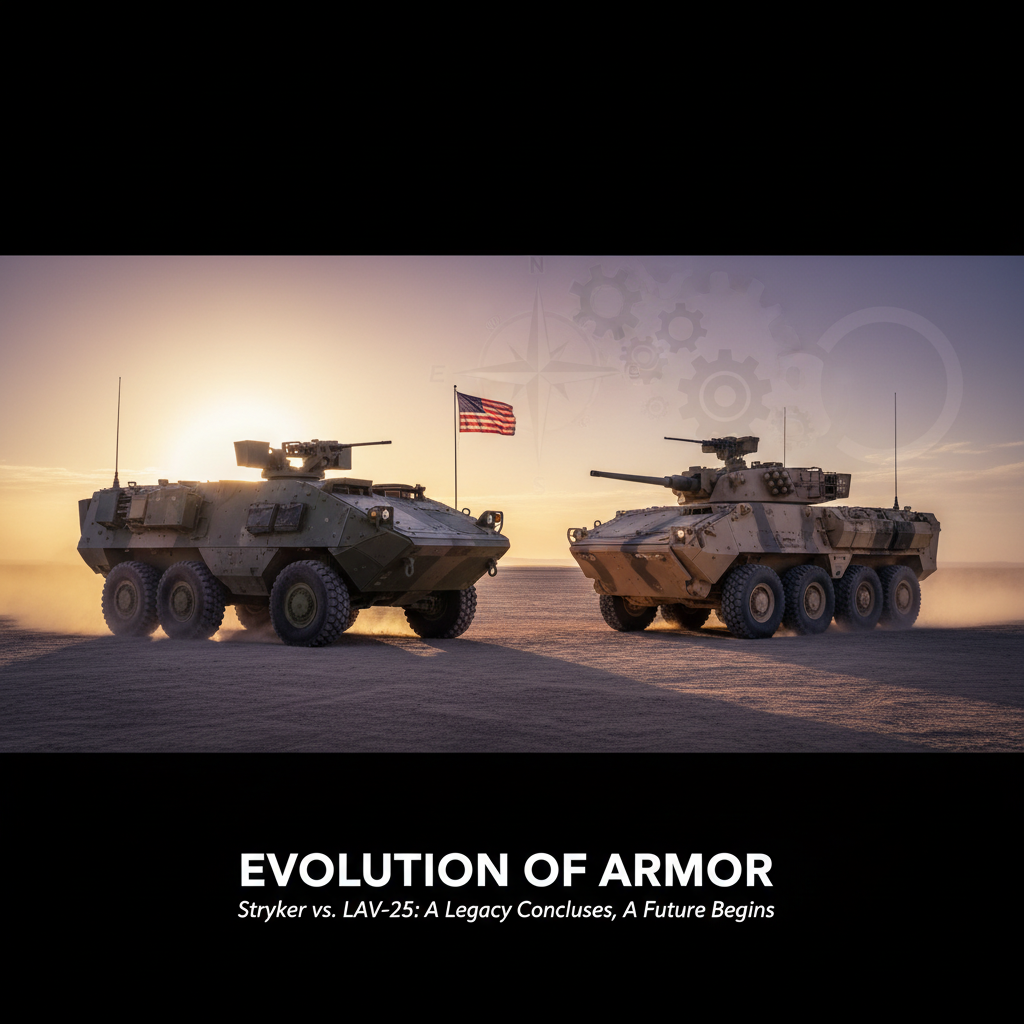
The Stryker and LAV-25 represent different philosophies in armored vehicle design. The LAV-25 prioritizes speed, amphibious capability, and cost-effectiveness – perfect for the Marine Corps’ expeditionary role. The Stryker prioritizes protection, firepower, and versatility – ideal for the Army’s need for a rapidly deployable medium force.
Both vehicles have proven their worth in decades of combat operations. While the LAV-25 is nearing replacement, its legacy lives on in the design of newer vehicles. The Stryker continues to evolve, incorporating lessons learned and new technologies to remain relevant on future battlefields.
For military enthusiasts and defense analysts, both vehicles represent successful examples of wheeled armored vehicle design, each optimized for their service’s unique requirements and operational doctrine.