Stryker vehicles have gotten complicated with all the variants, upgrade packages, and tactical debates flying around. As someone who has followed the Stryker program from its controversial beginnings to its current dominance in medium-weight warfare, I learned everything there is to know about these eight-wheeled fighting machines. Today, I will share it all with you.
Named after two Medal of Honor recipients — PFC Stuart Stryker from WWII and SPC Robert Stryker from Vietnam — this vehicle family transformed U.S. Army force structure when it showed up in 2002. It filled a gap that frankly had existed for decades.
Development Background
The Army realized it had a problem. Light infantry could deploy fast but showed up without firepower. Heavy armored divisions brought overwhelming force but took forever to get there. General Eric Shinseki championed the Interim Armored Vehicle program to create something in between. GDLS won with a design based on the Canadian LAV III and Swiss MOWAG Piranha family. The selection wasn’t without controversy, but the vehicle proved itself.
Technical Specifications
Probably should have led with this section, honestly. The Stryker measures 22.9 feet long, 8.9 wide, 8.7 tall. Combat weight ranges from 38,000 to 51,000 pounds depending on which variant and how much armor you bolt on. The Caterpillar C7 diesel makes 350 horsepower, drives all eight wheels through an automatic transmission, and pushes this thing to 62 mph on roads. That’s quick for an armored vehicle.
The 8×8 wheeled setup offers real advantages. Lower maintenance costs than tracks. Quieter operation — important when you’re rolling through a city at night. Self-deployment over road networks without a heavy equipment transporter. And the central tire inflation system lets crews adjust tire pressure on the move for different terrain. Clever engineering.
Stryker Variants
The M1126 Infantry Carrier Vehicle is the baseline — nine infantry soldiers plus a two-person crew. But the family gets big from there. The M1128 Mobile Gun System puts a 105mm cannon in an unmanned turret. The M1127 Reconnaissance Vehicle handles cavalry scout missions. The M1129 Mortar Carrier brings organic indirect fire with 120mm or 81mm tubes.
Then there’s the M1130 Commander’s Vehicle, M1131 Fire Support Vehicle for calling in artillery, M1132 Engineer Squad Vehicle with mine-clearing kit, M1133 Medical Evacuation Vehicle, M1134 Anti-Tank with TOW launchers, and M1135 NBC Recon Vehicle. That’s ten variants on one chassis. Logistics people love that kind of commonality.
Combat Performance
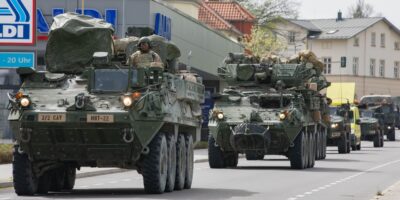
That’s what makes the Stryker endearing to us armor watchers — it proved the doubters wrong. It first saw combat in Iraq in 2003, and the results shut up a lot of critics. The vehicle’s quiet operation and agility in city streets made it effective for counterinsurgency work. Early deployments exposed RPG and IED vulnerabilities, which led to the slat armor “birdcage” that became the Stryker’s signature look.
Stryker brigades deployed extensively to Iraq, Afghanistan, and Europe. The strategic mobility argument paid off — Stryker units got to the fight faster than heavy brigades while bringing substantially more punch than light infantry.
Upgrades and Future
The Army keeps modernizing. The Double-V Hull provides better IED protection. The Dragoon variant straps on a 30mm cannon in a remote turret, which is a serious firepower upgrade for facing peer adversaries who bring more than RPGs to the party. Future plans include hybrid-electric drives and maybe directed energy weapons. The Stryker’s story is far from over.

Stay in the loop
Get the latest military vehicles vault updates delivered to your inbox.