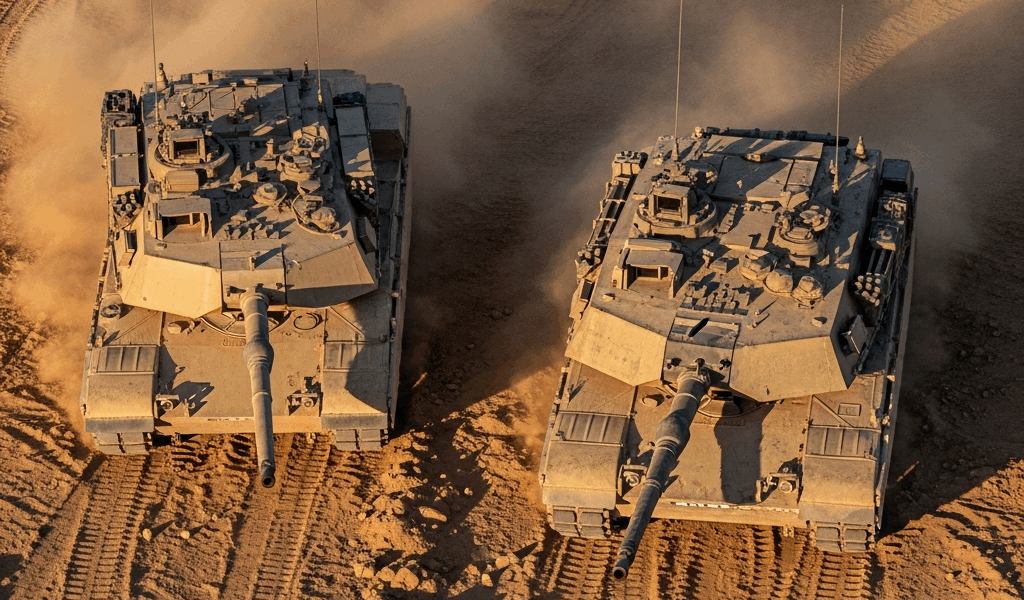
M1A2 Abrams vs Challenger 2 — Two NATO Tanks, Two Different Philosophies
The M1A2 Abrams vs Challenger 2 debate has gotten complicated with all the spec-sheet noise flying around. As someone who spent years buried in after-action reports, crew testimonies, and technical breakdowns from Iraq 2003, I learned everything there is to know about what separates these two machines. Today, I will share it all with you. And honestly, the specs aren’t even the interesting part — it’s the philosophy gap. These tanks were built by people who disagreed on nearly everything that matters: gun design, engine choice, crew protection, and what “survivable” actually means when rounds are coming at you. That gap tells you more than any spreadsheet ever will.
Smoothbore vs Rifled — The Gun Debate That Defines Both Tanks
But what is the core argument here? In essence, it’s a barrel dispute. But it’s much more than that.
The Abrams fires through a 120mm Rheinmetall L44 smoothbore barrel. The Challenger 2 runs a 120mm Royal Ordnance L30A1 rifled barrel. Same caliber. Completely different engineering logic. Rifling spins a projectile as it exits — stabilization through rotation. Smoothbore barrels skip all that and use fins instead. NATO’s consensus shifted toward smoothbore in the 1970s and 80s because fin-stabilized kinetic energy penetrators — those long dart-like rods that punch through armor — actually fly worse with spin. Rotation degrades their penetrating geometry. Germany went smoothbore with the Leopard 2. The US followed. Britain didn’t.
Frustrated by the idea of abandoning their existing doctrine and stockpiles, British engineers stuck with rifling — and the reason comes down to one round: HESH, or High Explosive Squash Head. It works by flattening plastic explosive against an armor plate before detonating, sending a shockwave through the metal that spalls lethal fragments off the interior surface. Devastating against older Soviet-era vehicles, field fortifications, light armor. HESH needs rifling to fly accurately at long range. The British had the stockpiles, the doctrine, and a strong institutional preference for the round’s versatility against a wider target set than just other main battle tanks.
Was staying rifled the right call? Honestly, it’s complicated. The L30A1 fires the L27A1 APFSDS tungsten penetrator well enough — Challenger 2 crews in Iraq reported high confidence in their accuracy at range. But the tank cannot fire standard NATO 120mm smoothbore ammunition. That’s a real logistical liability in a coalition environment. The Abrams, the Leopard 2A6, most other NATO tanks — all share compatible ammunition. Challenger 2 stands alone on this one. Don’t make my mistake of glossing over that detail; it matters enormously when you’re sharing a supply chain with allies.
Ammunition capacity tips slightly toward the Challenger 2 — 49 rounds versus the Abrams’ 42. That’s meaningful in a sustained engagement. The two tanks handle ammunition storage differently too. The Abrams uses a blow-out panel system that vents an explosion outward away from the crew. The Challenger 2 uses a different stowage arrangement in the hull bustle. Both designs take crew protection seriously here — just with different mechanical solutions to the same problem.
Armor Protection — Chobham Heritage, Different Approaches
Probably should have opened with this section, honestly. Because armor is where the design philosophy split becomes impossible to ignore.
Both tanks trace their armor lineage back to one place: a British research facility at Chobham Common in Surrey, where engineers in the late 1960s developed the first generation of composite ceramic-metal armor. The Americans licensed the technology for the original M1. The British used it on the Challenger 1, then substantially upgraded it for the Challenger 2 in a package they named Dorchester — sometimes called Burlington in earlier literature, though those names refer to different generations of the same lineage.
Dorchester armor is what makes the Challenger 2 arguably the most crew-survivable tank ever fielded. The exact composition is classified. What’s publicly known involves multiple layers of ceramic, metal, and undisclosed materials configured to defeat both kinetic energy penetrators and shaped charges through different mechanisms depending on the threat type. The British concentrated this protection heavily in the turret — where the crew sits, where most anti-tank rounds are aimed.
The Abrams takes a different approach. The M1A2 uses a composite package incorporating depleted uranium mesh layers distributed more broadly across the hull. DU is extraordinarily dense — about 1.7 times denser than lead — and that density stops penetrators effectively. The M1A2 SEPv3, which is the current production standard, weighs approximately 73.6 tons fully combat-loaded. Partly because of all that uranium.
The British said: protect the crew compartment above everything else, concentrate your best armor there, accept more hull vulnerability. The Americans said: distribute protection broadly, use DU’s properties to harden the tank throughout. Neither answer is wrong. They’re just answers to different threat models — and that distinction followed both tanks into actual combat.
The Challenger 2 TUSK and Streetfighter II modification packages later added reactive armor and slat armor for urban operations — suggesting the base protection had known gaps against RPGs and tandem-charge warheads, the same threats that proved deadly in Iraq.
Power and Mobility — Turbine vs Diesel
This is the section where logistics officers get either excited or furious, depending on which side they’re on.
The Abrams runs on a Honeywell AGT1500 gas turbine producing 1,500 horsepower. Gas turbines are remarkable machines — they’ll run on JP-8 jet fuel, diesel, even gasoline in a pinch. They start in extreme cold without complaint. They’re compact for their power output. They make the Abrams fast — top road speed around 42 mph, with cross-country capability that lets it keep pace with lighter vehicles over rough terrain. That’s what makes the turbine endearing to us armor enthusiasts. But the fuel consumption is the problem.
The AGT1500 burns roughly 10 gallons per hour at idle. Under hard driving, that climbs to around 60 gallons per hour. The Challenger 2’s Perkins CV12 — a 26.1-liter V12 diesel making 1,200 horsepower — burns dramatically less. I’m apparently a diesel partisan at this point, and the numbers work for me while turbine economics never quite add up. Multiple sources estimate the consumption ratio at roughly 3:1 in favor of the diesel under comparable operational conditions. That’s not a minor difference. That’s the difference between a supply convoy reaching the front once a day or three times a day to keep the same number of tanks rolling.
Humbled by a particularly detailed breakdown of Operation Iraqi Freedom’s fuel logistics, I came to appreciate just how much the Abrams’ turbine appetite shaped American operational planning. Units had to build substantial forward fuel stocks before major pushes. The tank is fast enough that it can literally outrun its own supply chain.
The Challenger 2 tops out around 37 mph — slower, yes. But that gap closes fast in cross-country movement where both tanks operate well below their road speed maximums anyway. The British Army accepted the speed trade-off for dramatically simpler, cheaper, more fuel-efficient logistics. The diesel also runs quieter at idle, which matters more than people expect in ambush environments.
Power-to-weight ratio favors the Abrams: approximately 23.8 hp/ton versus the Challenger 2’s roughly 19 hp/ton. In mud, loose sand, or steep grades, that gap shows. The Abrams can push through terrain that forces the heavier, less powerful Challenger 2 to find another route. So, without further ado, let’s be honest about the trade-off — the British bought logistics efficiency with speed and mobility currency, and they knew exactly what they were doing.
Combat Records — Iraq, Ukraine, and What They Proved
This is where the comparison stops being theoretical.
Both tanks deployed to Iraq in 2003. The Challenger 2 saw its most intense combat during the Battle of Basra with the British 7th Armoured Brigade. One incident became something of a legend in armor circles: a single Challenger 2 absorbed approximately 70 RPG rounds during an ambush in Basra — and drove away. Seventy. The crew walked out uninjured. The tank needed repair but wasn’t destroyed. That’s not a typo and it’s not exaggeration. It’s documented in British Army after-action reports and has been cited in subsequent armor protection analysis ever since.
The only Challenger 2 destroyed in Iraq was taken out by friendly fire. A British Challenger 2 engaged another British Challenger 2 in a misidentification incident in 2003, killing two crew members. That was the sole Challenger 2 combat loss in the entire Iraq campaign. No enemy action destroyed one. That was 2003 — and that record still stands.
The Abrams record is more complex. American units operated M1A1 and M1A2 variants extensively from 2003 through years of counter-insurgency operations. Multiple Abrams were knocked out or damaged by RPG attacks, EFPs, and friendly fire incidents. Several were lost to IEDs during the occupation phases. The US Army made the difficult decision to destroy a number of disabled Abrams in place to prevent capture — which tells you something about operational tempo and recovery capability under those conditions.
Comparing the two directly in Iraq isn’t entirely clean — the British operated largely in urban Basra while the Americans worked across a broader, often more intense operational area. Context matters. But the Challenger 2’s near-total immunity to crew casualties from enemy fire is a real data point, not a narrative someone invented afterward.
Then there’s Ukraine. The United Kingdom committed 14 Challenger 2 tanks to Ukraine in January 2023. Ukrainian crews trained on the system and deployed them to the southern front in late 2023. At least one was destroyed — visibly, with footage showing the tank burning after what appeared to be multiple hits, at least one reportedly a Russian FPV drone strike to the engine compartment. The turret was blown off in what analysts described as a catastrophic ammunition cook-off.
That loss drew significant attention partly because of the Challenger 2’s survivability reputation. The circumstances mattered — drone warfare in Ukraine operates on different physics than the RPG ambushes of Basra. A drone striking the rear deck bypasses the frontal arc protection that makes the Challenger 2 so formidable head-on. The M1A1 Abrams tanks sent to Ukraine were quietly withdrawn from front-line use in October 2023 after the Pentagon cited concerns about Russian drone and loitering munition threats — a tacit acknowledgment that no main battle tank designed in the 1970s and 80s was fully prepared for that threat environment.
The Verdict — Which Tank Would You Want
Clear position: if I had to choose one of these tanks to go to war in tomorrow, I’d want to be in a Challenger 2.
The Abrams is a better tank in the abstract — faster, better cross-country mobility, wider ammunition compatibility with allies, and a more robust upgrade path producing the M1A2 SEPv3 as a genuinely modern system. The distributed DU armor gives it solid hull protection. By most aggregate measures, it’s the more capable vehicle. Don’t make my mistake of dismissing that.
But crew survival is not an abstract category. The Challenger 2’s Dorchester armor and turret protection philosophy produced a combat record in Iraq that is almost without parallel in modern tank warfare — one loss, zero crew killed by enemy action. In a conflict where multiple Abrams were disabled, destroyed, or abandoned, that’s not coincidence. That’s the result of a specific decision to make crew survivability the first priority even at the cost of other capabilities.
The rifled gun is a genuine limitation in coalition operations — I’m apparently particular about ammunition logistics, and incompatibility with NATO standard rounds bothers me more the longer I think about it. The fuel efficiency advantage of the diesel only matters as much as your logistics chain is competent enough to exploit it. Real weaknesses, both. But the armor protection record and the crew survivability philosophy represent a coherent, proven answer to the actual question any soldier asks about their vehicle: if this goes wrong, do I come home?
The Abrams wins on mobility, logistics flexibility in a modern NATO context, and the breadth of its upgrade ecosystem. The Challenger 2 wins on crew protection and, arguably, gun versatility against the full spectrum of targets rather than just other main battle tanks. Both are elite vehicles — top tier of NATO armor, full stop.
But the tank with one combat loss in Iraq — zero from enemy action — is the one I’d climb into. The Challenger 2’s design philosophy put the crew first. In 2003, that philosophy proved itself under fire in ways that no exercise or simulation could have replicated beforehand.
- Firepower edge — Abrams, for NATO ammunition compatibility and penetrator performance
- Mobility edge — Abrams, by a meaningful margin in power-to-weight and top speed
- Logistics edge — Challenger 2, diesel efficiency reduces supply chain pressure significantly
- Crew protection edge — Challenger 2, and it’s not particularly close based on combat evidence
- Combat survivability record — Challenger 2, Iraq 2003 remains the definitive real-world test
- Upgrade path and future-proofing — Abrams, SEPv3 and ongoing US investment give it longevity
Neither of these tanks was built for the drone-saturated battlefield that Ukraine revealed. That’s the honest caveat to every conclusion drawn here. Both vehicles are being retrofitted with active protection systems, electronic countermeasures, and drone detection packages as a direct result of what’s happened since 2022. The next comparison — M1A2 SEPv3 with Trophy APS versus Challenger 3 — will probably look quite different. But based on what these tanks have actually done, in the conflicts where they were actually used, the Challenger 2’s design philosophy kept more soldiers alive. That counts for a great deal.

Stay in the loop
Get the latest military vehicles vault updates delivered to your inbox.