M113 history has gotten complicated with all the variants, upgrades, and global operators flying around. As someone who has followed armored personnel carriers since I first saw an M113 roll past during a base open house as a kid, I learned everything there is to know about this aluminum workhorse. Today, I will share it all with you.
Here’s a number that blows people’s minds: over 80,000 built since 1960. The M113 is the most widely produced armored vehicle in the Western world. It’s been everywhere, done everything, and it’s still out there doing it in dozens of militaries.
Development and Introduction
The Army wanted an air-transportable armored personnel carrier that could keep pace with tanks while stopping small arms and shrapnel. FMC Corporation won the contract, and the first M113s showed up in 1960.
The big innovation was welded aluminum armor. Aluminum instead of steel. That saved enough weight to make the M113 amphibious and light enough for a C-130 to carry. It still stopped 7.62mm rounds and shell fragments, which was the design requirement. Smart tradeoff.
Technical Specifications
Probably should have led with this section, honestly. Combat-loaded, the M113 weighs around 27,000 pounds. A Detroit Diesel 6V53T putting out 275 horsepower pushes it to 42 mph on roads and 3.6 mph swimming — yes, it swims using its tracks for propulsion. Crew is a driver, commander, and eleven infantry passengers.
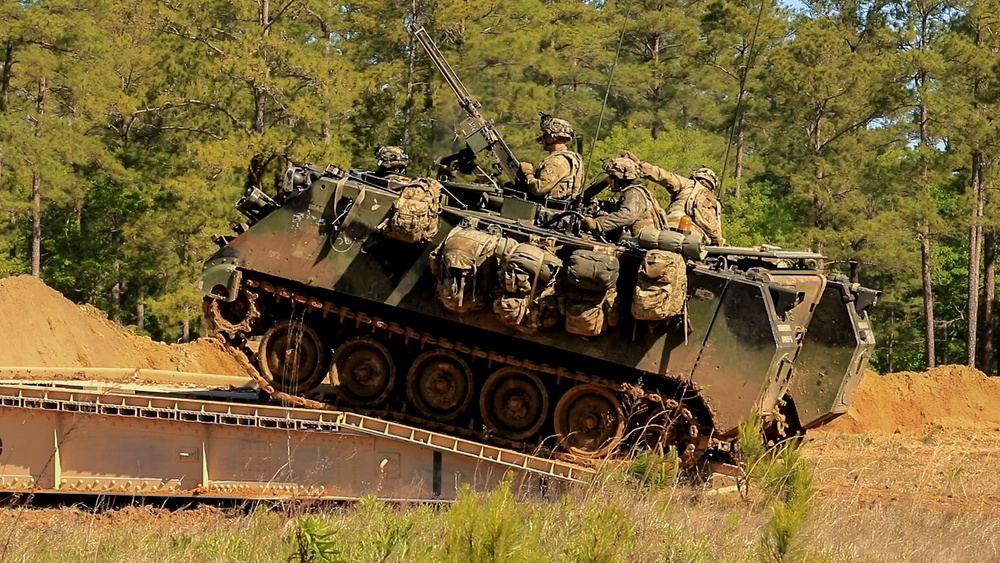
Standard armament is an M2 fifty-cal on a pintle mount, though crews in every war have bolted on whatever additional weapons they could find. The relatively low profile and small silhouette make the M113 harder to spot and hit than bigger APCs. Sometimes smaller is better.
Vietnam and Beyond
Vietnam was the M113’s trial by fire. American and South Vietnamese forces ran thousands of them as fighting vehicles, not just battle taxis. Crews added extra machine guns, welded on armored shields, and developed aggressive tactics that exploited the vehicle’s speed and firepower. They called them “tracks,” and those tracks changed the war.
After Vietnam, the M113 showed up at every American military operation: Grenada, Panama, Desert Storm, Somalia, Bosnia, Iraq, Afghanistan. Its simplicity and versatility kept it in service decades past its planned retirement. The Army kept trying to replace it, and the M113 kept hanging around because nothing else did everything it did for the price.
Variants and Adaptations
The M113 chassis spawned so many variants it’s almost ridiculous. M106 mortar carrier. M577 command post. M901 ITV with TOW anti-tank missiles in a hammerhead launcher. M163 Vulcan with a 20mm rotary cannon for air defense. Medical evacuation, recovery, fire support, engineer — you name it, somebody built it on an M113.
That’s what makes the M113 endearing to us armor enthusiasts — every country that got their hands on one did something different with it. Israel turned them into heavily modified vehicles like the Zelda and Nagmachon. The creativity is impressive.
Current Status
The U.S. Army is finally phasing M113s out, with the Armored Multi-Purpose Vehicle stepping in as the replacement for armored brigade combat teams. But thousands remain in Guard inventories and foreign service. The M113’s simplicity, reliability, and massive spare parts supply mean it’ll keep rolling into the 2030s in various armies.
And here’s a recent twist: Ukraine has received hundreds of M113s from multiple NATO countries. The old APC is back in high-intensity combat operations, fighting alongside equipment that’s decades newer. Sixty-plus years old and still in the fight. Try that with your lease vehicle.

Stay in the loop
Get the latest military vehicles vault updates delivered to your inbox.