
Military communications vehicles have gotten complicated with all the acronyms and systems flying around in discussions. As someone who’s spent years studying these rigs and working with veterans who actually operated them, I learned everything there is to know about how the military keeps its forces connected in the field. Today, I will share it all with you.
Military communications have evolved from signal flags to satellite links, but one constant remains through every technological leap: communications equipment must go where the forces go. Vehicle-mounted radio systems, satellite terminals, and networking equipment provide the connectivity that enables modern military operations. Without reliable comms, even the best-equipped force is fighting blind.
The Evolution of Mobile Communications
Probably should have led with this section, honestly. World War II established the pattern we still follow today: radio-equipped jeeps and trucks provided mobile communications that kept advancing forces connected to their commanders. The famous SCR-300 “walkie-talkie” and vehicle-mounted SCR-508 radios enabled coordination that previous armies couldn’t even dream of achieving.
Cold War developments added secure voice transmission, longer ranges, and many more channels to work with. Vietnam introduced helicopter-borne relay stations and early satellite communications experiments. Each conflict pushed communications capability forward, often out of desperate necessity. That’s what makes military comms history so fascinating—it’s driven by real operational needs, not marketing.
HMMWV Radio Configurations
The HMMWV proved ideal for communications installations, and that wasn’t an accident. Its cargo space accommodates radio racks, its electrical system (that beefy 24-volt setup I mentioned in another post) powers demanding equipment, and its mobility allows communications vehicles to follow the units they support.
Standard configurations include SINCGARS radio installations for tactical voice communications, Harris radio systems for longer-range communication needs, and increasingly sophisticated digital networking equipment. The S250 shelter variant provides enclosed workspace for communications personnel—basically a mobile office that can survive conditions that would destroy civilian equivalents.
Satellite Communications
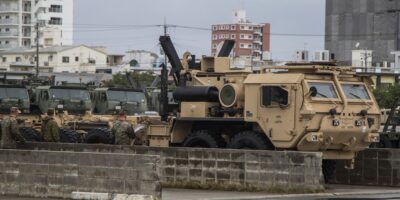
Vehicle-mounted satellite terminals connect ground forces to worldwide networks in ways that would have seemed like science fiction to earlier generations of soldiers. Systems range from compact VSAT terminals mounted on HMMWVs to large dish antennas on specialized trucks. These systems provide the bandwidth for video teleconferencing, serious data transmission, and reach-back to stateside support resources.
The Joint Network Node system links ground tactical networks to satellite communications, enabling internet-like connectivity in remote field locations. That’s what makes modern military operations so different from even twenty years ago. A patrol in Afghanistan could access databases located in the United States through these mobile gateways—capability that fundamentally changed how we fight.
Electronic Warfare
Communications vehicles aren’t just for talking—they’re also for listening, and sometimes for shutting the other guy up. Electronic warfare vehicles intercept enemy communications, locate transmitters through direction finding techniques, and jam hostile networks when ordered. These capabilities require specialized vehicles with sophisticated antenna systems and processing equipment that most people never see.
Counter-IED jamming vehicles became absolutely critical in Iraq and Afghanistan. Vehicle-mounted jammers blocked the radio signals used for remote-controlled detonators, protecting convoys from the most common IED trigger method. Those jammer trucks saved countless lives during the height of the insurgency.
Future Connectivity
Future military communications will leverage commercial advances in 5G, mesh networking, and software-defined radios—the military is actually watching civilian tech closely for once. Smaller, lighter systems will provide more capability than the heavy racks of previous generations. Autonomous vehicles may eventually serve as mobile relay stations, providing connectivity without risking human operators in dangerous positions.
But the fundamental requirement remains completely unchanged: military forces need reliable communications that work in hostile environments where civilian systems would fail immediately. The vehicles that carry this equipment will continue evolving alongside the technology they support, and that evolution shows no signs of slowing down.

Stay in the loop
Get the latest military vehicles vault updates delivered to your inbox.