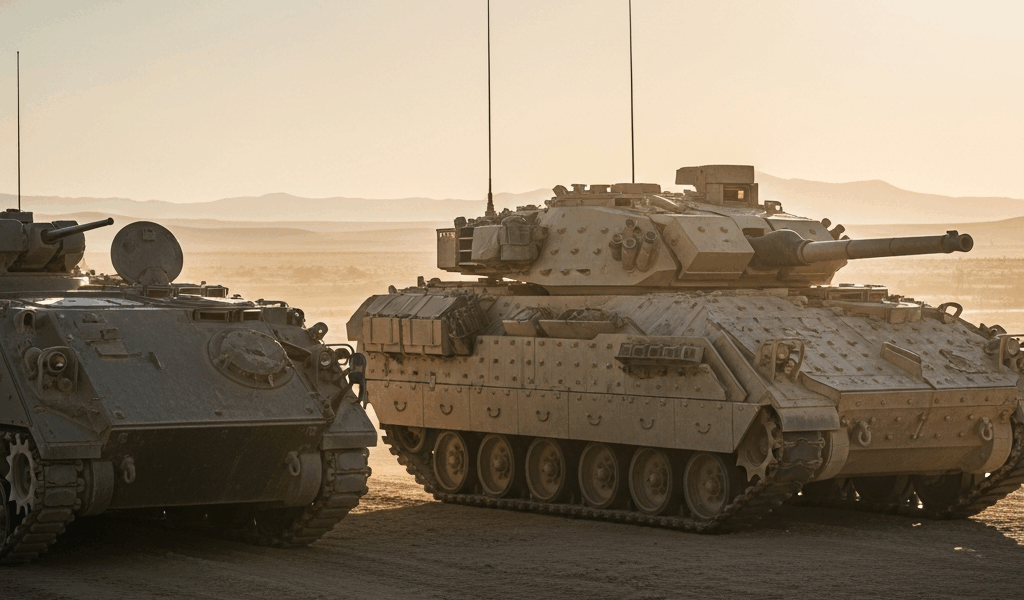
What the M113 Was Actually Built to Do
The Bradley Fighting Vehicle vs M113 debate has gotten complicated with all the armchair analysis flying around. I’ve spent years buried in declassified Army after-action reports and unit histories spanning Vietnam through the Gulf War, and the thing that keeps striking me is how consistently people misread the M113’s original purpose. It wasn’t a fighting vehicle. Not even close.
But what is the M113, really? In essence, it’s a battlefield taxi. But it’s much more than that — or at least it became more than that, which is half the story right there.
The M113 Armored Personnel Carrier hit service in 1960 with a brutally simple mission: get infantry across contested ground without them dying from artillery fragments and small arms fire. That’s the whole job description. Ride in it. Don’t fight from it.
What made the M113 revolutionary wasn’t any single feature — it was the package. Aluminum hull construction, specifically 5083 alloy, kept weight around 10.5 tons. Light enough for C-130 transport. Genuinely amphibious without any prep work at all. Drive it into a river. It floats. No kit, no setup, no waiting. The vehicle hauled 11 infantrymen plus a two-man crew and hit roughly 42 mph on road. For a Cold War Army expecting Soviet armor pouring through the Fulda Gap, something that could sprint rifle squads across Central European terrain wasn’t just useful — it was essential.
Vietnam exposed the platform’s real character. In the Mekong Delta, M113s pushed into terrain that swallowed tanks whole. Crews stripped overhead armor, mounted additional M60 machine guns, and rode exposed — turning a personnel carrier into something that fought more like a cavalry mount. “Zippo tracks.” “Cavalry tracks.” Soldiers improvised because the platform let them. That adaptability was genuine. So was the vulnerability. Aluminum armor handled small arms at distance but wasn’t engineered for RPG warheads. In Vietnam, RPGs became a serious problem. Don’t make my mistake of glossing over that detail when comparing these two vehicles — it matters enormously for everything that came after.
How the Bradley Changed the Mission
Probably should have opened with this section, honestly, because it reframes the entire comparison.
The Bradley didn’t replace the M113. It replaced the doctrine the M113 was built around. Those are completely different things.
Through the 1970s, Army planners watched Soviet mechanized doctrine evolve and reached an uncomfortable conclusion — dropping infantry near an objective wasn’t cutting it anymore. Infantry needed to fight mounted, with direct fire support from the vehicle itself, against other armored vehicles. That shift produced the M2 Bradley Infantry Fighting Vehicle. It entered service in 1981. That was a 21-year gap between vehicles, and every year of it showed in the design philosophy.
The armament change is where the mission change becomes impossible to ignore. The M113’s standard loadout was a single .50 caliber M2HB machine gun. The Bradley showed up with a 25mm M242 Bushmaster chain gun — capable of punching through light armor at combat ranges — plus a twin-tube TOW missile launcher for engaging main battle tanks. Troop capacity dropped from 11 soldiers to 6. That trade-off was genuinely controversial inside the Army. Critics said the vehicle was too complex to maintain, too heavy to move strategically, and carrying too few troops to justify the firepower compromise. Some of those critics had valid points. Some didn’t.
That’s what makes the Bradley endearing to us armor enthusiasts — it was a genuinely contested design that forced the Army to define what it actually wanted from a mechanized infantry platform.
The Gulf War settled most of the argument. Bradley crews destroyed more Iraqi armored vehicles during Desert Storm than M1A1 Abrams crews did. Not a typo. The vehicle critics called over-armed and over-complicated outperformed the main battle tank in vehicle kills — operating in exactly the combined arms formations it was designed for. So, without further ado, let’s get into why that happened and what it actually means.
Armor, Survivability, and the Weight Problem
Here’s where the trade-offs get honest.
The M113’s aluminum armor stops 7.62mm rounds at combat distance and handles artillery fragments reasonably well. It does not reliably stop 12.7mm heavy machine gun fire. It stops RPGs sometimes — angle-dependent, inconsistent, not something you’d want to bet your life on repeatedly. Later appliqué steel armor kits, specifically the M113A3 configuration, improved protection significantly. They also added weight and killed the amphibious capability that made the original design worth building in the first place. You can’t have everything.
The Bradley hull is steel, with appliqué armor options that were expanded substantially in the M2A3 and M2A4 variants. It absorbs considerably more punishment. In Iraq, Bradley crews walked away from IED strikes that would have turned M113s into scrap. The protection improvement isn’t marginal — it’s the kind of difference that shows up in casualty statistics.
But that protection costs weight. The original M2 Bradley came in around 22 tons. The M2A3 pushed toward 30 tons. A C-130 Hercules can carry one Bradley — with restrictions. It carried two M113s comfortably. Strategic deployability matters enormously, and heavier vehicles strain bridges, landing craft, and logistics chains in ways that compound over the length of a campaign. The M113 at roughly 10.5 to 12 tons fully loaded was simply easier to move across the world. In low-intensity environments where strategic lift is the actual constraint, that gap isn’t theoretical — it dictates what you can do and when.
I’m apparently someone who obsesses over logistics footnotes, and the C-130 payload difference works for me as a shorthand for the entire weight problem while abstractions about “strategic mobility” never quite land the same way. Mechanical simplicity cuts the same direction. Fewer systems mean fewer failure points. A motivated crew with basic hand tools could keep an M113 running in conditions that would ground a Bradley waiting on a Raytheon technician with proprietary diagnostic equipment.
Combat Record — Where Each Vehicle Was Tested
Stripped of the rhetoric, the records are clear.
The M113 fought in Vietnam’s rice paddies and jungle river deltas from 1962 onward. Flat, flooded Delta terrain gave American and South Vietnamese forces mobility no other vehicle could match. Fast enough to pursue dismounted infantry. Amphibious enough to cross waterways that stopped tanks cold. The 11th Armored Cavalry Regiment’s M113 operations along the Cambodian border in 1969 and 1970 are still studied as examples of what the platform could do when crews pushed it aggressively.
The Bradley’s real test came in the Kuwaiti desert, February 1991. During the 100-hour ground campaign of Operation Desert Storm, Bradley-equipped units from the 1st Infantry Division and 2nd Armored Cavalry Regiment engaged Republican Guard armor in direct fire. Final count: 280 Iraqi armored vehicle kills attributed to Bradley crews. The Abrams accounted for roughly 250. That outcome validated every argument the Bradley’s designers had made about mounted combined-arms warfare against a peer mechanized threat.
Iraq from 2003 onward added a harder data set. Bradleys absorbed IED hits, RPG strikes, and direct fire that would have been catastrophic in earlier vehicles. Casualties happened — the vehicle wasn’t invulnerable. But survivability in that environment exceeded what the 1980s threat models had projected. That’s a meaningful result, even accounting for the selection bias in how the vehicle was deployed.
Which One Wins — and Why the Answer Depends on the War
Frustrated by years of forum arguments going in circles, I kept digging through the records expecting a clean answer to surface. It never did. The honest answer is that both vehicles won — in the wars they were designed for.
As someone who has read more unit histories from both conflicts than is probably healthy, I learned everything there is to know about why this comparison refuses to resolve cleanly. Today, I will share it all with you — or at least the part that actually matters for understanding why both vehicles still have defenders.
The Bradley wins in mechanized combined arms warfare against any threat carrying anti-armor weapons. The 25mm Bushmaster and TOW integration give it a capability the M113 simply cannot replicate. Fighting Russian motor rifle units in Eastern Europe? You want the Bradley. Fighting Republican Guard divisions in Kuwait? Bradley. No serious debate there.
The M113 wins in low-intensity conflict, disaster response, logistics operations, and any environment where strategic mobility and mechanical simplicity are the binding constraints. It wins when you need 200 vehicles in a theater instead of 50. When roads are bad. When bridges are weak. When your maintenance battalion is already stretched past its rated capacity.
The telling fact — the one that makes this whole debate interesting — is that the M113 never actually left. The U.S. Army still operates M113 variants in support roles: ambulances, command vehicles, mortar carriers. Dozens of allied nations still run them as primary infantry carriers. A vehicle that was supposed to be replaced in the 1980s is still doing useful work in the 2020s. That’s not nothing.
That staying power isn’t nostalgia. It’s proof that the original mission — move troops, absorb small arms fire, go anywhere — remains a valid requirement in conflicts that don’t look like Desert Storm. The Bradley solved a problem the M113 wasn’t designed for. The M113 kept solving the problem it was designed for. Both statements are true simultaneously — and that’s what makes this comparison endearing to anyone who takes military history seriously.

Stay in the loop
Get the latest military vehicles vault updates delivered to your inbox.