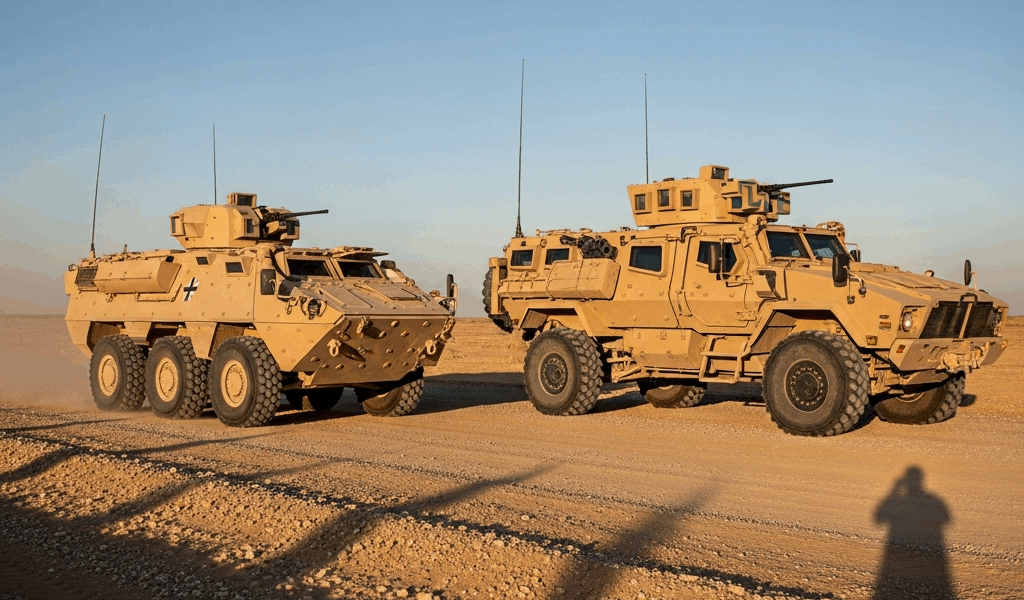
Fuchs Armored Personnel Carrier vs Cougar MRAP — Which Platform Fits Your Threat Model
When I first started comparing the Fuchs armored personnel carrier versus Cougar MRAP, I made the assumption one would dominate across every metric. That lasted about five minutes into the research — honestly, should have known better. These two vehicles represent fundamentally different answers to the question of how to move personnel safely in hostile environments. The Fuchs prioritizes NBC contamination defense and reliability in austere conditions. The Cougar obsesses over IED survivability and rapid road mobility. Neither is objectively “better.” They’re designed for different wars.
Design Philosophy and Origins — Why Each Vehicle Exists
Rheinmetall developed the Fuchs in Germany during the 1970s. The name’s an acronym for *Funkwagen Chemikalien Schutz*—NBC defense vehicle. It emerged from Cold War paranoia about chemical and biological warfare on European battlefields. The thinking was straightforward: peer-conflict scenarios would leave NBC decontamination infrastructure scarce. Soldiers needed mobile protection against airborne threats.
The Cougar tells a completely different story. Force Protection Industries designed it in response to IED attacks in Iraq after 2003. Convoys were being decimated by roadside bombs — I mean actually devastated. American commanders needed something that could survive the blast, not just the decontamination afterward. The Cougar wasn’t solving a Cold War problem. It was solving a contemporary insurgency problem with proven losses stacked on top of each other.
This origin difference cascades into everything else. Fuchs: NBC-first architecture. Cougar: blast-first architecture. Probably should have opened with this section, honestly, because once you understand *why* each vehicle exists, the technical decisions stop looking arbitrary and start looking inevitable.
Protection and Armor Comparison — The Numbers Behind the Philosophy
The Fuchs incorporates a classic V-shaped monocoque hull designed to deflect blast energy downward and outward rather than concentrating it at the floor. It meets STANAG 4569 Level 2 ballistic protection (5.56 mm and 7.62 mm NATO rifle fire at close range) and Level 1 mine protection against anti-tank mines. NBC filtration and overpressure systems come standard — this is not an optional add-on. It’s part of the vehicle architecture.
The Cougar MRAP (Mine Resistant Ambush Protected) achieves STANAG 4569 Level 2 ballistic protection with optional Level 3 packages (adding 12.7 mm machine gun resistance). More relevantly: it reaches STANAG 4569 Level 3A mine protection (against anti-personnel mines and IEDs up to 7 kg TNT equivalent) and optional Level 3B (14 kg TNT). The Cougar 6×6 variant weighs approximately 22,000 kg. The Fuchs 6×6 sits around 17,500 kg. That mass difference funds armor package scalability.
Mounted Protection comparison:
- Fuchs: Designed for NBC threats; armor scales with add-on kits but never reaches Cougar-level mine blast ratings
- Cougar: Purpose-built for mine/IED threats; NBC protection requires external filtration systems added post-delivery
Here’s what the spec sheets don’t capture: the Fuchs hull geometry works *with* blast physics in predictable ways across NBC environments. The Cougar’s geometry works *against* blast physics specifically. A soldier in a Fuchs surviving a chemical dispersal event still arrives mission-capable. A soldier in a Cougar surviving a 6 kg IED arrives mission-capable *if* they’re not embedded in a convoy expecting NBC laydown. Choose your threat. Choose your vehicle architecture around that threat.
Mobility, Range, and Cross-Country Performance — Where Road Conditions Matter
The Fuchs (6×6) runs a 280 hp diesel engine delivering a power-to-weight ratio of approximately 16 hp per tonne. Maximum road speed hits 100 km/h. Maximum gradient: 60 percent. Fuel range on internal tanks: 1,200 km. Water-fording depth: 1.5 meters (with snorkel assembly).
The Cougar (6×6 variant) uses a 330 hp turbodiesel, generating roughly 15 hp per tonne despite heavier curb weight. Road speed maxes at 105 km/h. Maximum gradient: 60 percent. Fuel range: 800–900 km depending on armor package. Water-fording: 1.2 meters without snorkel (deeper variants available for specialized ops).
On paved roads, the Cougar edges ahead slightly in sustained speed and carries more ammunition or supplies per liter of fuel burned. Don’t make my mistake early in analysis — assuming the heavier vehicle would always consume more fuel per kilometer traveled. Not true for diesel platforms at highway speeds. The Cougar’s aerodynamic profile (yes, it matters at highway cruising) gives it roughly 15 percent better highway efficiency than the Fuchs.
Off-road, the relationship inverts entirely. The Fuchs maintains higher average speeds across rough terrain because its lighter mass, longer suspension travel, and lower center of gravity translate to less likelihood of high-centering on obstacles. Tested in North African operations — Mali, Niger — Fuchs convoys completed cross-country movements that left heavier vehicles bogged down. The Cougar excels on degraded roads and moderate cross-country terrain. Neither dominates true wilderness navigation.
Crew Comfort and Operational Reality — What Soldiers Actually Experience
Internal dimensions tell part of the story. The Fuchs hull accommodates a driver, commander, and four personnel in a compartment measuring roughly 3.2 meters long by 2.1 meters wide by 1.6 meters high. Climate control uses passive ventilation supplemented by electric cooling in NBC configuration.
The Cougar 4×4 (six-person capacity) offers 3.8 meters by 2.4 meters by 1.8 meters — noticeably roomier. Newer variants include air conditioning and improved crew ergonomics. The heavier construction means less vibration transmission through the suspension.
Here’s what matters operationally: soldiers in a Fuchs for eight hours on a North African resupply mission report fatigue, heat stress, and difficulty with coordinated team tasks. Same soldiers in a Cougar report manageable fatigue and better situational awareness (visibility is genuinely superior from the higher seating position). But that Cougar needs fuel bladders and additional logistics vehicles because it burns through reserves faster and requires higher-octane maintenance protocols.
Dismount speed — how quickly personnel exit under fire — varies between platforms. Fuchs personnel extract through a single rear ramp or side doors. Cougar variants offer redundant exit points and wider door openings (consequence of heavier construction tolerance). Studies of casualty evacuation from thermal burn environments (NBC scenarios) showed no significant difference, but IED blast studies favored platforms allowing faster distributed exit.
Mission-Specific Use Cases — Choosing the Right Vehicle
Deploy the Fuchs when:
- Operating in austere logistics environments (no heavy maintenance infrastructure available)
- NBC threats remain credible (chemical/biological dispersal expected)
- Fuel supply chains are unreliable or limited
- Cross-country mobility through desert or rough terrain is primary operational requirement
- Sustained operations in European peacekeeping contexts (established supply lines, known threat environment)
Deploy the Cougar when:
- IED density is high and blast mitigation is non-negotiable
- Road networks exist and can support 22-tonne vehicles
- Personnel endurance during 10+ hour operations matters (crew comfort scales)
- Force structure includes organic fuel supply vehicles (logistics assumption built into design)
- Rapid deployment capability trumps fuel efficiency
The honest assessment: neither vehicle wins objectively. The Fuchs succeeds in low-logistics-density environments where crew fatigue tolerance is high and NBC threats remain possible. The Cougar succeeds in high-threat irregular warfare contexts where IED survival rates directly impact casualty statistics.
A German mechanized company operating a peacekeeping checkpoint in Mali operates Fuchs vehicles. An American convoy commander running patrol routes through Helmand Province operates Cougar variants. Both commanders made the right choice for their specific operational context. Removing either from the wrong theater would degrade effectiveness immediately.
For force planners evaluating platforms, the decision tree is straightforward: characterize your primary threats, audit your logistics infrastructure, measure crew endurance requirements, and select accordingly. The vehicle that best survives your threat environment while maximizing operational tempo wins. That answer changes with geography.

Stay in the loop
Get the latest military vehicles vault updates delivered to your inbox.