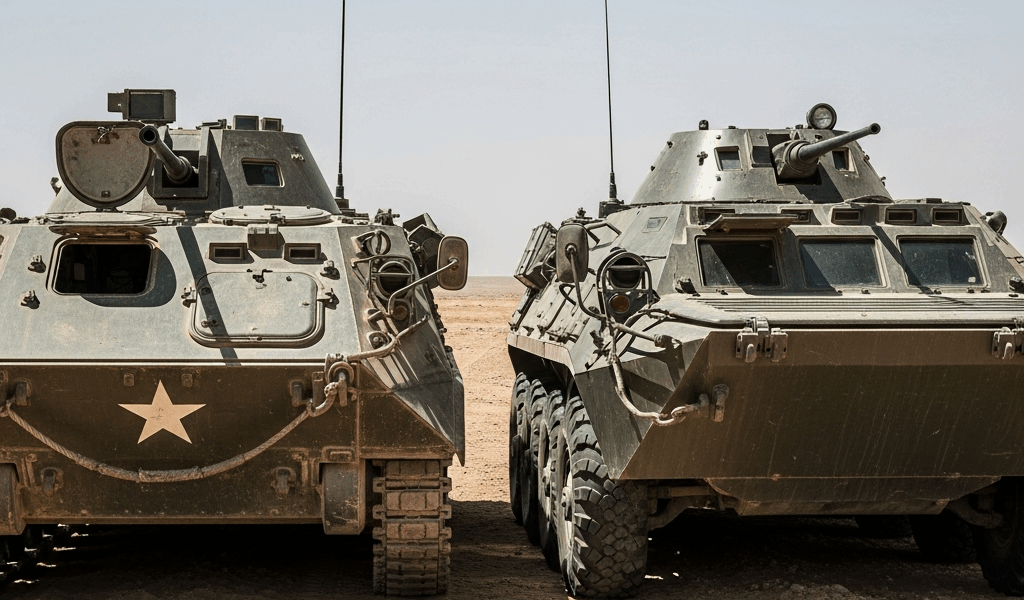
Two APCs, Two Doctrines
The M113 vs BTR-60 debate has shifted noticeably with all the tank-obsessed content flying around. Seriously — try finding a proper breakdown of these two vehicles and you’ll wade through a dozen M60 vs T-72 pieces before you find anything useful. These workhorses of the Cold War get ignored. They weren’t photogenic. Nobody put them on magazine covers. But the M113 and the BTR-60 moved infantry into contact on nearly every significant proxy war from the 1960s through the 1980s, and the design philosophies baked into each one couldn’t have been further apart.
The M113 was built around adaptability — bolt something to it, and it becomes that thing. The BTR-60 was built for exactly one scenario: keeping pace with Soviet armor in a high-speed push across the Central European plain. Both worked. Both had serious, sometimes fatal, problems. Here’s the honest breakdown.
Armor, Protection and Surviving a Fight
The aluminum hull on the M113 is what gets people. Aluminum — on a vehicle meant to carry troops into live fire. The hull runs about 38mm at its thickest points, which sounds reasonable until you learn that the 12.7mm DShK heavy machine gun, standard Soviet kit, punched straight through it at normal combat ranges. That wasn’t a theoretical problem. In Vietnam, Viet Cong and NVA crews with .51 caliber DShKs were killing soldiers inside M113s that their own commanders believed were protected. The Army eventually fielded appliqué steel armor kits. Crews started stacking sandbags on the floors. Added weight, created new problems — but they learned. The hard way, obviously.
The BTR-60 used welded steel construction, roughly 9mm on the sides. Better against small arms and light automatic fire, which fit the intended role well enough. On a prepared Warsaw Pact offensive axis — wide roads, combined arms support, engineers clearing obstacles out front — 9mm of steel is probably adequate. But the real BTR-60 problem wasn’t armor thickness. It was the exits.
One rear hatch. Eight or more fully equipped troops. Under fire. That’s a tactical nightmare — at least if you expect to survive the dismount. Reports from Afghanistan describe Soviet soldiers bailing out of the top hatches during contacts because waiting for the rear hatch was simply too slow and too lethal. The top gunner positions were open, which exposed crew exactly when you’d want them most protected. So both vehicles had survivability gaps. They just failed in completely different ways.
Mobility and Where Each One Thrives
Tracked versus wheeled is a debate that never really settles, and the M113 against the BTR-60 is maybe the clearest case study in why the answer is always “it depends on the ground under you.”
The BTR-60 runs on eight wheels and moves fast on improved roads — around 80 km/h, which is genuinely impressive for a troop carrier. It was amphibious out of the factory, no preparation required, which mattered enormously for Soviet operational planners dealing with river-heavy European terrain. The whole design assumed movement: fast, road-bound or near it, with support assets clearing hard obstacles ahead. In that context, the speed and range are real advantages, not marketing numbers.
Put it in Vietnam-style terrain and the math flips immediately. Tracks handle rice paddies, soft ground, jungle trails, and steep slopes in ways eight wheels simply cannot replicate. The M113 — running the Continental Motors 75 hp gasoline engine in early production variants and the Detroit Diesel 6V53 in later ones — topped out around 61 km/h on roads. Slower than the BTR-60. But American crews in Vietnam figured out they could push M113s through vegetation, across paddies, directly at enemy positions, almost like cavalry charges. FMC hadn’t designed the vehicle for that. The terrain forced the improvisation, and the tracks made it possible.
Important part first. The terrain context is what makes every other comparison actually make sense.
Combat Record — Where They Actually Got Used
Frustrated by how often armchair analysis ignores what actually happened downrange, I spent considerable time going through after-action reports and operational histories from conflicts where both vehicles showed up. The differences are stark.
The M113 arrived in Vietnam in 1962 with ARVN units as part of early US advisory efforts. Almost immediately it demonstrated something the designers hadn’t fully anticipated — it was genuinely terrifying to lightly armed infantry caught in open terrain. During the Battle of Ap Bac in January 1963, ARVN M113s absorbed heavy fire that killed and wounded multiple crew members, partly because commanders were using them in roles the vehicles weren’t optimized for. Those lessons fed directly into later American employment doctrine. By the late 1960s the M113 had become mortar carriers, command vehicles, flamethrower platforms, improvised gun trucks. Israeli forces used them hard during the 1973 Yom Kippur War — took losses, but demonstrated the vehicle could sustain a combined arms fight across the Sinai. British forces deployed them in the Falklands in 1982. Terrain that was essentially the opposite of anything the original designers had imagined.
The BTR-60 met its real test in Afghanistan starting in 1979. Soviet forces entered expecting the wheeled APCs to perform as they had in exercises — road-mobile, fast, supporting mechanized advances. The terrain and the insurgency exposed the design’s weaknesses in ways European planning had never anticipated. Mujahideen fighters learned quickly that RPG shots into the wheel wells and undercarriage could kill the vehicle, and that single rear exit created fatal bottlenecks during ambushes in mountain passes. That was 1980. The Soviets were already planning the BTR-80 — a direct answer to the Afghanistan lessons. Cuban-operated BTR-60s saw extensive combat in Angola throughout the late 1970s and 1980s, generally performing adequately in the more open southern terrain where the wheeled design was less of a liability.
Which One Would You Want to Be In
Forced to choose, it depends entirely on which war you’re fighting — and honestly, that’s the whole point.
If you’re a Soviet motor rifle trooper in 1980, executing a combined arms offensive across the North German Plain with air support, artillery preparation, and engineers clearing hard obstacles ahead, the BTR-60 fits the doctrine it was built for. Speed matters in that scenario. Amphibious crossing capability matters. The vehicle makes sense.
But what is genuine adaptability worth in a fighting vehicle? In essence, it’s the ability to keep being useful as the mission changes around you. But it’s much more than that — it’s the difference between a vehicle that survives six decades and one that gets replaced after its first real war.
If you’re operating in unpredictable terrain, without a prepared axis of advance, in a conflict that keeps changing shape — the M113 wins. Not on armor, not on firepower. On adaptability. You can bolt almost anything to an M113 and make it work. Operators have done exactly that, repeatedly, across six decades. Don’t make the mistake of judging it by what it looked like in 1960.
I’m apparently wired to appreciate platforms over point solutions — and the M113 works for me while the BTR-60 never quite does outside its specific context. M113 derivatives are still in active service with multiple militaries right now, in 2024, more than sixty years after the original design entered production. The BTR-60 has been replaced by successive generations. That’s not a knock on the Soviet engineers. It’s a reflection of what doctrinal flexibility actually buys you over time — the M113 was never the best at any single thing, and that turned out to matter more than anyone expected.

Stay in the loop
Get the latest military vehicles vault updates delivered to your inbox.