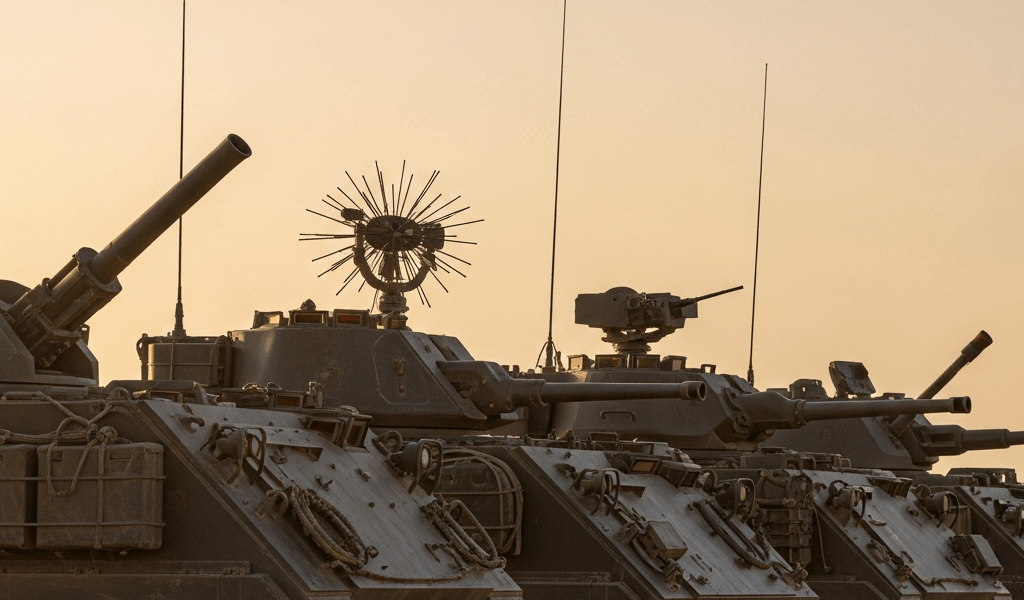
The M113 Was Never Just a Box on Tracks
M113 APC variants have evolved with all the misinformation flying around. Most people picture the wrong vehicle entirely — usually the bare-bones troop carrier, nothing else. The base M113 armored personnel carrier rolled off assembly lines starting in 1960, and by the time production wound down decades later, over 80,000 had been built across dozens of countries. But here’s what gets buried under that headline number: the M113 wasn’t a finished product. It was a platform. A chassis. A blank slate waiting for an engine shop or ordnance team to bolt something completely different on top.
I spent three years researching Cold War armor procurement, and I made the rookie mistake of treating all M113s as interchangeable. They aren’t. Not even close. The difference between an M106 mortar carrier and an M577 command post goes way beyond paint and furniture — it’s about mission, firepower, and how a battalion commander could actually function in the field. Worth mentioning before anything else, because understanding the platform first is what makes the variants click.
The Army didn’t slap different turrets on the same hull for fun. Each variant solved a specific operational problem that standard APCs simply couldn’t touch.
Fire Support and Mortar Carrier Variants — The M106 and M125
Want to know what an underreported variant looks like? The M106 107mm mortar carrier. This thing saw heavy action in Vietnam — particularly with artillery batteries supporting rifle companies in the Mekong Delta and Central Highlands. The M106 mounted a rifled 107mm mortar directly inside an M113A1 hull, with the gun crew operating from within the armored shell rather than sitting exposed in an open pit.
By Vietnam standards, that was genuinely revolutionary. A towed mortar left your crew out in the open while the gun was setting up. The M106 let crews shoot on the move, or dig in for fire support missions with full protection overhead. Units like the 25th Infantry Division ran them hard. Maximum range sat around 5,500 meters, and trained crews could pump out roughly six rounds per minute. That’s not a typo — six per minute. Enough to suppress an ambush or reinforce a contact point while the reaction force organized itself and got moving.
The M125 came later, trading the 107mm for an 81mm mortar. Same basic concept, but the 81mm was lighter, more flexible, and became the standard NATO battalion-level mortar. The M125 saw service through the 1970s and into the Gulf War, where it proved its worth in a completely different kind of fight. Desert warfare meant longer sightlines and bigger engagements. The M125’s lower profile tucked behind a sand dune was actually useful — not just a limitation.
Mounting a mortar inside an M113 instead of towing it solved two problems simultaneously:
- Crews stayed under armor during both setup and firing
- The vehicle could relocate without disconnecting ammunition or gun systems
That second point matters more than it sounds. In a mobile engagement, every minute spent hooking and unhooking a trailer is a minute you’re not supporting the main effort. That math gets brutal fast.
Command, Comms, and Specialized Roles — The M577 and M548
If you’ve ever seen a photograph from a 1970s Army field exercise and noticed an M113 with a noticeably taller rear section, you were looking at an M577 command post variant. The raised roof — almost three additional feet of vertical clearance — wasn’t cosmetic. Battalion and company commanders needed actual working space: maps, radios, personnel, without everyone hunched over a cramped aluminum box that smelled like diesel and sweat.
The M577 carried up to 11 radios and a full staff inside. That meant a battalion commander could establish a mobile command post that actually functioned like one. Maps spread across tables. Radio operators at separate stations. Running a battalion-sized operation inside a standard M113 hull was like trying to perform surgery in a phone booth — technically possible, definitely not recommended, and probably going to get someone killed.
The M548 cargo carrier handled supply and ammunition transport, which sounds boring until you realize that logistics wins wars. An M548 could haul 3.5 tons of ammunition, fuel, or rations over terrain that would strand a standard 5-ton truck. That payload capacity mattered enormously in Vietnam, where resupply convoys navigated narrow jungle tracks barely wide enough for a single vehicle. It mattered just as much in Europe, where the M548 could keep pace with M113 rifle companies moving cross-country at sustained speeds.
Medical evacuation variants also emerged — though they’re rarely catalogued separately in most reference materials. Standard M113A1s were modified to carry litter racks and basic field hospital equipment, turning the armored box into a mobile ambulance capable of extracting wounded from active hot zones. Some units stripped the gun mounts entirely and fitted stretcher frames, creating dedicated MEDEVAC tracks that could operate in environments where an unarmored ambulance wouldn’t last ten minutes.
The Weird Ones — Flame Throwers and Anti-Tank Variants
Here’s where the M113 story gets genuinely strange — and honestly, more interesting. The M132 Zippo — yes, that was the actual nickname, borrowed directly from the lighter brand — mounted a 200-gallon napalm thrower on an M113 chassis. Designed in the late 1950s, it entered combat in Vietnam starting in 1964. The psychological impact of a flame-throwing armored vehicle rolling through dense jungle during a sweep operation is difficult to fully appreciate from a distance of sixty years.
Tactically, the M132 solved a specific problem: clearing fortified positions without leveling structures that might still contain civilians. A burst from the M132’s flame gun — effective range roughly 150 meters — could force VC fighters out of bunkers and tunnel complexes, turning them into easier targets for follow-on rifle squads. It was brutal. It worked. And it’s almost completely absent from casual discussions of Vietnam-era armor, which is a strange omission given how widely the vehicle was deployed.
But what is the M901 Improved TOW Vehicle? In essence, it’s an anti-tank missile platform built on the M113 chassis. But it’s much more than that. By the 1980s, the M113 platform had spawned this variant, which mounted a two-tube BGM-71 TOW — Tube-launched, Optically-tracked, Wire-guided — missile system capable of engaging enemy armor at distances where the M113’s machine guns were completely useless. The M901 ITV could operate independently or as part of a mechanized company, filling a dedicated tank-killer role nobody originally designed the M113 to handle.
The M901’s targeting system used a day/night sight mounted above the turret — crews could acquire targets, range them, and fire a wire-guided missile without ever fully exposing their profile. That capability kept the M113 platform relevant deep into the Cold War’s final decade, when Soviet armor was getting faster, heavier, and considerably more dangerous to engage at close range.
Which Variants Are Still in Service Today
The U.S. Army officially retired the M113 from frontline service in the early 2000s, replacing it with the Stryker wheeled vehicle. But “retired” is a generous term. Greece, Taiwan, Brazil, and dozens of other allied nations still operate M113 variants daily. The M577 command post continues serving several NATO armies — sometimes retrofitted with modern communications gear that would baffle the engineers who built the original hull in 1960. The M548 cargo variant still pulls supply runs for smaller armed forces that can’t justify the cost of newer platforms.
The M106 and M125 mortar carriers are genuinely rare in Western inventories now, but they surface regularly in militia forces and older reserve components worldwide. It’s not unusual to find M113-family vehicles modified three separate times — original 1960s design, upgraded in the 1980s, modified again sometime around 2005 — still conducting actual operations somewhere. That’s the real legacy here. The platform was designed for modularity and upgrade. It delivered on both counts, consistently, for six decades.
That flexibility — more than armor thickness or raw firepower — is what kept the M113 running long after every contemporaneous vehicle design had been scrapped or forgotten. Its variants proved the platform could adapt to roles no designer anticipated when the first prototypes rolled out in 1961. The M113 outlasted almost everything built in the same decade. Not because it was the best at any single thing. Because it was genuinely good at being changed.

Stay in the loop
Get the latest military vehicles vault updates delivered to your inbox.