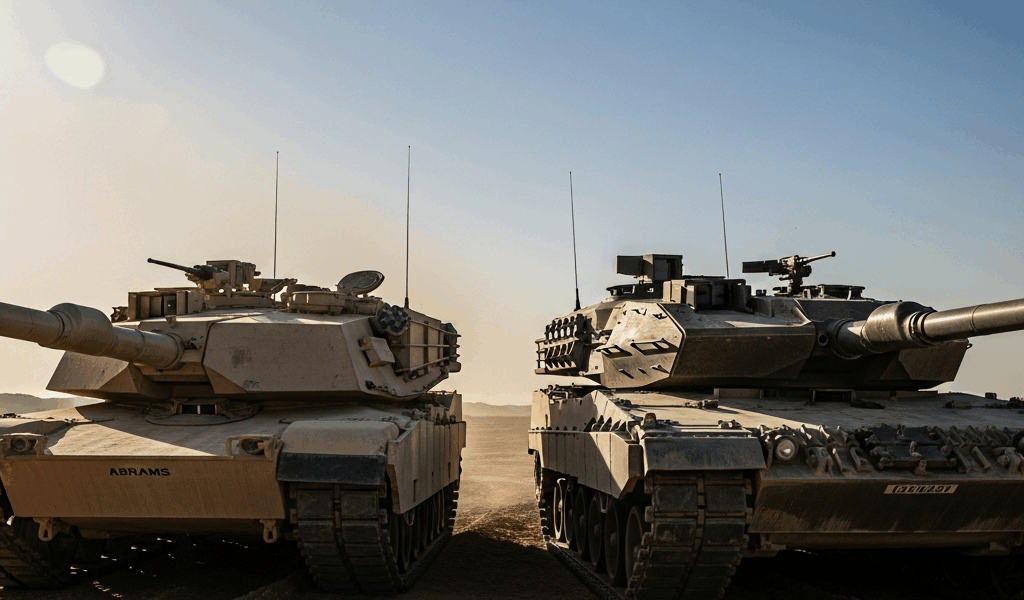
The M1 Abrams and the Leopard 2 are the two defining NATO main battle tanks, and the debate over which one is better has been running since the 1980s. Both fire the same 120mm Rheinmetall smoothbore cannon. Both weigh roughly the same. Both have been upgraded continuously for four decades. But underneath the similar specs, they represent fundamentally different engineering philosophies — and those differences matter enormously in actual operations.
This article includes affiliate links. We may earn a commission at no extra cost to you.
The short version: the Abrams is better protected. The Leopard 2 is easier to keep running. Which matters more depends on where and how you plan to fight.
The Core Design Philosophy Difference
The M1 Abrams runs on an AGT-1500 gas turbine engine — essentially a jet engine adapted for ground use. The turbine produces 1,500 horsepower and gives the Abrams extraordinary acceleration for a 70-ton vehicle. The drawback: it drinks fuel at roughly 3 gallons per mile on road and significantly more cross-country.
The Leopard 2 runs on an MTU MB 873 twin-turbo diesel engine producing 1,500 horsepower — same power output, completely different fuel logistics. Diesel is available everywhere military operations happen.
Armor — Depleted Uranium vs Composite Steel
The Abrams uses depleted uranium (DU) mesh in its composite armor array. DU is extremely dense and provides exceptional protection against kinetic energy penetrators. The Leopard 2 uses non-DU composite armor — layers of steel, ceramics, and other materials. The Leopard 2A7V and later variants have significantly improved armor packages that close much of the protection gap, but the DU advantage in the Abrams’ frontal arc remains a documented edge.
Firepower — Both Use the Same Gun
Both tanks fire the Rheinmetall 120mm L44 smoothbore cannon. The gun is identical in performance. Where ammunition diverges: the US stocks DU sabot rounds (M829 series) that are among the most effective anti-armor kinetic energy penetrators in any inventory. Germany and most Leopard 2 operators use tungsten-core sabot rounds, which are effective but do not match DU penetration performance.
Operational Reality — Which Is Easier to Maintain?
The Leopard 2 wins this category decisively. The MTU diesel engine is mechanically simpler, shares a fuel supply with every other vehicle in a NATO formation, and can be field-serviced by mechanics trained on conventional diesel powerplants. The Leopard 2’s powerpack can be swapped in the field in under an hour by a trained crew.
The Verdict
The M1 Abrams is the more capable tank in a direct engagement. Better armor protection, better ammunition, better sensors and fire control. In a tank-on-tank fight, you want to be in the Abrams.
The Leopard 2 is the more practical tank for coalition operations and sustained campaigns. Better fuel logistics, easier maintenance, wider international parts support, and no DU political complications.
Model builders can explore both platforms in detail with Tamiya’s excellent 1/35 scale kits — the M1A2 Abrams and the Leopard 2 A6 are both highly detailed builds that bring these engineering differences to life.


Stay in the loop
Get the latest military vehicles vault updates delivered to your inbox.