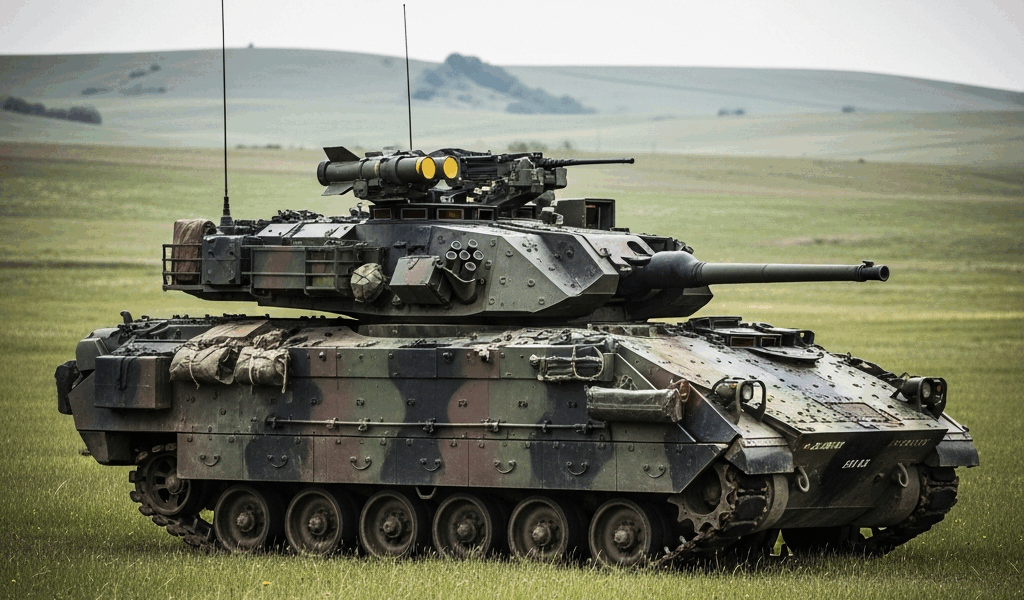
The M2 Bradley and the BMP-2 were designed to solve the same problem — get infantry to the fight and support them with firepower once they get there. Both emerged from the Cold War, both carry a squad of dismounts plus a turret crew, and both have been shooting at each other in Ukraine since 2022. The combat footage from that conflict has answered questions that forty years of spec-sheet debates never could.
This article includes affiliate links. We may earn a commission at no extra cost to you.
Bradley vs BMP-2 — The Cold War IFV Matchup
The M2 Bradley entered US Army service in 1981. The BMP-2 entered Soviet service in 1980. Both were designed as mechanized infantry fighting vehicles — not just armored taxis, but active combat platforms with their own anti-armor and anti-infantry weapons systems. The design philosophies diverged significantly: the Bradley prioritized crew survivability and firepower range, while the BMP-2 prioritized speed, low profile, and mass production simplicity.
Both remain in active frontline service. The US has sent Bradleys to Ukraine. Russia fields BMP-2s as a primary IFV alongside the newer BMP-3. The head-to-head comparison is no longer theoretical.
Armament Comparison
Bradley: M242 Bushmaster 25mm chain gun plus dual TOW anti-tank guided missile launcher. The 25mm fires armor-piercing and high-explosive rounds effective against light armored vehicles, infantry positions, and low-flying helicopters. The TOW missile system gives the Bradley standoff anti-armor capability — it can engage a tank at 3,750 meters, well beyond the range at which most tanks can effectively return fire against an IFV-sized target.
BMP-2: 2A42 30mm autocannon plus AT-5 Spandrel anti-tank guided missile. The 30mm cannon fires faster and hits harder per round than the Bradley’s 25mm — better against infantry positions and light structures. The AT-5 Spandrel missile has a maximum range of approximately 4,000 meters, comparable to the TOW, but uses an older guidance system that requires the gunner to keep the crosshair on the target for the full flight time.
The firepower verdict: the 30mm gun advantage of the BMP-2 is real in close-range engagements. But the Bradley’s TOW missile system gives it a decisive advantage in standoff engagements. In Ukraine, Bradleys have engaged targets at range where the BMP-2 could not effectively respond.
Armor and Survivability
The Bradley hull is aluminum with bolt-on steel armor plates and, in current configurations, explosive reactive armor (ERA) applique. The BMP-2 hull is all steel but relatively thin — the sides are vulnerable to heavy machine gun fire at combat ranges.
The survivability verdict: the Bradley is meaningfully better protected. In Ukraine, Bradley crews have survived RPG hits and mine strikes that would have killed the crew of a BMP-2 in the same situation.
The Verdict — Lessons from Ukraine
Ukraine has provided the first large-scale direct comparison of these two vehicles in actual combat, and the results are clear: the Bradley is the superior IFV by a significant margin.
The BMP-2 has one advantage the Bradley cannot match: it is cheap and simple to produce in massive numbers. For a military that values trained crews and operational flexibility, the Bradley is the clear winner.
For a deep dive into the Bradley’s development and operational history, Bradley: A History of American Fighting and Support Vehicles by R.P. Hunnicutt is the definitive reference — part of his acclaimed 10-volume series on American armored vehicles. Steven Zaloga’s M2/M3 Bradley Infantry Fighting Vehicle 1983-1995 provides a more concise Osprey-format overview.

Stay in the loop
Get the latest military vehicles vault updates delivered to your inbox.