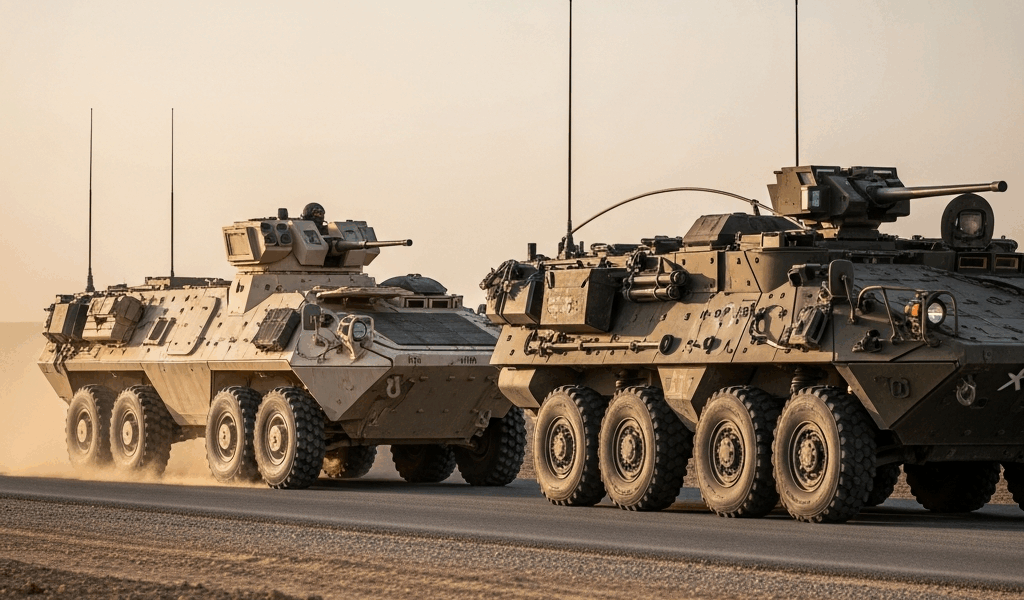
You’re looking at two eight-wheeled armored vehicles from fifty yards away and they’re practically twins. Same wheel count. Same manufacturer (General Dynamics, technically). Both hauling infantry squads into harm’s way. So what’s actually different between the LAV-25 and the Stryker — and why did the Army pour billions into a new platform when the Marines already had something that worked?
This article includes affiliate links. We may earn a commission at no extra cost to you.
Short version: the Stryker is bigger, heavier, and built around a completely different tactical idea. The LAV-25 is faster, lighter, and exists to get Marines somewhere in a hurry. They share a family tree — the Stryker grew out of the same LAV III platform — but they were designed to solve different problems for different branches.
Origins — Why Two Vehicles Exist at All
The LAV-25 showed up in Marine Corps motor pools in 1983. General Motors of Canada (now GDLS-Canada) built it on the Swiss MOWAG Piranha I chassis — a design that was already proven in several NATO countries. The Marines had a specific wish list: something that could roll off amphibious ships under its own power, haul across highways at freeway speeds, and pack enough reconnaissance firepower that it didn’t need a tank babysitting it. At around 12.8 tons combat-loaded, the LAV-25 squeezed inside a C-130 and could swim across rivers with a bit of setup.
The Stryker didn’t arrive until two decades later. Through the 1990s, the Army kept running into the same problem — Somalia, Bosnia, Kosovo, all places where Humvees got chewed up and Bradleys were too heavy to fly in fast enough. The Interim Armored Vehicle program kicked off in 1999, the Army picked the LAV III (a newer Piranha cousin), and the first Strykers rolled into operational units in 2002. The vehicle honors two Medal of Honor recipients: PFC Stuart Stryker from World War II and SPC Robert Stryker from Vietnam.
Size and Weight — The Numbers That Matter
Here’s where the family resemblance falls apart. The Stryker ICV (Infantry Carrier Vehicle) weighs in at roughly 18.5 tons — almost six tons heavier than the LAV-25. All that extra weight buys you thicker armor, more room inside, and a nine-person dismount squad instead of the LAV’s six (both vehicles carry a crew of three up front).
Length-wise, the LAV-25 runs about 21 feet. The Stryker stretches out to nearly 23. They’re close in width — both somewhere between 8.5 and 9 feet — but the Stryker stands taller at 8.9 feet versus the LAV’s 8.2 feet. That 8-inch height difference actually matters when you’re trying to tuck behind a berm or use terrain for cover.
Quick comparison:
| Spec | LAV-25 | Stryker ICV |
|---|---|---|
| Combat weight | ~12.8 tons (28,200 lbs) | ~18.5 tons (40,800 lbs) |
| Length | 21 ft (6.4 m) | 22.9 ft (6.95 m) |
| Height | 8.2 ft (2.5 m) | 8.9 ft (2.72 m) |
| Crew + dismounts | 3 + 6 | 2 + 9 |
| Main armament | M242 25mm Bushmaster | M2 .50 cal or Mk 19 (RWS) |
| Top speed (road) | 62 mph (100 km/h) | 60 mph (97 km/h) |
| Range | 410 miles (660 km) | 330 miles (530 km) |
| Amphibious | Yes (with prep) | No |
| C-130 transportable | Yes | Technically — but tight |
Firepower — This Is the Biggest Difference
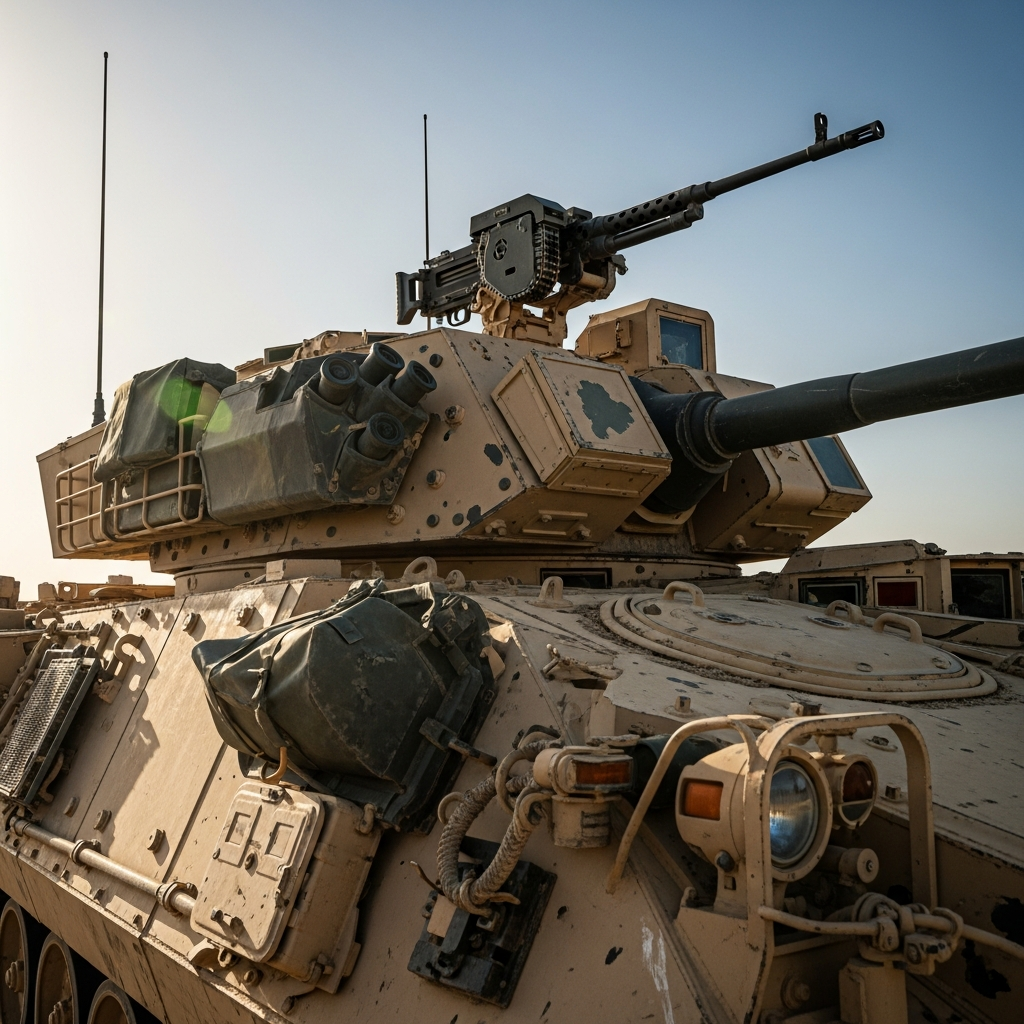
The LAV-25 packs a two-man turret with an M242 Bushmaster 25mm chain gun and a coaxial M240 7.62mm machine gun. That 25mm cannon punches through light armor, drops concrete walls, and reaches out past 2,000 meters. For a reconnaissance vehicle, it’s got serious teeth.
The standard Stryker ICV carries a remote weapon station (RWS) with either an M2 .50 caliber heavy machine gun or an Mk 19 40mm grenade launcher. Both are effective against troops and unarmored vehicles, but neither comes close to the anti-armor punch of a 25mm autocannon. The gunner operates everything from inside through a screen and joystick — definitely safer, but you lose some of the awareness that comes with sticking your head in a real turret.
One important wrinkle: the Stryker Dragoon variant (M1296) added a 30mm XM813 Bushmaster II in a remote turret. The Army started deploying Dragoons to Europe in 2018, specifically to counter Russian BTRs and BMPs rolling around near NATO borders. But only a small percentage of the Stryker fleet carries this upgrade — most units still have the standard .50 cal or Mk 19 setup.
Armor and Protection
Neither one of these was ever meant to go toe-to-toe with a tank. Both stop small arms fire and artillery fragments at baseline. The LAV-25 uses an aluminum hull that handles 7.62mm rounds and shrapnel. The Stryker went with steel, offering comparable base protection but with a lot more room to bolt stuff on — which is exactly what happened once IEDs started shredding convoys in Iraq.
Stryker crews in Iraq ended up adding ceramic applique armor panels, slat armor (those cage-like structures designed to catch and pre-detonate RPG warheads before they hit the hull), and eventually underbody V-hull kits for IED protection. Fully kitted out, a Stryker can push past 22 tons. The LAV-25A2 upgrade brought better mine protection and enhanced armor plates, but the add-on options just aren’t as deep as what the Stryker platform supports.
The Stryker’s original flat bottom turned out to be a real problem when buried IEDs became the primary threat in Iraq and Afghanistan. The Double-V Hull (DVH) program, which started fielding around 2012, addressed this with an angled underbody that pushes blast energy outward instead of straight up through the crew compartment. LAV-25s generally saw less IED exposure — different deployment patterns, different theater roles — though the A2 variant did improve mine resistance.
Mobility — Where the LAV-25 Wins
Road speeds look almost identical on the spec sheet — 62 mph for the LAV, 60 for the Stryker. But the LAV-25 has one massive advantage the Stryker simply doesn’t: it swims. Raise the trim vane at the front, fire up the bilge pumps, and the LAV-25 drives itself into the water. It propels at about 6 mph using its wheel rotation. Not fast, but it gets across. The Stryker? It needs a bridge. Or a ferry. Or combat engineers building something.
Weight plays into this too. The LAV-25’s Detroit Diesel 6V53T puts out 275 horsepower pushing 12.8 tons. The Stryker’s Caterpillar 3126 makes 350 hp, but it’s dragging 18.5 tons — and often more with all the add-on armor. Off-road, the LAV just feels quicker. The Stryker, loaded up with a full squad and bolt-on protection kits, drives like exactly what it is: a platform that traded agility for survivability.
Fuel range shows the same gap. The LAV-25 covers 410 miles on a tank; the Stryker gets about 330. When you’re running a reconnaissance screen or pushing a rapid advance, those extra 80 miles mean you’re not stopping for fuel while the infantry is still moving.
How They’re Actually Used
The LAV-25 lives in Marine Light Armored Reconnaissance (LAR) battalions. Its whole purpose is getting out ahead of the main body — find the enemy, report back, fight for information when it has to. Think of it as a scout that can actually punch back. Marines use it for screening, route recon, and flank security. It’s built to avoid slugging matches, but when a chance contact happens, that 25mm means the crew isn’t helpless.
The Stryker sits at the center of the Army’s Stryker Brigade Combat Teams (SBCTs). These are medium-weight formations — faster to deploy than a heavy armored brigade, but carrying more firepower and protection than a light infantry battalion on foot. The Stryker hauls a full nine-person squad right up to the objective, the ramp drops, dismounts pile out, and the vehicle sticks around to provide overwatch with its weapon station. Battle taxi with teeth, not a scout.
That doctrinal split is really the whole story. The Marines needed a fast, light reconnaissance vehicle that could keep up with the maneuver force. The Army needed a deployable infantry carrier that could take a hit in Fallujah or Mosul. Same bloodline, completely different missions.
Variants — The Stryker Family Is Much Bigger
The LAV family has about eight variants total: the standard LAV-25 with the 25mm turret, a mortar carrier (LAV-M mounting an 81mm mortar), an anti-tank version (LAV-AT with TOW missiles), a logistics carrier, a command vehicle, and a handful of others. Solid lineup, but it hasn’t grown much since the Reagan era.
The Stryker family is substantially bigger — over ten variants with more in development. You’ve got the ICV (infantry carrier), the now-retired Mobile Gun System (MGS — the one that crammed a 105mm cannon onto the chassis), the NBCRV for nuclear/chemical recon, the Engineer Squad Vehicle, the Medical Evacuation Vehicle, and the newer Dragoon and SHORAD (Short-Range Air Defense) variants that carry Stinger missiles and Hellfire launchers. The Army essentially treats the Stryker platform like a modular base they can build anything on top of.
The Verdict — Which One Is Better?
Need to move a full infantry squad into a fight fast, survive IEDs and urban ambushes, and plug into a brigade-level combined arms operation? The Stryker wins that job. More people in the back, a deeper library of armor upgrades, and a variant family that covers nearly every battlefield function the Army needs.
Need to scout ahead of the main force, cross rivers without waiting for engineers, deploy straight off an amphibious ship, and fight for information with a weapon that actually scares people? That’s the LAV-25. Lighter, faster, amphibious, and that 25mm chain gun outguns anything on a standard Stryker by a wide margin.
The Army absolutely could have just bought LAVs back in the 1990s. But the LAV couldn’t carry a full squad, didn’t have enough armor for the urban fights the Army saw coming, and wasn’t designed for the Swiss-Army-knife variant approach the service wanted. The Stryker fixed all of that — at the expense of weight, range, and the amphibious capability the Marines refused to give up.
Two vehicles from the same family. Two branches with two different ways of fighting. Neither one is going anywhere — both have upgrade programs running well into the 2030s. The real answer isn’t which one is “better.” It’s which job needs doing.



Stay in the loop
Get the latest military vehicles vault updates delivered to your inbox.